

The Golders Green Stabbing: What We Know About The Suspect, Motive, And A City On Edge
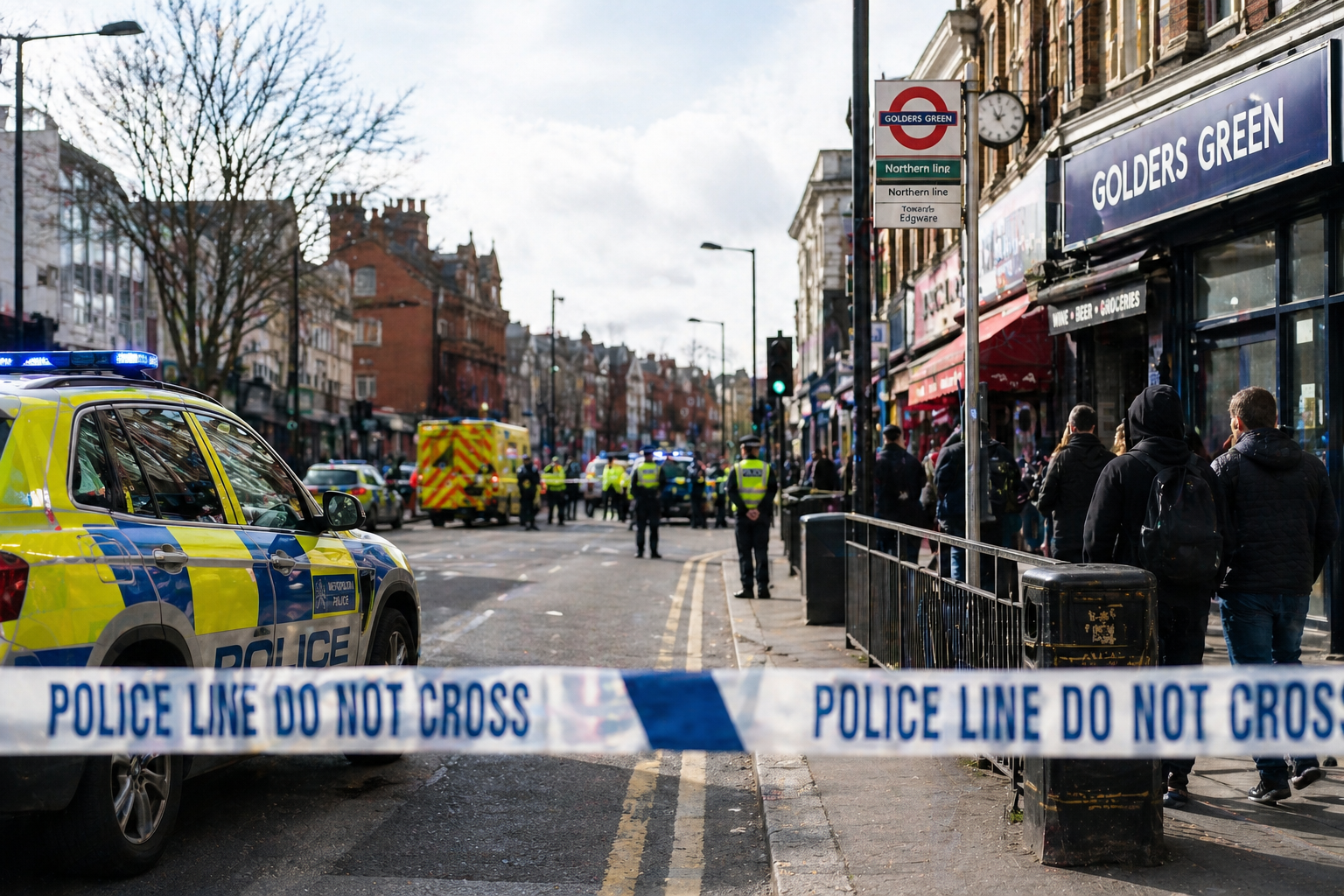
The London Stabbing That Has Triggered National Concern
London Knife Attack Sparks Fear As Motive Questions Intensify
A man running through a London street with a knife is not just a crime scene. It is a signal — something has broken, escalated, or shifted.
On 29 April 2026, that signal appeared again in Golders Green, a north London area with a large Jewish community. Two people were stabbed. A suspect was detained. And within minutes, the story moved from local incident to national concern.
What followed was not clarity but questions.
What Happened — And What Is Confirmed
The basic facts are now broadly established.
A man armed with a knife was seen moving through Golders Green Road, attempting to stab individuals.
Two people were injured in the attack.
Members of a local Jewish neighborhood security group intervened and detained the suspect before police arrived.
Police used a Taser and arrested the individual at the scene.
Emergency treatment was provided quickly, including by community ambulance volunteers. The full condition of the victims has not been formally detailed, but the incident has been described as serious.
At this stage, the suspect’s identity has not been publicly confirmed by authorities.
The Motive Question — And Why It Matters
The most important unknown is also the most sensitive: why did the attack happen?
Early indications suggest the attacker may have been targeting members of the Jewish community.
That is not yet a formally confirmed motive. But it is not speculation without context.
This incident follows:
Recent arson attacks on Jewish sites in north London
Attempted attacks on synagogues
Threat activity linked, in some reports, to extremist or foreign-aligned groups
Taken together, the pattern matters more than the single event.
If the motive is confirmed as targeted hate, the story changes category—from violent crime to community-directed threat.
That distinction is not academic. It determines how police respond, how politicians react, and how communities feel about their own safety.
The Suspect — What We Know And What We Don’t
Currently, the public information about the suspect is limited.
Confirmed:
A male suspect was arrested at the scene
He was subdued before police intervention
He is now in custody
Not confirmed:
Identity
Background
Nationality
Any organisational links
Mental health factors
Prior criminal history
That gap matters.
In modern incidents like these, the narrative fills faster than the facts.
Speculation — especially online — often attempts to assign motive or identity before investigators have evidence. That process is not just unreliable. It can distort the public understanding of what actually happened.
Authorities are likely to prioritize the following:
CCTV analysis
Witness accounts
Digital footprint of the suspect
Any ideological indicators
Until that process is complete, any definitive claim about motive remains premature.
Why This Incident Feels Bigger Than It Looks
On paper, the incident is a two-victim stabbing.
In reality, it lands in a much larger context.
London—and the UK more broadly—has been dealing with persistent concerns around knife crime for years. But not all knife attacks carry the same implications.
This one touches three sensitive layers at once:
1. Community Targeting Risk
If confirmed, targeting a specific religious or ethnic group escalates the seriousness immediately.
2. Pattern Recognition
This is not an isolated week. The surrounding incidents — including arson and attempted attacks — create a sense of escalation rather than randomness.
3. Public Confidence
Incidents like this test something intangible but critical:
Do people feel safe in public spaces?
That question cannot be answered with statistics alone. It is shaped by perception, repetition, and visibility.
The Response—And The Pressure On Authorities
Political and community responses were swift.
Senior figures described the incident as deeply concerning.
Security organizations representing the Jewish community are now working alongside police.
Behind the scenes, the priorities are clear:
Reassurance patrols
Intelligence gathering
Threat assessment
Preventing copycat incidents
The challenge is balance.
Overreact, and you risk amplifying fear.
Underreact, and you risk missing escalation signals.
What Most People Miss
The visible part of an incident like this is simple:
a suspect, a weapon, victims.
The invisible part is where the real story sits.
These incidents operate on three timelines:
Immediate — the attack itself
Short-term — arrests, motive investigation
Long-term—shifts in behaviour, security, and trust
The third timeline is the one that matters most—and receives the least attention.
Will community behavior change?
Will security presence increase permanently?
Will this become part of a pattern or remain an isolated spike?
Those questions define the real impact.
What Happens Next
In the coming days, expect:
Formal police statements on the suspect
Clarification on motive
Possible classification (hate crime, terrorism-related, or criminal act)
Increased visible policing in the area
What should not be expected — at least immediately — is full certainty.
Investigations of this kind take time, especially when motive is unclear.
The Bottom Line
This is not just a London stabbing.
It is a moment where multiple pressures meet:
community tension, public safety, and the speed at which narratives form.
The facts are still emerging.
But one thing is already clear —
The impact of this incident will not be defined by what happened in those few minutes on a London street.
It will be defined by what happens next.
