She needed a tragedy to sell. He was living one. We explain Fruit Fly, its biggest twists and its unsettling last scene.
A Blocked Novelist Found Her Next Bestseller in a Stranger's Worst Nights
Fruit Fly is Josh Silver's pitch-black satire about a novelist who decides that the quickest way back to the bestseller lists is to borrow a stranger's suffering. Mallory Maddox has not written a book in seven years. Leo Fuller is 22, addicted, homeless and trading sex to survive in north London. When their lives collide outside a drug-fuelled party, Mallory sees a story, and Leo sees a mark. The novel was the year's surprise word-of-mouth hit in Britain and crossed to the United States in August 2026. This guide explains the book without spoilers first, then tells the whole story in the order the novel reveals it, before explaining the unsettling final scene, what really happens in the kitchen, and what Leo is planning.
The Book at a Glance
Fruit Fly is Josh Silver's first novel for adults. In the United Kingdom it was published by Magpie, an imprint of the independent London publisher Oneworld, as a 416-page hardback on 23 April 2026 (ISBN 9781836431473, recommended price £16.99). A UK paperback is scheduled for 4 March 2027 at £9.99. In the United States and Canada it was published by Crooked Lane Books on 4 August 2026, as a 384-page hardcover ($29.99) and a paperback ($19.99) released the same day.
The novel has done well on both sides of the Atlantic. On 12 November 2026 it was the number one book in Amazon UK's fiction bestseller chart. In the US, the paperback is number 14 on the New York Times trade fiction paperback list dated 22 November 2026, and the book is a nominee in the 2026 Goodreads Choice Awards, the reader-voted prizes run by the book site Goodreads, in the Fiction category. The New York Times called it "a funny and nasty novel about appropriation", and the Daily Mail likened it to the offspring of Trainspotting and Yellowface.
Silver grew up on a farm in the Lake District and moved to Manchester as a teenager. He trained as an actor at the Royal Academy of Dramatic Art, performed in the West End and on Broadway, then retrained as a mental health nurse. He had already written novels for young adults; his UK publisher says the most recent, TraumaLand, won the YA Book Prize in 2026.
Where the Idea Came From
Silver has traced the novel to his acting career. He told Out magazine that he entered the industry in 2012 as a closeted gay man, at a time when he was warned that being openly gay would not help his career. Several years later, after a cultural shift towards diverse casting, his agent told him he could now tell casting directors he was gay, because they were looking for gay actors. He described the whiplash as confusing and then "kind of gross": a part of himself he had been told to hide had suddenly acquired market value.
He has named Percival Everett's Erasure and R. F. Kuang's Yellowface, two novels about race, authorship and publishing, as major influences. His nursing work fed the darker material. He told the Los Angeles Times that he once worked in a drug and alcohol detox unit, where he saw many young gay men coming off GHB and other chemsex drugs, and that he wanted to write about that world with empathy rather than fetishising it. Silver, who is now sober, has said he drew on his own experience of addiction too.
The book's American success has been rapid. The Los Angeles Times reported in September 2026 that its US publisher had ordered nearly a dozen reprints, totalling around 100,000 copies, within weeks of publication.
What Kind of Book Is It?
Fruit Fly is a literary satire with the pace of a psychological thriller. Most chapters alternate between Leo and Mallory, and a few are poems Leo posts online under the name @Alias22, which give him a voice the people around him rarely hear. Later chapters include emails, an interview and pages from Mallory's manuscript, so the reader is constantly asked who is telling the story and why.
The title is a pointed joke. "Fruit" is an old slur for gay men, and a "fruit fly" is slang for a straight woman who spends her time around gay men, sometimes as a friend and sometimes as a tourist. Mallory is very much the second kind.
The book also assumes some knowledge of London's queer nightlife and recovery culture. Grindr is a dating and hook-up app for gay and bisexual men. "Chemsex" refers to sex parties fuelled by drugs such as crystal meth and GHB, which Leo calls "Tina and G". Narcotics Anonymous, or NA, is the twelve-step recovery fellowship for people addicted to drugs.
Who Are Mallory and Leo?
Mallory lives in a beautiful house in Crouch End, north London, with her husband, Ronan McSweeny, a newly promoted Netflix commissioning editor. Seven years ago her debut novel, Shallow Embers, was a bestseller. Since then she has written nothing, lost her agent and drifted into pretending: guests compare her to Virginia Woolf's Mrs Dalloway, a novel she has only read summaries of.
Leo has been awake for three days when we meet him. He is clever, funny, furious and frequently dishonest, and he survives through drugs, theft, dealing and sex work. He once loved writing.
Spoiler warning: the following summary discusses the plot, major twists and ending.
Content note: Fruit Fly includes drug addiction, sexual assault, the sexual abuse of a pupil by a teacher, suicide and suicidal thoughts, coercive control within a marriage, violence and antigay abuse. The summary describes these events without graphic detail.
Go Gay, Go Sad, Go Dark
After one of her own dinner parties, Mallory sits beside her sleeping husband and scrolls through a cynical Reddit post on how to write a bestseller. Its advice boils down to one formula: a story that is gay and sad will sell. Mallory, who has a tenuous connection to queer culture and a brother, Nick, who died by suicide, decides to do some research.
She downloads Grindr and builds a profile using cropped photographs of Ronan, naked and asleep, taken without his knowledge. A man calling himself Daddy invites her to a "T-party". Mallory, half drunk and a little stung after seeing a friend's text mocking her as "Meek Mal", packs leftover canapés and a bottle of wine and drives over, imagining something faintly genteel.
The Night on Priory Road
The party is for chemsex, as Mallory realises only once she is parked outside. Leo arrives to supply drugs, already high and carrying flowers he has stolen from a grave, and he owes money to the wrong people. On the doorstep he is shoved over, and then a dealer Leo calls Brick arrives and beats him in the street.
Mallory intervenes with pepper spray, but Brick uses Leo as a shield and the spray hits Leo in the eyes. As sirens approach, Leo begs her not to call the police, so she bundles him into her car and drives away. Leo refuses to go to hospital. Mallory goes home and, for the first time in seven years, writes.
Mandy the Therapist
Mallory tracks Leo down and turns up at a recovery meeting he attends, introducing herself as Mandy and inventing a recovery story of her own. She then offers Leo free therapy sessions, although she has only limited counselling training, and uses them to collect the details of his childhood, addiction and relationships.
Leo has his own agenda. He sees Mandy as rich, naive and useful, and he performs his suffering to get money, shelter and attention. Crucially, he also works out that Mandy is the novelist Mallory Maddox, and he does not tell her. Both of them are lying, and each believes they are the one in control.
Slay
The material pours into a manuscript Mallory calls Slay. Leo becomes a character called Liam, Mallory becomes Mandy, and the people around them become fictional versions of themselves. She reconnects with Stanley Maier, known as Stan, who loves the pages but wants a stronger personal reason why Mallory should be the one telling this story. So she tells him Liam is inspired by her dead brother, Nick. It is a lie that makes the book more saleable and turns her own grief into marketing.
Their sessions become more troubling. Leo lies spectacularly, at one point claiming that a man tried to drown him in a canal, but he also tells her that he once had a sexual relationship with a teacher at school. Mallory realises she is hearing about abuse she has no qualifications to handle, and she tries to end the session. Leo experiences that as rejection, storms out and, in front of Mallory's friend Joanie, snatches an elderly woman's handbag, knocking her to the pavement. Mallory lies to Joanie about who he is, goes home and writes the robbery into Slay.
Ronan
The novel slowly reveals that Mallory is also living in a kind of captivity. Ronan controls their money, invokes a psychiatric hospital stay from seven years earlier whenever she disagrees with him, and wants a baby on his timetable. After Joanie tells him about the incident in the street, he confiscates Mallory's car keys and insists on tracking her phone's location. This is coercive control, a pattern of behaviour that isolates and dominates a partner; in England and Wales it has been a criminal offence since 2015. Mallory is exploiting Leo and being controlled by Ronan at the same time, and the novel refuses to let either fact cancel out the other.
The Worst Night
Leo's life becomes more dangerous. He goes to a party at the flat of a man called Mo, is given a mix of drugs and is sexually assaulted by several men while incapacitated. Traumatised, bleeding and high, he goes to Mallory's house in the middle of the night and demands help, revealing that he knows exactly who she is.
Ronan comes out with her phone open on Grindr. The secret profile, the photographs and the double life are exposed in one moment. Leo is driven off, and later, overwhelmed by what has happened to him, he walks into a canal intending to drown himself. He survives, and something in him decides it wants to live.
The Air Between Us
The fallout leaves Mallory under house arrest in all but name. Ronan makes her delete Slay in front of him and lets her keep her laptop only after she pitches a cheerful romance novel, which he titles The Air Between Us. She pretends to work on it by day. By night she secretly keeps writing Slay from a hidden copy, and a publisher is soon offering her a large advance, if she can deliver a convincing ending.
Then Ronan announces that Mallory's mother, Stacey, is coming to stay to keep her "safe". Stacey fawns over her son-in-law and accuses Mallory of inventing a painful past to justify her drama. In the row that follows, Mallory admits she has always blamed her mother for Nick's suicide, and that she has always wondered whether Nick was gay. The argument gives her the idea for a darker ending.
Going Home
Leo, meanwhile, tries to get sober. He goes back to his parents' house, which reveals that the tragic backstory he fed Mallory was largely invented. His family are alive, worn down and wary. At a tense dinner he slips and starts drinking, and his father refuses to pay for another attempt at rehab, telling him the family has already remortgaged the house once. With nowhere else to go, Leo heads for Mallory's.
He hides in her garden and sleeps in her shed. One night he climbs into the house, takes some of her prescription medication and, hiding in a cupboard, watches Ronan take explicit selfies and send them to someone else. The man who has policed his wife's phone has secrets on his own. Then Leo finds Mallory's laptop and reads Slay, including her plan to end the book with Liam's suicide.
The Body in the Canal
Mallory hears a news report about a man's body found in a London canal and fears it is Leo. It is Mo. The police are looking for a young man who was with him that night, and Mallory realises that Leo is alive and that the police want to trace him.
The Kitchen
That night, Mallory walks into her kitchen and finds Leo waiting, drunk, furious, holding her laptop and a kitchen knife. He has read everything, including the email about her advance. He tears into the manuscript's inaccuracies, pointing out among other things that his mother is alive, and he reminds her that the real Leo studied English, writes poetry and has an inner life that Liam lacks.
Ronan and Stacey are drawn in. Calling himself Liam, Leo stages a mock "book club" around the kitchen table, exposes Ronan's selfies and demands a share of the money. Then he turns the knife towards his own stomach and asks whether Liam has to die for people to buy the book, threatening to act the ending out for them.
At that moment, the novel cuts away.
Mallory's Email
The next chapter is an email from Mallory to Stan, attaching the final ending of Slay and insisting it is non-negotiable. In that version, Mandy calms Liam, who exposes the husband, Richard. Richard lunges, forces the knife into Liam's stomach and beats him; Mandy's mother knocks Richard out with a fruit bowl, and Liam dies telling Mandy he never wanted to die.
This is fiction within the fiction. Fruit Fly never shows what actually happened after Leo turned the knife on himself; it shows only the version Mallory chose to sell.
Thirteen Months Later
The final part jumps forward thirteen months. Slay has been published and is a huge success. Mallory has divorced Ronan, moved to a house on the coast and is giving magazine interviews in which she comes across as warm, ordinary and brave. At her sold-out launch at a Waterstones flagship store in London, she spots a blond man at the back of the room and realises it is Leo, transformed. When the host asks who Liam is based on, she repeats the story about her brother.
Leo is sober and has been for months, with a Narcotics Anonymous sponsor and a new life of sorts. Outside the event, talking to people from Mallory's publisher, he learns that Liam dies at the end of Slay and that the book has secured a major US deal. He introduces himself as Luke, a poet. He realises that the industry is hungry for dark, "authentic" stories, and that Stan once rejected his own poems for not being authentic enough.
So Leo writes. Using the name Luke and the computers in a public library, he sends Stan the opening chapters of a psychological horror novel, The Poet Acts, about a man who becomes obsessed with the therapist who abandoned him. Stan loves it and encourages him to make the protagonist a real threat and to make the story darker.
In the final scene, Leo stands outside Mallory's house by the sea at night, watching her through the window as she sits at her writing desk. She has become his lead character. A new story is beginning.
Fruit Fly Ending Explained
What Really Happened in the Kitchen?
This is the question readers ask most, and the honest answer is that the novel does not say. The violent scene with the stabbing and the fruit bowl belongs to Slay, Mallory's book, not to Fruit Fly's reality. We know it is not a faithful record because the real Leo is alive, sober and standing in the audience thirteen months later, while Liam dies.
What is clear is what changed. Mallory left Ronan; the marriage that had controlled her did not survive. Leo walked away from the kitchen with a reason to live and, eventually, a plan. Beyond that, Silver leaves a gap where the truth should be, and that gap is the point. The reader has spent the whole novel watching two unreliable narrators lie to each other, and the one time we might see the real version, we are handed the commercial one instead.
Why Does Liam Have to Die?
Mallory's first proposed ending was hopeful: Liam recovers, forgives his abuser and opens a mental health centre with his therapist. Her editors rejected it as inauthentic. The ending that sells is the tragic one, and Leo names the logic at the kitchen table when he asks whether Liam has to die for people to buy the book.
That is the satire's sharpest edge. The novel is not only attacking Mallory but an industry, and a readership, that rewards queer suffering most generously when it ends in death. Mallory's final email insists her ending is "truthful to the characters", but by killing Liam she also erases the real man who supplied the story, and replaces him with her dead brother in every interview.
What Is Leo Going to Do?
The ending is deliberately unsettling because it reverses the novel's opening. At the start, a comfortable woman watched a vulnerable man through a car window and decided he was material. At the end, the man watches the woman through her window and decides the same thing.
The Poet Acts, about a patient terrorising the therapist who discarded him, could be revenge, art, or both. Stan's advice to make the threat real is darkly ironic, because he is unknowingly commissioning a real-life horror story. The book does not tell you whether Leo intends to frighten Mallory, write about her, or simply take back the power to tell his own story. What it does make plain is that the power has changed hands.
Is Leo a Victim or a Manipulator?
Both, and Silver insists on it. He told Out that the headline of the book is that Mallory steals someone's story, but that what she actually steals is the story of a man who has been fabricating his own life because he has learned that trauma gets him empathy, money and drugs. When Leo reads the manuscript and recoils, Silver suggests, he is partly seeing the narrative he fed her written down. That is why the kitchen scene stings for both of them: Mallory invented much of Liam, but she built him on Leo's lies.
None of that cancels out what was done to him. Leo is assaulted, robbed of his story and killed off for profit. The novel simply refuses the comfortable split between a pure victim and a pure villain, and the final scene, in which the exploited man learns to sell a darker story of his own, pushes that refusal as far as it will go.
Who Is the Real Fruit Fly?
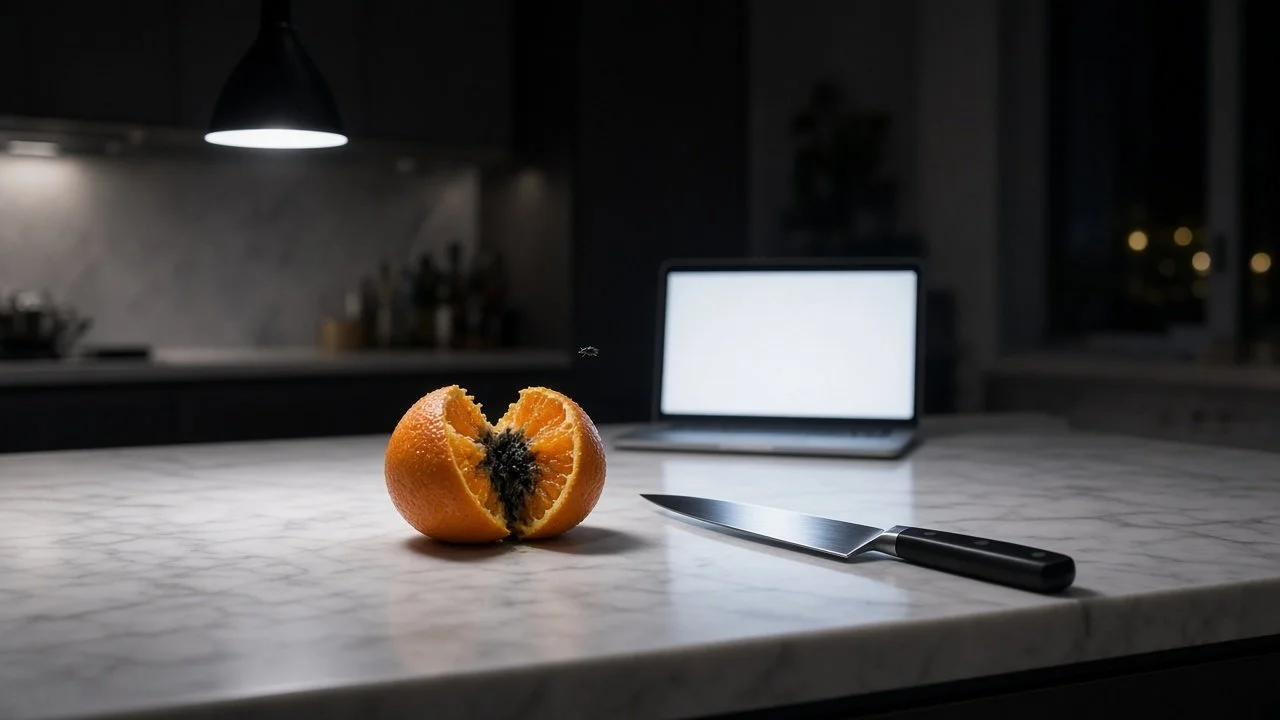
The obvious answer is Mallory, the straight woman hovering around gay men's lives for material. But the image of a fly drawn to rotting fruit runs through the book, from the rotting tangerine that unsettles Mallory to Leo's poem comparing himself to an orange gone black inside. By the end, the label fits a whole industry, and arguably the reader, drawn to the sweetness of decay.
Silver Changed the Ending
In an interview with Cultured magazine, Silver said he rewrote the final part after sending his first draft to his editor, because the choices the characters made in the original ending were not ones they would really make. He said he had been trying to fulfil a brief for an audience, and that his editor had wanted a slightly happier ending. In a neat echo of the novel, his rewrite begins with Mallory emailing her agency to say she needs to change the ending. Silver has also said he is comfortable with readers feeling a sense of frustration.
Who Gets to Tell a Story?
The headline of Fruit Fly is that a straight, middle-class woman steals a young gay man's story. But Silver complicates it. As he told the LGBTQ magazine Out, what Mallory actually steals is the story of someone who is lying about his own life. Leo performs his trauma for money; Mallory performs empathy for a book deal. The novel asks whether "authenticity", the quality the publishing industry claims to prize, can survive being sold at all.
Pain as Currency
Everyone in the publishing machine wants pain: Stan wants urgency, sales want something "necessary", the publicist wants Mallory to look scared in photographs because it suits her brand. The book treats this as a market, with real suffering as its raw material.
Two Kinds of Captivity
Leo's danger is physical and immediate. Mallory's is quieter: a husband who tracks her phone, controls her money and uses her mental health history against her. The novel makes her both victim and predator, and refuses to resolve that discomfort.
Is Mallory an Addict Too?
The novel draws a deliberate parallel between its two leads. Leo uses drugs to escape himself; Mallory uses Leo. Silver told the Los Angeles Times that Mallory is in a kind of "fantasy addiction": each line she crosses for the book makes the next one easier, and the story becomes a way of escaping her own life in the same way Leo escapes his through drugs. Read that way, the ending is not just a reversal of power but a relapse in waiting. Mallory has her bestseller and her house by the sea, yet she is still watching for Leo, and he is still watching her.
Addiction Without Redemption Clichés
Silver's background as a mental health nurse shows in the way addiction is written: Leo's relapses, hallucinations and moments of guilt are not tidied into a neat recovery arc. Even his sobriety at the end is shown as fragile, built on a sponsor's blunt advice that no one is coming to save him.
Is There a Fruit Fly TV Series?
Yes, one is in development. In July 2026, Deadline reported that A24's UK television division had won the rights to adapt Fruit Fly as a TV series after a competitive bidding process, with Silver as an executive producer. As of 12 November 2026, no writer, director, cast, broadcaster or release date had been announced, so the series should be treated as in early development, not confirmed for any UK or US service.
Fruit Fly ends with an image rather than an answer because it is a book about the danger of answers that are too neat. Mallory's career is saved by turning chaos into a tidy tragedy. Leo's survival depends on refusing the role she wrote for him. The final scene at the window leaves the reader in the uncomfortable position the novel has occupied all along: watching someone else's life and wondering what story we would make of it. If you enjoyed its savage take on online identity and performed lives, Taylor Tailored's guide to Yesteryear explained, by Caro Claire Burke, who called Fruit Fly a "wildly shrewd takedown of modern identity culture", unpacks another novel about a perfect public image hiding a prison.
Sources
Fruit Fly, Oneworld Publications (UK edition details, author biography, review quotes)
Fruit Fly by Josh Silver, Penguin Random House / Crooked Lane Books US listing
Fruit Fly UK hardback, Waterstones
Fruit Fly: A24 Options Josh Silver Novel For TV, Max Goldbart, Deadline, 29 July 2026
The secret to Josh Silver's bestselling book 'Fruit Fly'? Go gay. Go sad. Go dark., Emily St. Martin, Los Angeles Times, 15 September 2026
Fruit Fly author Josh Silver doesn't care if you find his characters 'awful', Mathew Rodriguez, Out, 26 August 2026
The Author of Surprise Best-Seller 'Fruit Fly' on the Trouble With Authenticity Politics, Cultured, 1 September 2026
Paperback Trade Fiction, The New York Times, list dated 22 November 2026 (No. 14)
Best Sellers in Fiction, Amazon UK (captured 12 November 2026, No. 1)
Readers' Favorite Fiction nominees, Goodreads Choice Awards 2026
Plot and ending corroboration: SuperSummary, Books That Slay, Your Summary and r/weirdgirlliterature (all read 12 November 2026; details found in only one were omitted)
