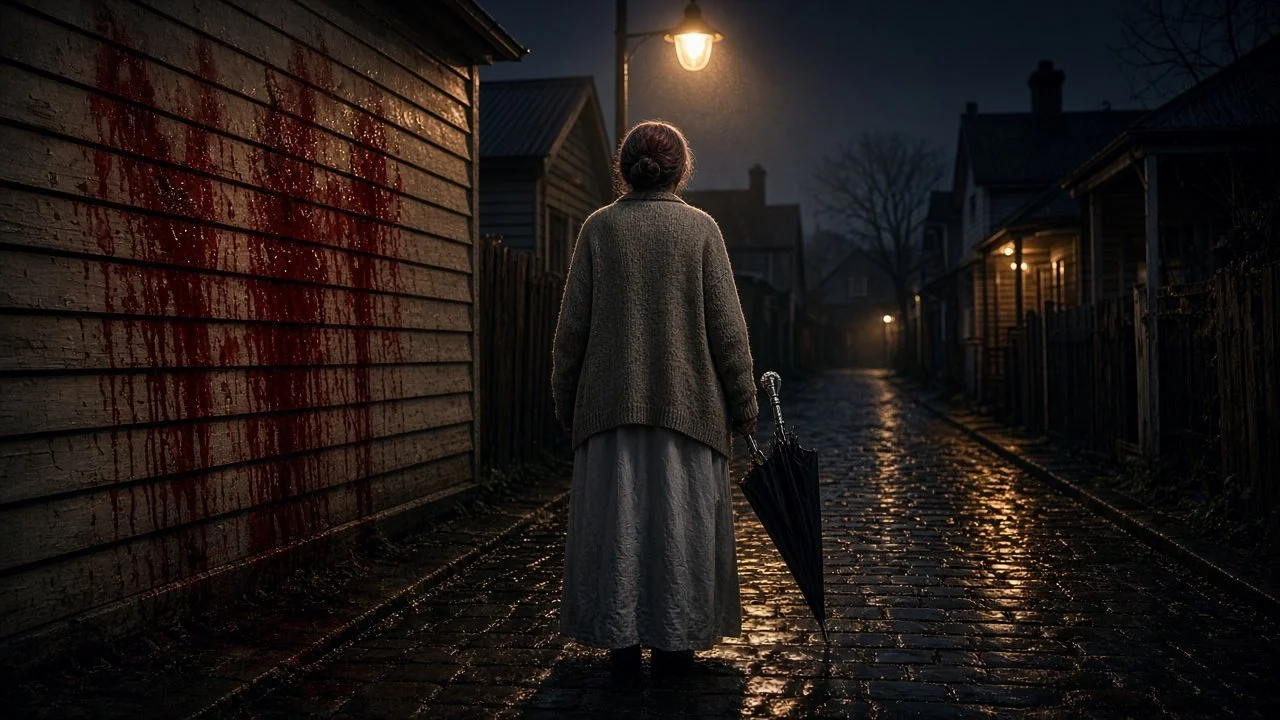
She was convicted of murder at fifteen. Sixty years later, her neighbour is dead and the cameras are back. We explain Mad Mabel, its biggest twists and its final line.
The Old Woman on Kenny Lane Has Been Hiding a Famous Name for Sixty Years
Mad Mabel is Sally Hepworth's darkly funny thriller about an 81-year-old woman in Melbourne whose neighbour turns up dead, and whose past turns out to be far more famous than anyone on her street knew. Elsie Fitzpatrick is blunt, nosy and rude to almost everyone. She is also, it emerges, Mabel Waller, the girl convicted of murder in 1959 at the age of fifteen and remembered ever since as "Mad Mabel". Hepworth tells the story on two tracks, the present-day lane and the 1950s mansion where Mabel grew up, and lets each one change how the other reads. This guide explains the book without spoilers first, then tells the whole story in the order the novel reveals it, before explaining the ending: who Mabel really killed, who Daphne is, who Peter is, and what happens to Elsie.
The Book at a Glance
The book has done unusually well in all three. At home it won General Fiction Book of the Year at the 2026 Australian Book Industry Awards and the 2026 Ned Kelly Award for best crime fiction, according to its Australian publisher. In the United States it has been on the New York Times combined print and e-book fiction list for ten weeks, sitting at number 11 on the list dated 22 November 2026. In the UK it was third in Amazon's fiction bestseller chart on 12 November 2026. It is also a nominee in the 2026 Goodreads Choice Awards, the reader-voted prizes run by the book website Goodreads, in the Mystery and Thriller category.
What Kind of Book Is It?
Mad Mabel is part comedy, part thriller and part historical mystery. Its chapters alternate between "Now", narrated by Elsie in 2025, and "Then", her account of growing up in the 1950s, so the reader learns her history at the same pace as the people interviewing her. The narrator is the woman at the centre of the old case, which makes her both the most informed witness and the one with the most reason to shape the story.
The novel opens by pointing out that almost nobody suspects little girls or old ladies of murder, and then introduces a woman who has been both. Its UK publisher pitches it at fans of Fredrik Backman and Alison Espach. Bookreporter's Pamela Kramer called Elsie a perfectly roasted marshmallow, crisp on the outside and soft inside, and that tension between the prickly narrator and the grief underneath her is the engine of the book.
Who Is Elsie Fitzpatrick?
When the novel opens, Elsie is 81, very tall, broad-shouldered and fiercely private. She has lived for close to sixty years on Kenny Lane, a short, shabby street of six houses in Melbourne, and she has spent most of those years keeping her neighbours at arm's length.
Peter Pantages, across the way, is the one neighbour Elsie likes; he is kind, quietly protective and seems to keep an eye on her. Joan Waters is a busybody who sues people for sport. Roxanne is a single mother who works nights, and her seven-year-old daughter, Persephone, is loud, demanding and determined to make Elsie her friend. Old Ishaan, who is in his nineties, is Elsie's self-declared nemesis, mostly because of his barking Chihuahua, Nugget. And Elsie insists that her oldest friend, Daphne, has been beside her since childhood.
Elsie also tells readers, early and directly, that her story is a love story. Not a romance, but the love between female friends. As she puts it, friends are like oxygen, and she believes the only reason she is still alive is Daphne.
Spoiler warning: the following summary discusses the plot, major twists and ending.
Content note: Mad Mabel includes child abuse and neglect, the grooming of a pupil by a teacher, sexual assault, suicide, the death of a child, a homophobic murder, domestic abuse and gun violence. The summary below describes these events without graphic detail.
A Dead Neighbour and an Article Under the Door
The present-day story starts with two shocks on the same morning. Someone slips a photocopied newspaper article under Elsie's door about Mad Mabel, the fifteen-year-old convicted of murder in 1959. Elsie is Mad Mabel. Her real name is Mabel Waller, and she has spent decades living under a different one. Someone on the lane has worked it out.
Then Persephone points out that Ishaan has not answered his door, and boxes of vitamins are piling up on his step. Elsie climbs the shared fence, cutting herself on the way, and finds him dead on his kitchen floor.
His death looks natural, but Joan tells the paramedics that whoever found the body should be looked at, and then asks the whole street whether they know who Elsie really is. Elsie does not help herself. She tells the police exactly how much she disliked Ishaan, admits she threatened to send his dog to a sausage factory, and remarks that if she had been planning to kill him, she would hardly have announced it first. The detectives take one of her shoes for testing. More than sixty years after her conviction, Mabel Waller is once again a suspect.
Growing Up at Rosehill
The "Then" chapters go back to Rosehill, the grand Edwardian estate where Mabel was raised by wealthy parents, Elliott and Mary Waller. From the outside it was privilege. Inside it was frightening.
Elliott is cold, vain and controlling. Mary drinks and suffers from depression, and on her good days she treats Mabel like a doll, dressing her up and painting her lips blood red. Mabel is tall, red-haired and clever, and the other children bully her for all three. Long before she has done anything, she is already called Mad Mabel, and she does not understand why.
The reason lies in a death she cannot remember. When she is fourteen and in hospital after a fall at summer camp, Mabel finally learns that she once had a baby sister, Kitty. When Mabel was three, she had polio, and while she was isolated on the patio she was found playing with Kitty, although nobody could explain how the baby had got outside. Kitty died of polio at the age of one. Mabel recovered. Elliott has always believed, and told people, that his daughter unlocked the door on purpose.
That accusation is the seed of everything that follows. Mabel cannot remember whether she did it, and once the story spreads, a sick toddler's death becomes proof that she is a "baby killer".
The Hospital, Her Mother and a Friend Called Daphne
The same hospital stay brings a second catastrophe. During one of her parents' dinner parties, Mabel had wandered upstairs and seen her father having sex in the hallway with a platinum-blonde guest, Susan McGinty. She recognised him by his distinctive maroon-and-grey diamond socks. In hospital, not understanding what it means, she tells her mother what she saw. Mary, who has just discovered that Elliott is going to London with Susan, goes out of the room and jumps from the hospital to her death.
In the middle of that grief, someone appears in Mabel's hospital doorway: Daphne Barton, a quirky girl Mabel knew in kindergarten, who had moved to England and is now, she says, back in Melbourne for treatment for tuberculosis. Daphne proposes that they become friends, and they quickly become what Mabel, who loves Anne of Green Gables, calls bosom friends. From then on, Daphne is beside her through almost everything.
Cess and Ness
After Mary's death, Mabel's world briefly gets better. Her mother's younger sister, Cecily, known as Cess, moves in to look after her. Cess wears trousers, smokes, drinks martinis and adores her niece. Her inseparable friend Vanessa, known as Ness, is a librarian who listens to Mabel, praises her writing and encourages her to keep a diary.
The town has opinions about two unmarried women who share a life. Mabel does not yet understand what Cess and Ness are to each other, but she sees that they love her. Cess tells her that her father resents her not because of Kitty but because she is smarter and stronger than he is. It is the first time an adult has defended her without conditions.
Billy Harris and the Origin of a Nickname
At school, Mabel's chief tormentor is Billy Harris. At a beach bonfire, Billy is dared to kiss her and forces himself on her. When she pushes him away, he follows her down the beach and taunts her about Kitty, using a phrase she recognises as her father's. In that moment Mabel understands that Elliott spread the story that she killed her sister. That is where Mad Mabel came from, and that is why she has never had a friend.
The next day Billy does not come home. He is found badly injured at the bottom of concrete steps near a beach car park and spends weeks in a coma. Because Mabel was the last person seen with him, the rumour is immediate: she pushed him. Billy survives, but the town stops ignoring Mabel and starts fearing her.
Mr Loukas
This is the hardest part of the book to read. Mabel's history teacher, Mr Loukas, notices her grief, tells her she is amazing and offers to be there for her at any time. He then begins a secret sexual relationship with her. At fourteen and fifteen, desperate to be loved, Mabel believes it is a romance. The novel is clear that it is grooming, an adult deliberately building a child's trust in order to abuse her.
The truth arrives when Mabel goes to his house and meets his fiancée, Tessa, who tells her she is not the first pupil he has pursued. Humiliated and furious, Mabel punctures one of his car tyres. Soon afterwards he is found crushed beneath the car, apparently while changing the tyre. Mabel is questioned in front of the whole school, the affair becomes public and she is blamed for that death too, even though it is Tessa who is eventually charged.
Christos
One person refuses to treat Mabel as a monster. Christos is a Greek boy whose parents run a local fish-and-chip shop, an outsider himself because his family are migrants. He apologises for not stepping in when Billy humiliated her, tells her plainly that he does not believe she has killed anyone and keeps walking her home even when Billy turns his abuse on him.
Their friendship becomes Mabel's first healthy relationship, and her first real kiss, at a hidden beach cove, feels nothing like what happened with Mr Loukas. Then, in a confrontation in the school bike shed, Mabel shoves Billy away, he stumbles back into Christos, and Christos hits his head on the asphalt. He recovers, but his mother learns who Mabel is and forbids him from seeing her outside school.
Telling Her Story on Camera
In the present, the press arrives on Kenny Lane. Two young YouTubers, Adeem Anand and Libby Conquest, who reinvestigate old cases, persuade Elsie to tell her side of the story for the first time, on her own terms. Their interviews frame the "Then" chapters.
The publicity has consequences. One afternoon a stranger rushes at Elsie in the lane and fires a water pistol filled with fake blood; she throws herself in front of Persephone, falls and breaks her wrist. Roxanne, learning who her neighbour is, briefly bans Persephone from visiting. Later, someone paints MAD in red on the side of Elsie's house.
The police case also tightens. Elsie's DNA is found under Ishaan's fingernails, which she explains: he scratched her the day before while she was handing back his dog. The lawyer who turns up to help her is Joan's nephew, and Joan eventually admits she was the one who told the police about Elsie's past, apologises and becomes an unlikely ally.
Shane
Meanwhile, the present-day story finds its real danger. A man keeps appearing at the end of the lane asking for Roxanne. He is Shane, Persephone's father, who was violent towards Roxanne and keeps tracking them down. One night, while Roxanne is out on her office-cleaning shift and Persephone is home alone, Shane hammers on the door. Elsie bluffs that she is the babysitter, grabs the child and gets her safely inside.
After that, Elsie offers to look after Persephone on Roxanne's work nights. The woman who kept everyone out for sixty years starts making apple pie and being called Granny. Persephone, who has always mispronounced her name as Elsa, becomes the person Elsie loves most.
The Fight for Rosehill
Back in the 1950s, the danger is legal before it becomes violent. When Elliott returns from London and gives Cess seven days to leave, she produces the paperwork: Mabel's grandparents left Rosehill to Mabel herself, with Cess as trustee until she is grown. Elliott does not own the house he has always wanted.
He fights back. He plans to marry Susan, who has a young daughter, Amelia, and his lawyers argue that he needs Rosehill to raise his family, including the girl who owns it. His strongest weapon is Mabel's reputation. A daughter publicly known as mad, he suggests, cannot be trusted with anything. The nickname he planted is now an argument in his custody fight.
The Day of the Murders
The day it all ends, Mabel comes home early from school feeling ill. She hears her father inside, shouting at Cess and Ness in homophobic terms and claiming Rosehill. Through an open door she sees the two women in bed together and finally understands what they are to each other. Elliott orders her to pack, and she runs out into the rain.
When she returns, Cess is dead on the floor and Elliott is standing over her. He tells his daughter, calmly, that she will be blamed for this. Mabel takes his silver-handled umbrella and kills him with it.
She is fifteen. She is blamed for both deaths and convicted, and the court sends her to a psychiatric hospital rather than prison. She is also pregnant with Christos's child. To her sister, mother, aunt and first love, she now adds her freedom.
The Truth About Daphne
The first great reveal comes in the present, in front of the cameras. Libby and Adeem have checked the records. There was a real Daphne Barton in Mabel's kindergarten class, and she did move to England. There is no evidence she ever came back.
The Daphne who appeared in the hospital doorway, who rode bicycles in the rain with Mabel, defended her at school and has sat beside her on Kenny Lane ever since, was imaginary. At the trial, the court found Mabel's diary remarkably accurate about dates, weather and events. The one thing nobody could ever verify was Daphne.
Elsie will not use the word imaginary. Daphne is the reason she survived, which makes her real enough. Adeem tells her he thinks she was sane then and is sane now, and he and Libby offer to be her friends. For the first time, she accepts.
Peter
Libby then asks about the baby. While she was in the psychiatric hospital, Mabel gave birth to a son. She did not raise him. Ness, grieving Cess, adopted him and brought him up as Peter. The kind neighbour across Kenny Lane is Elsie's son.
How much each of them knew is gently handled. The detailed accounts agree that Elsie's sixty years on Kenny Lane were no accident, and that Peter knew more than he let on: before Ness died she told him who his birth mother was and made him promise to look after her. When Elsie puts her house up for sale, believing she is a danger to the street, Peter tells her Kenny Lane is her home and calls her "Mum" for the first time.
How Mad Mabel Ends
The documentary, titled Magnificent Mabel, is released and changes everything. It argues that Mabel was never mad, only failed by every adult around her, and public opinion swings so far that someone flies a banner over Melbourne asking her forgiveness.
But Elsie still thinks her presence endangers the people she loves, and Shane has not gone away. Roxanne tells her that he has threatened to get at her through Persephone. Then, at 1:11 in the morning, Elsie hears breaking glass. Shane is outside Roxanne's house with Persephone and a gun.
Elsie goes out in her nightgown to confront him. She tells him that his daughter is a person, not a way to hurt her mother. When he turns the gun on the child, Elsie steps in front of Persephone and is shot. The wound is fatal. She dies surrounded by Peter, Roxanne, Joan and Persephone, the neighbours who have become her family, and her last thought is that she is lucky.
The loose ends close after her death. Toxicology shows that Ishaan died of a vitamin overdose; there was no crime, and Elsie is formally cleared. Through a legal loophole, Rosehill, valued at more than A$20 million (roughly £10 million), passes to Peter. He shares the money with Roxanne, and she and Persephone move somewhere safe.
The Final Chapter: Persephone and Daisy
The last chapter is narrated by Persephone, three months after Elsie's death. She is in her new bedroom with her friend Daisy, still missing Elsie every day and worried that feeling better means she has stopped loving her. Daisy reassures her that she was not the only one who knew Elsie.
Then Daisy smiles and says that, back when she knew her, Elsie used to call her Daphne.
Mad Mabel Ending Explained
Who Did Mabel Actually Kill?
Only one person: her father, Elliott, after he murdered Cess. Every other death she was blamed for has a different explanation. Kitty died of polio. Mary took her own life. Billy survived his fall. Mr Loukas's fiancée was charged with his death. Christos was hurt in a scuffle Billy started, and recovered. Ishaan died of a vitamin overdose.
That is the novel's central argument. Mad Mabel was not a girl who left a trail of bodies; she was a girl who was standing nearby while terrible things happened, in a town that had already been told what she was. The only killing she committed came after a lifetime of abuse, moments after she found the one adult who loved her dead, and with the man responsible telling her she would take the blame.
Elsie herself puts it more harshly. She tells the interviewers that her father was responsible for every death, whether or not he was in the room. The book does not endorse what she did, but it shows why a girl called mad all her life might feel she had been made into what he said she was.
Is Daphne Real?
The plain answer is no, not in the way Mabel experienced her. The real Daphne Barton left for England as a small child and never came back. The companion who appeared at Mabel's lowest moment, in the hospital after her mother's death, was created by a lonely, traumatised girl's mind.
Re-read with that knowledge, the novel changes shape. Every scene in which Mabel seemed to have one loyal ally was a scene in which she was completely alone. It also explains how she was judged. A girl who talked about a friend nobody else could find was easy to call mad, and a court in 1959 did exactly that.
Hepworth does not treat Daphne as a cheap trick. Elsie's refusal to call her imaginary is the emotional point: when a friend is the only thing keeping you alive, the question of whether she is real stops mattering. The novel's love story between female friends is real; the friend is the part Mabel had to supply herself.
What the Daisy Ending Means
The final line reopens the question, and readers read it in two main ways. In the first, trauma repeats: Persephone, who has just lost the person she loved most, does what Mabel did and imagines a companion. In the second, something of Daphne was never only inside Mabel's head, and the friend has simply moved on to the next child who needs her. Hepworth deliberately does not say which.
What separates Persephone from Mabel is everything around her. Mabel had Daphne because she had no one else. Persephone has a mother who protects her, a home paid for by Elsie's son and a street of adults who know her. The ending suggests that the pattern echoes without having to repeat itself.
Why Elsie Dies Saving Persephone
Elsie's death is a deliberate reversal. The girl who was branded a baby killer after her sister's death ends her life throwing herself in front of a gun to save a child. It also echoes Cess, who died after standing up to Elliott to protect the people she loved, and whom Elsie had learned from.
Crucially, the redemption is Elsie's choice and comes before the public changes its mind. The world swaps Mad Mabel for Magnificent Mabel, one cartoon label for another, but readers have already met someone more complicated: a funny, furious, damaged woman who finally let people in.
Why Peter Matters
The Peter reveal is the gentlest twist in the book. It reframes Elsie's adult life: the woman who seemed to have chosen solitude had spent decades across the lane from the son she was not allowed to raise. His protectiveness, which looked like ordinary kindness, was a promise kept to Ness. And his inheritance of Rosehill means the house that was fought over in 1959 finally does some good, giving Roxanne and Persephone the safety Mabel never had there.
How Rumours Make Monsters
Mad Mabel is, above all, about how a story told about a person can become more powerful than the person. Elliott did not need evidence. He needed only to tell a version of Kitty's death that cast his daughter as dangerous, and the town did the rest. The modern strand repeats the pattern with newspapers, YouTube and a neighbour who slips an article under a door. Hepworth has described it as a book about a woman who has been underestimated, neglected and judged, and about the stories we tell about women, especially older women.
Friendship as Survival
The book's love story is platonic. Daphne, Cess and Ness, Christos and finally the neighbours of Kenny Lane all show Mabel what it means to be loved without conditions. Cess and Ness also give the novel its definition of love: the pain of caring about someone so much that their suffering frightens you. Elsie does not understand it as a girl. She understands it sitting in the gutter beside a sobbing Persephone.
Abuse Without Bruises
Elliott never hits his daughter; Elsie says he preferred the psychological version. The novel shows control working through blame and isolation, and is equally clear about how Mr Loukas exploited a grieving girl's need to feel special.
Is There a Mad Mabel Film or TV Series?
No screen adaptation of Mad Mabel had been announced as of 12 November 2026. Hepworth's work has been adapted before: her 2018 novel The Family Next Door became a six-part Australian television series, broadcast by ABC in Australia and streaming on Acorn TV in the United States, and The Soulmate and Darling Girls have been optioned for the screen. Until a deal is announced, any talk of a cast or date is speculation.
Mad Mabel works because each twist rewrites what came before. Daphne's absence shows how alone Mabel always was. Peter's identity shows what she gave up and what she quietly kept. Ishaan's harmless death shows how little evidence the world ever needed to accuse her. She was never mad. She was a girl nobody protected, who grew into a woman who protected someone else.
If you enjoy domestic thrillers built on family secrets, Taylor Tailored's guide to The Witch by Freida McFadden unpicks another inheritance that hides a family's worst crime, and The Good Daughter explained follows two sisters still living with a childhood act of violence decades later.
Sources
Review of Mad Mabel, Pamela Kramer, Bookreporter, 24 April 2026
Mad Mabel trade paperback listing, Pan Macmillan Australia (30 September 2025; ABIA and Ned Kelly award wins)
Mad Mabel is out in Australia/NZ today!, Sally Hepworth, 29 September 2025
My new book is available for pre-order!, Sally Hepworth, 9 June 2025
Mad Mabel UK hardback, Waterstones (Pan Macmillan, 9 July 2026, ISBN 9781037409875)
Mad Mabel UK hardback, Blackwell's (first UK paperback 22 April 2027)
Combined Print & E-Book Fiction, The New York Times, list dated 22 November 2026 (No. 11, 10 weeks)
Best Sellers in Fiction, Amazon UK (captured 12 November 2026, No. 3)
Readers' Favorite Mystery & Thriller nominees, Goodreads Choice Awards 2026
A skilfully woven tale of kindness, friendship and murder, The Sydney Morning Herald, 5 November 2025
Cake with Katie No. 10: Sally Hepworth, Beach Reads and Bubbly, 14 April 2026
Plot and ending corroboration: Spill the Plot, Ink & Imaginings, WroteABook and WhatHappened.fyi (all read 12 November 2026; details found in only one were omitted)
