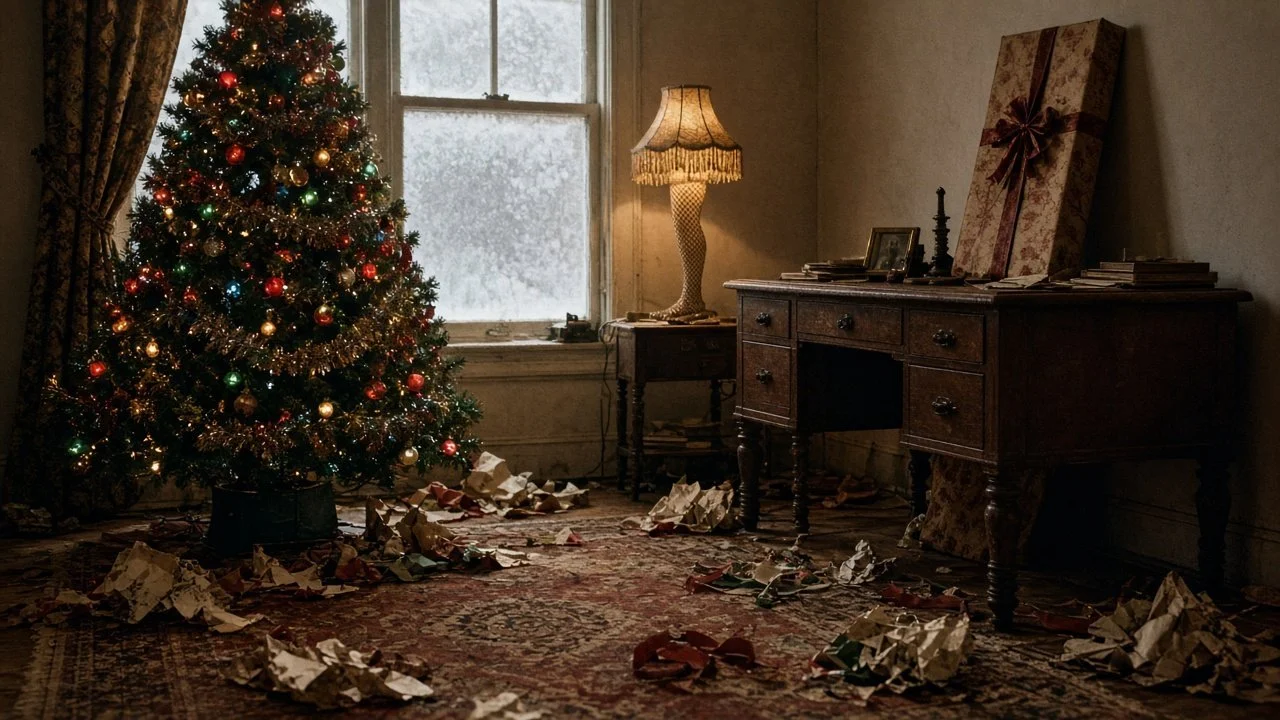
One Boy, One BB Gun and a Warning Every Adult Repeats
All Ralphie Parker wants for Christmas is a Red Ryder BB gun, and every grown-up he asks gives him the same answer: "You'll shoot your eye out." That simple setup has turned A Christmas Story, a modest 1983 comedy that did middling business in cinemas, into one of the most watched Christmas films in America, shown back to back for 24 hours every Christmas in the US. Under the leg lamp, the bunny suit and the frozen flagpole, it is a sharply observed film about childhood, family and the gap between what we want and what we get. Here is what happens, how the ending works, what is true and what is not, and why the film keeps coming back every December.
Spoiler warning: the following summary discusses the plot, major twists and ending.
What Is A Christmas Story About?
A Christmas Story was directed by Bob Clark and released by MGM/UA on 18 November 1983. It is based on Jean Shepherd's 1966 book In God We Trust: All Others Pay Cash, with some elements from his 1971 collection Wanda Hickey's Night of Golden Memories and Other Disasters. Shepherd wrote the screenplay with Clark and Leigh Brown, and he narrates the film as the adult Ralphie, looking back.
The story is set in Hohman, Indiana, a fictionalised version of Shepherd's hometown of Hammond, near Chicago. The year is deliberately vague. Clark said in his DVD commentary that he and Shepherd wanted it to feel "amorphously late-'30s, early-'40s", though a December 1939 calendar and a 1940 date on Ralphie's decoder pin point to around 1940.
Peter Billingsley plays Ralphie, a nine-year-old with glasses and a single-minded mission. Darren McGavin plays his father, known only as the Old Man. Melinda Dillon plays his mother, and Ian Petrella plays his younger brother, Randy.
The film is built from short episodes rather than one tight plot. The adult Ralphie's voice links them, and they all sit inside the countdown to Christmas morning.
Why Ralphie Wants the Red Ryder BB Gun
The film opens with Ralphie pressed against the window of Higbee's department store, staring at the object of his dreams: a Red Ryder Carbine Action 200-shot Range Model air rifle, the model with a compass in the stock.
Ralphie's problem is that every adult has the same objection. When he hints to his mother, she says he will shoot his eye out. When he writes a school essay, or "theme", about it for his teacher, Miss Shields, hoping to win her over, she gives it a C+ and writes the same warning in the margin. Ralphie then imagines her and his classmates celebrating his essay, a fantasy that collapses as soon as the real grade appears.
His last hope is Santa. Ralphie and Randy queue at Higbee's to see him, but when Ralphie reaches the top, he freezes, forgets what he wanted and agrees to a football. As he is being pushed down the slide he finally blurts out his request. Santa leans down and tells him, cheerfully, that he will shoot his eye out, and sends him on his way down the slide.
The repetition is the joke and the point. Adults all reach for the same easy line. To Ralphie, it feels like a conspiracy.
The Leg Lamp and the "Major Award"
The film's most famous running gag belongs to the Old Man. He enters newspaper puzzle contests constantly, and one night he is told he has won a "major award". When the crate arrives, marked "Fragile", which he proudly pronounces as if it were Italian, it holds a table lamp in the shape of a woman's leg in a fishnet stocking.
He is thrilled and puts it in the front window for the whole street to see. Mrs Parker is mortified. The result is what the narrator calls the Battle of the Lamp, which ends when she "accidentally" breaks it. The Old Man tries to glue it back together, fails and sadly buries it in the backyard.
It is a comic sideshow, but it also says something about the Parkers' marriage. Neither of them wins every argument, and both find quiet ways to get what they want.
The Triple Dog Dare and Other Childhood Scenes
Several of the best-remembered scenes have nothing to do with the gun.
At school, Ralphie's friends Flick and Schwartz argue about whether a tongue will stick to a frozen flagpole. Schwartz escalates to a "triple dog dare", skipping the normal "triple dare" etiquette, and Flick is left with no choice. His tongue sticks fast, and the fire brigade has to be called. Miss Shields asks who is responsible, and the class stays silent.
Ralphie becomes a loyal listener to the Little Orphan Annie radio show, sending off for a secret decoder pin. When it finally arrives, he locks himself in the bathroom to decode the week's secret message, letter by letter, only to find that it is a reminder to drink Ovaltine, the show's sponsor. His verdict, a "crummy commercial", is one of the sharpest moments in the film, a child discovering that he has been sold to.
The Old Man fights a running war with the house's ancient furnace, and his swearing, rendered as gibberish, is said to be still hanging in space over Lake Michigan.
What Happens in the "Fudge" Scene?
While helping his father change a flat tyre, Ralphie drops the hubcap full of wheel nuts and lets slip a word that the narrator tells us was not "fudge". It was "the queen-mother of dirty words", one starting with F. It is the only time he ever says it in front of his father.
At home, his mother washes his mouth out with Lifebuoy soap and asks where he heard it. Ralphie actually picked it up from the Old Man, but he blames his friend Schwartz instead. The film does not show the consequences directly, but we hear that Schwartz got a beating, which the adult Ralphie sees as payback for the triple dog dare. That night, Ralphie imagines going blind from soap poisoning, and his parents weeping with guilt.
Ralphie and Scut Farkus
Ralphie, Randy, Flick and Schwartz are tormented by two bullies: Scut Farkus, with his yellow eyes, and his sidekick, Grover Dill. One day, after a snowball hits him, Ralphie snaps. He tackles Farkus and pummels him, while swearing in a stream of gibberish similar to his father's.
His mother pulls him off and takes him home. Ralphie is terrified of what the Old Man will do. But when her husband comes in, she mentions it in passing and then changes the subject to football. Ralphie realises his mother has protected him, and the adult narrator credits her with a new kind of respect.
Zack Ward, who played Farkus, had been bullied himself at school. In 2017 he said he had been surprised to find himself ranked higher than the Grinch in lists of Christmas villains.
What Happens on Christmas Morning?
Christmas Day arrives with mixed blessings. Aunt Clara, who always believes Ralphie is either four or a girl, has sent him a pink bunny suit with feet, which his mother makes him put on. The Old Man takes one look and says he looks like a "pink nightmare". Mrs Parker agrees he need only wear it when Aunt Clara visits.
Ralphie opens his presents. They are fine, but there is no gun. Then the Old Man points him to one last box, hidden behind the desk in the corner. It is the Red Ryder. His father, it emerges, has been on his side all along. In a quiet aside he explains why: "I had one when I was eight years old."
How Does A Christmas Story End?
Ralphie runs outside in the snow and sets up a target. On his very first shot, the BB ricochets off the metal sign and hits him in the face, knocking off his glasses. For a moment he believes he has shot his eye out after all. Hunting for the glasses, he steps on them and breaks them.
Thinking fast, he invents a story. When his mother rushes out, he tells her an icicle fell from the garage roof and hit him. She believes him, and Ralphie gets away with it.
Then disaster strikes the Christmas dinner. The neighbours' dogs, the Bumpus hounds, which have chased the Old Man throughout the film, burst into the kitchen and devour the family turkey. With Christmas dinner gone, the Old Man takes everyone out to a Chinese restaurant, where the staff serve a roast duck, sing carols and chop off the bird's head at the table. The family laugh, and the evening becomes, in the narrator's words, a "Chinese turkey" Christmas.
That night, Ralphie goes to sleep with the rifle beside him. The adult narrator closes the film by calling it "the greatest Christmas gift I had ever received... or would ever receive".
What the Ending Really Means
The ending is a neat double reverse. Every adult warned Ralphie that he would shoot his eye out, and he very nearly does, on his first shot. In one sense the grown-ups were right. But he still loves the gun, the lie works, and the warning has become a family joke rather than a tragedy.
The other reversal concerns the Old Man. He spends the film as a grumbling, swearing figure who fights furnaces and dogs, but he is the one who understood what his son wanted, because he had wanted exactly the same thing at the same age. The final gift is as much about a father recognising himself in his son as it is about the BB gun.
The Chinese restaurant scene works the same way. The perfect Christmas the Parkers planned is ruined, and the improvised version becomes the one they remember. Shepherd once described his stories as a Christmas Carol "as retold by Scrooge". The film softens his cynicism, but it keeps the idea that a good Christmas rarely goes to plan.
The Most Quoted Lines in A Christmas Story
Much of the film's afterlife comes from its dialogue and Shepherd's narration, which fans can recite word for word. "You'll shoot your eye out" is the obvious one, delivered by Ralphie's mother, Miss Shields on his essay and Santa himself. The Old Man's pride in his "major award", and his reading of the word on the crate as "fra-gi-ley" ("That must be Italian"), come a close second.
The narration supplies the rest. The Old Man's swearing becomes "a tapestry of obscenity" that is still hanging over Lake Michigan. Schwartz commits "a slight breach of etiquette" by skipping straight to the "sinister triple dog-dare". Scut Farkus stares out "with his yellow eyes". And the swear word on the tyre-change is "the queen mother of dirty words". Much of the film's comedy lives in that gap between a nine-year-old's experience and a grown man's wry, overblown memory of it.
Who Was the Real Ralphie?
Ralphie is a version of Jean Shepherd, the radio storyteller and humorist who wrote the stories behind the film. Several of them first appeared in Playboy between 1964 and 1966 before being collected in In God We Trust: All Others Pay Cash. Shepherd also told them on his WOR radio show in New York. Bob Clark said he first became interested after hearing Shepherd tell the story of Flick's tongue on the radio in 1968, and it took him years to get the film made.
Hohman is based on Hammond, Indiana, where Shepherd grew up, and the Parkers live on Cleveland Street, the name of his real childhood street. There really was a Miss Shields: she was Shepherd's second-grade teacher at Warren G. Harding Elementary School in 1928. But Shepherd was several years older than Ralphie would have been, and he was famously loose with the facts of his own life, so the film is best treated as memory filtered through a storyteller rather than as autobiography.
The collaboration was not always smooth. According to Wikipedia, Clark did not like Shepherd trying to direct the actors and eventually had him barred from the set. Shepherd still appears in the film, though: he is the man in the Santa queue at Higbee's who tells Ralphie and Randy where the line ends, and his wife, co-writer Leigh Brown, stands beside him.
How Ralphie and the Old Man Were Cast
Clark said Peter Billingsley was his first choice for Ralphie, but worried that he was too obvious a pick. He reportedly auditioned around 8,000 boys before deciding Billingsley was right after all. For the Old Man, Clark has said that Jack Nicholson was considered before the role went to Darren McGavin, a decision Clark said he was grateful for. Melinda Dillon was cast because of a similar mother role in Close Encounters of the Third Kind.
Was the Red Ryder BB Gun Real?
Partly. Daisy began making the Red Ryder BB gun in Plymouth, Michigan, in 1938, but it was never manufactured in the exact form described in the film. The compass and sundial in the stock came from a different Daisy model, the Buck Jones. On Ralphie's gun they were even placed on the opposite side of the stock, because Peter Billingsley is left-handed.
The film has been very good for Daisy. According to Wikipedia, the company reported that the film drives sales of the Red Ryder every Christmas, turning it into something close to a holy grail for collectors.
Where Was A Christmas Story Filmed?
Most exterior scenes were shot in Cleveland, Ohio, chosen partly because the Higbee's department store agreed to take part. The house used as the Parkers' home, in the Tremont area of Cleveland, has been restored and is open to visitors as A Christmas Story House. Other scenes were filmed in Canada: the school scenes at Victoria School in St Catharines, Ontario, and interiors and some exteriors in Toronto, including the "fudge" scene.
How A Flop Became a Christmas Classic
A Christmas Story was released a week before Thanksgiving 1983 and earned about $2 million in its first weekend. By Christmas it had left most cinemas. It made about $19 million in its first run on a $3.3 million budget, and MGM brought it back briefly in December 1984. In Canada, it won two Genie Awards, for Bob Clark's direction and for the screenplay.
Television made it a classic. After years of cable and local station showings, TNT began its "24 Hours of A Christmas Story" marathon in 1997: twelve consecutive airings from 8pm Eastern Time on Christmas Eve. TBS took it over in 2004. Roger Ebert, who first gave the film three stars, later upgraded it to four and added it to his Great Movies list. In 2012 it was selected for the US National Film Registry.
The film has three sequels: My Summer Story (1994), also directed by Clark, the straight-to-DVD A Christmas Story 2 (2012), and A Christmas Story Christmas (2022) on HBO Max, with Billingsley returning as a grown-up Ralphie. It has also been turned into a stage musical.
Is A Christmas Story Popular in the UK?
Much less than in America. The film never had the same television tradition in Britain, so many UK viewers know the leg lamp and "you'll shoot your eye out" from memes and American sitcoms rather than the film itself. If you are coming to it fresh, expect a gentle, episodic comedy rather than a big family adventure, and a very American picture of Christmas in the Midwest. Streaming availability changes every year, so check a service such as JustWatch for where to watch it in your country.
If you want to compare it with other festive favourites, our ranking of the best Christmas films ever puts it in context, and our guide to Home Alone looks at another film about a boy, a family Christmas and a lot of things going wrong.
Why A Christmas Story Still Works
A Christmas Story lasts because it remembers childhood accurately: the obsessions, the injustices, the fear of parents and the moment you realise they are on your side. The famous warning comes true, almost, and it does not matter. The turkey is lost, and the improvised Chinese dinner becomes the memory. Underneath the jokes is a father who quietly bought his son the present he had once wanted himself. That is why the film keeps returning every December.
Sources
- A Christmas Story – Wikipedia — Release date, source books, cast, plot, dating of the story, locations, the Red Ryder and Buck Jones details, box office, reviews (including Ebert's Great Movies upgrade and the Rotten Tomatoes score), Genie Awards, the TNT and TBS marathon and the National Film Registry.
- A Christmas Story (1983) – Rotten Tomatoes — Critics' score and consensus.
- A Christmas Story script, page 6 – Scripts.com — Christmas morning dialogue used to check the final scenes.
