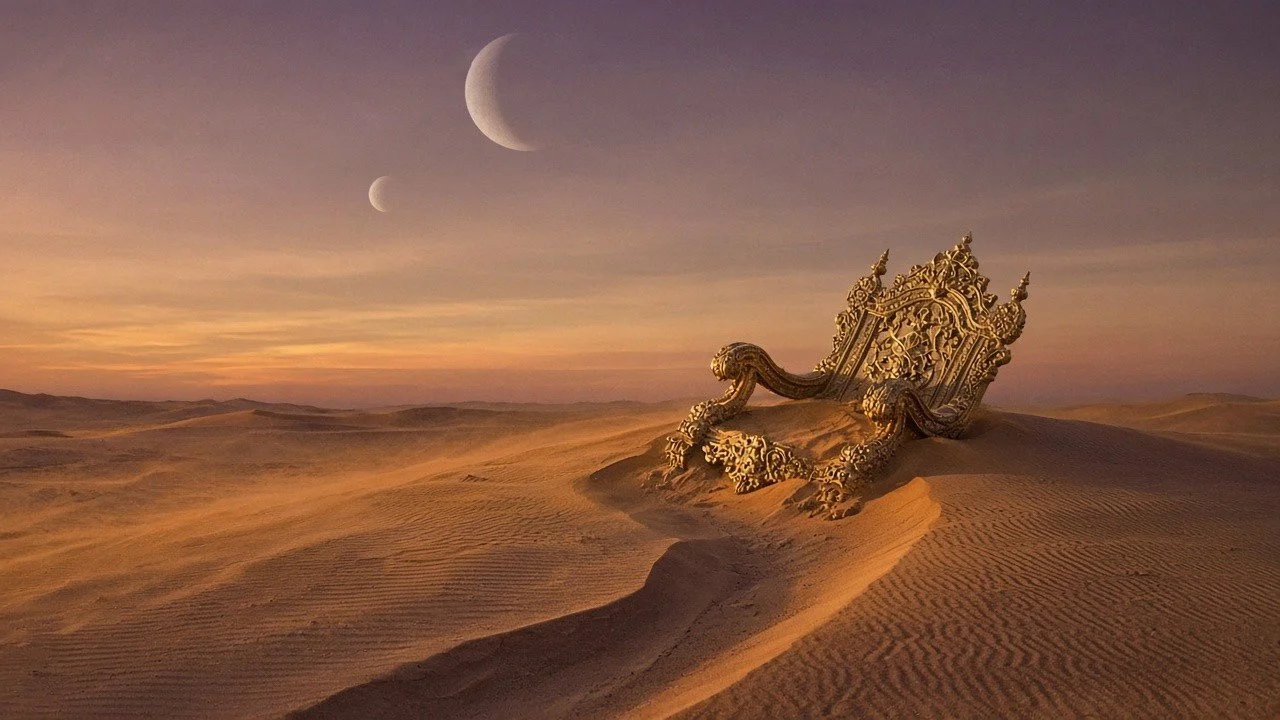
Dune Messiah is the book where Paul's victory becomes his tragedy. We explain how it ends, and what Villeneuve's Dune: Part Three has already changed.
Herbert Wrote a Warning. Villeneuve Is Telling It His Own Way
Dune Messiah is the book in which Frank Herbert turns his hero into a problem. Published in 1969, four years after Dune, it picks up Paul Atreides years into his reign as Emperor and shows what his victory has cost. Denis Villeneuve's Dune: Part Three, the last film in his trilogy, adapts it. The film opens in UK cinemas on Friday 18 December 2026, the same day as in North America, with Warner Bros. rolling it out in some other international markets from 16 December.
The film is not out yet, so nobody outside the production can give a full comparison. What can be done is to set out the book clearly and then look at the differences that are already official or clearly reported from trailers and the studio's own material. Each one is labelled for what it is. Anything about the film's plot beyond that has to wait.
What Is Dune: Part Three?
Villeneuve directs from a screenplay he wrote with Brian K. Vaughan, based on Herbert's novels. Timothée Chalamet returns as Paul, Zendaya as Chani, Florence Pugh as Princess Irulan, Rebecca Ferguson as Lady Jessica and Javier Bardem as Stilgar. Anya Taylor-Joy plays Paul's sister, Alia, and Charlotte Rampling returns as the Reverend Mother Mohiam. Jason Momoa is back, this time as Hayt, the cloned Duncan Idaho. Robert Pattinson joins as Scytale, a shape-shifting Tleilaxu Face Dancer, and Isaach de Bankolé plays the Fremen veteran Farok. Hans Zimmer composes again, and Linus Sandgren takes over as cinematographer. For UK fans who want a refresher on the big screen, Warner Bros. UK has announced that Dune: Part One and Part Two return to IMAX from 4 December, with an exclusive sneak peek of Part Three.
The studio's synopsis says the film "is set nearly two decades after Paul Atreides seized control of the Imperium". Paul is "now a ruthless Emperor" who "must face the consequences of his reign as old allies return, terrifying new threats emerge, and betrayal lurks in every shadow". Haunted by "visions of Imperial collapse and the reappearance of his long-lost love", he is drawn into "a sweeping conspiracy, with Chani at the heart of its unfolding mystery".
The cast have been open that it is not a literal adaptation. "There's a lot in this film that is very true to the source material, and there are departures," Zendaya said in a New York Times interview reported by Variety. Asked whether he was satisfied with the trilogy's ending, Chalamet said: "Absolutely. It didn't feel like the bar dropped at all, Denis just changed the location of the bar. This movie is its own thing."
Spoiler warning: the following summary discusses the plot, major twists and ending of the novel Dune Messiah.
Dune Messiah in Brief: The Book's Story
The novel opens twelve years after Paul became Emperor. As Muad'Dib, the messiah of the desert Fremen, he has unleashed a holy war, a jihad, that has conquered most of the known universe and killed 61 billion people. Paul's visions tell him this is not the worst future humanity could have faced, so he lets the war run on while trying to reform the Empire and secure his dynasty. He hates what he has become, but believes stopping would be worse.
Against him, three powers form a conspiracy. The Bene Gesserit, the sisterhood that bred Paul's bloodline, are represented by the Reverend Mother Mohiam. The Spacing Guild, which controls space travel, sends the Navigator Edric, whose own prescience hides the plotters from Paul's sight. The Bene Tleilax, makers of flesh and genetic tools, send Scytale, a Face Dancer who can change his appearance. Princess Irulan, the wife Paul married only for politics, joins them.
The domestic story drives the political one. Paul refuses to have a child with Irulan, and he and Chani, the woman he loves, have no heir. Irulan has been secretly feeding Chani contraceptives. Paul knows, but lets it continue, because he has foreseen that the birth of his heir will kill Chani. When Chani switches to a traditional Fremen diet, she becomes pregnant, but her body has been weakened.
The conspirators' gift to Paul is Hayt, a ghola: a body grown from the dead Duncan Idaho, Paul's old swordmaster and friend. The Fremen see the Tleilaxu as unclean, so even accepting the gift costs Paul support. Hayt has been conditioned to kill Paul when a particular trigger arrives.
The plot comes to a head in an attack using a stone burner, an atomic weapon. It kills and maims many of Paul's soldiers and blinds him. Fremen custom says the blind must walk into the desert, but Paul astonishes them by moving as if he can see. His visions are now so complete that he can live inside them, step by step.
In childbirth, Chani dies. She gives birth to twins, Leto and Ghanima. Paul had foreseen only the girl, so the boy is a complete surprise. Paul's grief triggers Hayt's conditioning, but the shock instead restores Duncan's full memory and frees him from Tleilaxu control. That is what the Tleilaxu wanted all along: Scytale now offers to bring Chani back as a ghola in exchange for Paul's surrender. Paul refuses. When Scytale threatens the babies, Paul, seeing through his son's eyes, kills him.
His prescience now gone, Paul is truly blind. He chooses to follow Fremen custom and walks alone into the desert, leaving Alia to rule as regent for the twins. Alia has the conspirators executed, but spares Irulan, who renounces the Bene Gesserit and vows to teach Paul's children. The ending is a kind of escape: by walking away as a man, Paul refuses to remain a god.
Why Herbert Wrote It That Way
Herbert described his first three Dune books as a fugue, with Dune as the heroic melody and Messiah as its inversion. Readers who cheered Paul's rise in the first book are asked to look at where that rise leads: a messiah who cannot control his religion, a jihad he cannot stop, and visions that trap him rather than free him.
That has always made it a difficult book to adapt. Much of its conflict is alluded to rather than shown, and it is short, cerebral and bleak. Villeneuve, though, had already moved towards it. His Dune: Part Two ends with a Paul who is clearly dangerous, and with a rift between him and Chani that is not in the original novel. In the book, Chani stays loyal to Paul throughout. In Villeneuve's version, she has walked away from him before the third film begins.
The Changes Already Confirmed or Reported
These are the differences that can be stated responsibly before release. The first comes from the studio's official synopsis; the others come from the trailers and the studio's casting, as reported by several outlets. None of them tells you how the film ends.
A Longer Time Jump
The book is set twelve years after Paul takes the throne. The official synopsis says the film is set "nearly two decades" later. Reports describe the change as a way of showing Paul's crimes at greater scale and of ageing key characters, including Alia and Paul's children. Precisely how many years pass on screen is best confirmed from the film itself.
Chani at the Centre of the Conspiracy
This is the biggest reported departure. In Dune Messiah, Chani is Paul's loyal partner and is never part of the plot against him. The official synopsis places "Chani at the heart of its unfolding mystery" and speaks of "the reappearance of his long-lost love", which implies the two have been apart for some time. One trailer appears to show Pattinson's Scytale and Pugh's Irulan plotting "regime change", then cuts to Chani after Scytale says, "I found someone." Several outlets have read that as Chani joining the conspiracy. What the trailer cannot tell you is how far she is involved, or why. That is exactly the kind of detail that has to wait.
The Twins Are Already Here
In the novel, Leto and Ghanima are born at the very end, as Chani dies. The film's final trailer gave a first look at them as older children, played by Nakoa-Wolf Momoa and Ida Brooke. That is a structural change in its own right: the twins become characters rather than an ending. It also means the film cannot follow the book's version of Chani's death in the same way. How Villeneuve handles Chani's fate is not known.
Jessica Returns
Paul's mother, Lady Jessica, does not appear in Dune Messiah. She has gone back to Caladan, the Atreides homeworld, and only returns to the story in Children of Dune. Rebecca Ferguson is in the film's cast as Jessica. The size of her role has not been confirmed.
The Holy War on Screen
The book mostly tells us about the jihad through statistics and conversation. Trailers for the film show wars and conflicts from the years between the two stories, which suggests audiences will see more of Paul's holy war than Herbert's readers did.
A Conclusion, Not a Middle Chapter
Herbert followed Dune Messiah with four more novels, beginning with Children of Dune, which continues the story of the twins. Villeneuve's film is billed as the conclusion of his trilogy. Some outlets have read the twins' bigger role and Jessica's return as signs the film borrows from Children of Dune, though the extent of any borrowing has not been confirmed.
What Has to Wait Until 18 December
The most important comparisons cannot be made yet. They include whether the stone burner attack and Paul's blindness stay; whether Hayt's conditioning and Duncan's recovered memory play out as in the book; what bargain, if any, Scytale offers; what happens to Chani; and whether Paul still walks into the desert. Those are the moments that give the novel its meaning, and any claim about how the film treats them before release is a guess.
What can be said is that the confirmed changes point in a consistent direction. Villeneuve has given Chani a will of her own since Part Two, and the third film appears to make her choice central rather than incidental. If she really is among the people working against Paul, then the story's moral weight shifts. In Herbert's book, Paul is undone by the people who want to use him. In the film, he may also have to face the person who knew him best and decided he had to be stopped.
Why the Book Still Matters
Even if the film strays far from it, Dune Messiah is the key to reading what Villeneuve is doing. Herbert's argument is that a saviour can be more dangerous than a tyrant, because people will follow him anywhere. Villeneuve's first two films already point that way, ending Part Two with a Paul who is plainly dangerous, which is why his trilogy has always been heading here. Our full Dune Messiah summary and ending explained goes deeper into the novel. Anyone interested in how Villeneuve handles a story about identity, control and manufactured purpose will also recognise the territory from Blade Runner 2049.
Dune: Part Three keeps the novel's bones: an emperor trapped by his own legend, a conspiracy of the Empire's oldest powers, a resurrected friend and a family at the centre of it all. What it already changes is time, the twins and, above all, Chani. Herbert wrote a warning about heroes. On the evidence of its trailers and its own synopsis, Villeneuve's version will deliver that warning through the woman who refused to worship Paul. How it ends, and how far it departs from the book, will be clear on 18 December.
Sources
Dune: Part Three, Official Movie Site (Warner Bros. and Legendary)
Dune: Part One and Part Two Return to IMAX From 4 December, Warner Bros. UK on X (12 Nov 2026)
'Dune 3' Cast Says the Movie Takes 'Departures' From the Books, Variety (4 Nov 2026)
Dune: Part Three Teaser Trailer Shows Off Key Book Character, Radio Times
Dune 3's New Trailer Teases Big Changes From the Books, Polygon
Dune: Part Three's Novel Changes Are Denis Villeneuve's Smartest Decision, ComingSoon
6 Biggest Changes Dune 3 Has Already Made to the Book, Screen Rant
