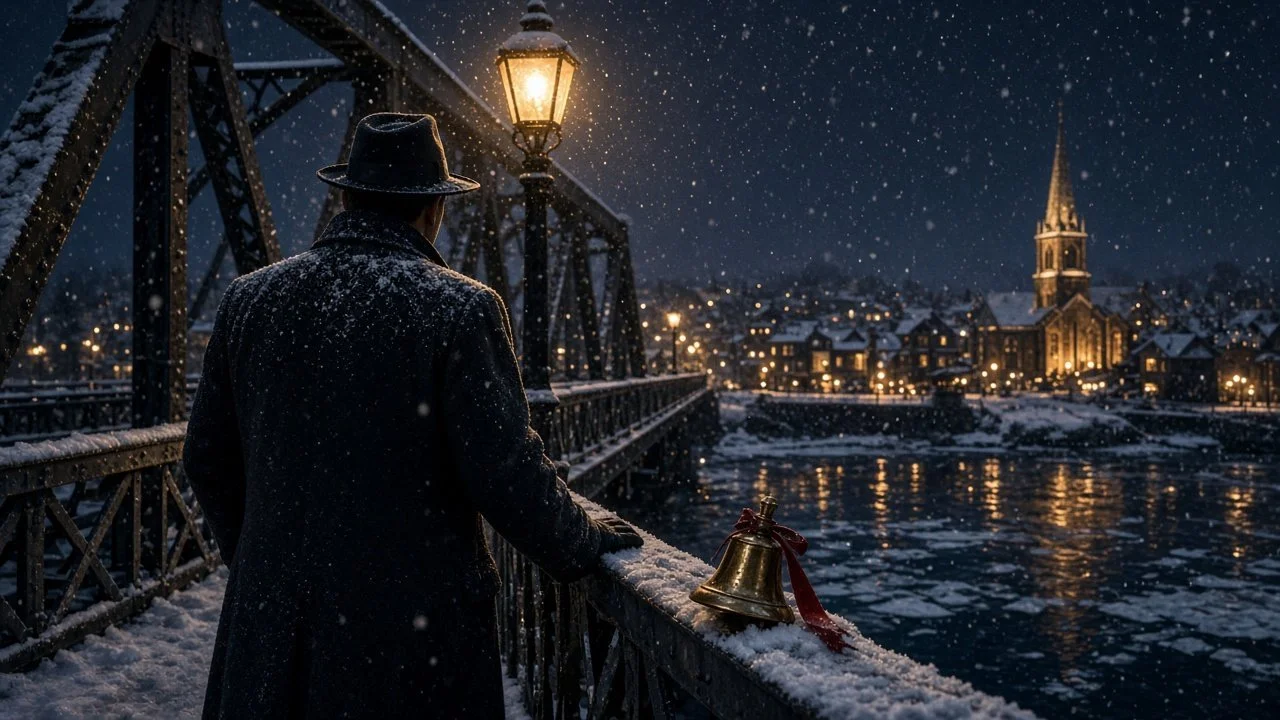
A Man Who Gave Away Every Dream He Had Gets One Night To See What It Was Worth.
It's a Wonderful Life is 80 years old this December, and Frank Capra's 1946 film about George Bailey, the small-town banker who stands on a bridge on Christmas Eve wishing he had never been born, has become the most famous Christmas film ever made by a director who never meant it to be a Christmas film at all. James Stewart plays George, a man who keeps putting off his escape from Bedford Falls to protect his neighbours from the town's richest man, Mr Potter. When $8,000 goes missing and ruin looms, an angel named Clarence shows him the town as it would have been without him. The film lost money on release, was nearly forgotten, and was rescued by a clerical error that let American television show it for free. For its 80th anniversary, Paramount is returning it to UK cinemas in 4K from Friday 11 December 2026, and US screenings begin on 12 December.
This article explains the plot in full, including the ending, so it contains spoilers throughout.
When Is It's a Wonderful Life Back in Cinemas?
In the UK, Paramount Pictures is releasing a new 4K presentation of the film for two weeks from Friday 11 December 2026. Independent cinemas including the Showroom in Sheffield, Watershed in Bristol, the Hyde Park Picture House in Leeds and the Savoy in Doncaster all list screenings from that date, and several run them through to Christmas Eve. The film keeps its U certificate and runs for 2 hours 10 minutes.
There is one wrinkle worth knowing about. The listings aggregator GoFilm shows the film playing in more than 350 UK cinemas from Monday 7 December, so a few venues may be screening it before the official start date. If you want to see it in a particular cinema, check that cinema's own listings rather than relying on the national date.
In the US, Fathom Entertainment is presenting the 80th anniversary 4K version as part of its Big Screen Classics series, with an introduction from the film historian Leonard Maltin. Fathom says screenings begin on 12 December and continue to Christmas Day, although dates vary by chain. For viewers at home, NBC will broadcast the film on Christmas Eve, Thursday 24 December, at 8pm Eastern time, a tradition the network has kept since it bought exclusive American television rights in 1994.
What Happens in It's a Wonderful Life?
The film opens with prayers rising from Bedford Falls on Christmas Eve 1945. Friends and family are asking God to help George Bailey. In heaven, the senior angels assign the job to Clarence Odbody, an "angel second class" who has been waiting 200 years to earn his wings. Before he goes, Clarence is shown George's life so far.
At 12, George saves his younger brother Harry from drowning in an icy pond and loses the hearing in one ear. Working at Mr Gower's chemist shop, he notices that the grieving druggist has accidentally put poison into a prescription and refuses to deliver it, taking a beating rather than letting a child die.
As a young man, George is desperate to leave. He plans to travel the world, go to college and build skyscrapers. But on the night of his brother's graduation party, after a dance with Mary Hatch that ends with them both falling into a swimming pool hidden under the gym floor, his father has a stroke and dies. George stays to sort out the family business, the Bailey Brothers Building and Loan, a small mutual society that lends working families the money to buy homes. Mr Potter, who owns most of the town and wants to swallow the Building and Loan, tries to have it dissolved. The board agrees to keep it open only if George runs it. He gives his college money to Harry, on the understanding that Harry will take over when he graduates. Harry comes home married, with a job offer from his father-in-law, and George is trapped again.
He marries Mary instead of leaving. On their wedding day, as they set off on honeymoon, a run on the bank begins. Panicking shareholders queue to withdraw their money, and Potter offers to buy their shares at half price. George and Mary hand over their own $2,000 honeymoon fund to keep the business open until the bank reopens, and finish the day with $2 left. Over the following years, George builds Bailey Park, a development of modest family homes that frees families from renting Potter's slums. Potter tries to buy him off with a $20,000-a-year job, and for a moment George is tempted, until he realises that Potter's real aim is to close the Building and Loan.
The Missing $8,000
The crisis comes on Christmas Eve 1945. Harry, now a Navy pilot, has won the Medal of Honor for shooting down enemy planes and saving a troopship, and the town is preparing a hero's welcome. George's absent-minded Uncle Billy goes to Potter's bank to deposit $8,000 of the Building and Loan's cash, taunts Potter with a newspaper about Harry, and accidentally hands back the money folded inside the paper. Potter finds it and keeps it.
A bank examiner is in town that very day to inspect the books. Unless the money is found, the Building and Loan faces collapse and George faces a charge of fraud and possibly prison. He goes home and takes out his fury on his family, shouting at his children and smashing a model bridge. He then goes to Potter to beg for a loan. Potter refuses, sneering that with a life insurance policy worth $15,000, George is "worth more dead than alive", and threatens to have him arrested.
George gets drunk in a bar, crashes his car into a tree and walks to a bridge over the icy river, intending to throw himself in. Before he can, Clarence jumps in first, and George instinctively dives in to save him.
Pottersville: What the Alternate World Shows
Drying off in the bridge-keeper's hut, George says he wishes he had never been born, and Clarence grants the wish. The sequence that follows is the most famous part of the film, and the darkest.
Bedford Falls has become Pottersville, a town of bars, pawnshops, dance halls and neon. Mr Gower spent 20 years in prison for poisoning a child, because George was not there to stop him. Harry drowned at the age of nine, so he never grew up to save the men on the troopship. Uncle Billy is in an asylum. Bailey Park was never built, and the families who live there are still in Potter's slums. George's mother does not recognise him and runs a boarding house. Mary never married and works in the town library, and when George grabs her she screams and runs away.
The point Clarence makes is the film's thesis: "Each man's life touches so many other lives. When he isn't around he leaves an awful hole, doesn't he?" George's sacrifices, which looked to him like a string of failures, turn out to have been holding the town together.
How Does It's a Wonderful Life End?
Terrified, George runs back to the bridge and begs Clarence, and then God, to let him live again. Snow begins to fall, a police officer who had been chasing him in Pottersville now recognises him, and his bleeding lip, which Clarence's world had erased, is back. George runs home through Bedford Falls shouting "Merry Christmas!" at everything, including the old Building and Loan, and finds the bank examiner and a sheriff's officer with a warrant waiting at his door.
While he was gone, Mary and Uncle Billy spread the word, and the townspeople George has helped for years arrive with whatever they can spare. Baskets of cash fill the table, more than enough to cover the shortfall. A telegram arrives from Sam Wainwright, George's rich old friend, authorising up to $25,000. Harry arrives through the snow and raises a glass: "To my big brother George, the richest man in town." The bank examiner adds his own money, and the sheriff's officer tears up the warrant.
Among the gifts is a copy of The Adventures of Tom Sawyer, inscribed by Clarence: "Remember no man is a failure who has friends. Thanks for the wings! Love, Clarence." A bell on the Christmas tree rings, and George's youngest daughter, Zuzu, says the line that has become part of the language: "Teacher says, every time a bell rings an angel gets his wings."
What the Ending Means
On the surface the ending is a happy one, and audiences remember it that way. But it is worth noticing what it does not resolve. Potter is never caught. He keeps the $8,000, nobody ever learns what he did, and the film does not punish him. The money that saves George does not come from justice but from community, from hundreds of small debts of gratitude being repaid at once.
That is the film's real argument. George has measured his life by what he gave up: travel, college, architecture, escape. Clarence makes him measure it instead by what would be missing without him. Harry's toast reverses Potter's sneer: the man who was "worth more dead than alive" is "the richest man in town", not in money but in the people who turned up for him.
Critics have long argued over how comforting this really is. Some have pointed out that the Pottersville sequence looks much more like a real postwar American town than Bedford Falls does. The ending is a fantasy of what a community could do if it chose to, and Capra, who had grown up poor after his family emigrated from Sicily, clearly believed in it. That tension between dark realism and determined hope is a large part of why the film still works for audiences who find most Christmas films too sweet.
The film's handling of George's despair is also unusually frank for 1946. He is a man in a financial crisis who has decided his family would be better off with his life insurance, and the film treats that as a real danger rather than a plot device. For many viewers, that honesty is what earns the ending.
Who Is in the Cast?
James Stewart was 38 when he played George, aging from an eager young man to a worn-out father of four over the course of the film. His performance moves from screwball charm in the early scenes to something close to breakdown in the bar and on the bridge, and it is the reason the ending lands rather than cloys.
Donna Reed plays Mary Hatch, the girl who has loved George since she whispered into his deaf ear as a child. She was not Capra's first choice. Jean Arthur, Stewart's co-star in You Can't Take It With You, was considered, as were Olivia de Havilland and Ginger Rogers, before Capra borrowed Reed from MGM. Mary is far from passive: it is she who saves the business on their wedding day, turns a derelict house into a home and organises the rescue at the end.
Lionel Barrymore plays Henry F. Potter, the wheelchair-bound banker who is the closest thing American cinema has to Ebenezer Scrooge without the redemption. The casting was apt: Barrymore had played Scrooge in annual radio adaptations of A Christmas Carol for years. Henry Travers gives Clarence a gentle, slightly bumbling innocence, and Thomas Mitchell plays Uncle Billy, the kind but forgetful man whose mistake sets the crisis in motion. Gloria Grahame appears as Violet Bick, the town flirt whom George quietly helps to leave town. Karolyn Grimes, who played Zuzu at the age of six, has spent much of her later life attending screenings and festivals, and in 2010 she cut the ribbon at the museum in Seneca Falls.
Where Did the Story Come From?
The film is based on The Greatest Gift, a short story by the American historian and writer Philip Van Doren Stern. He began it in 1939, could not find a publisher, and in 1943 printed 200 copies as a 24-page booklet that he sent to friends and family as a Christmas present. In his version, a man called George Pratt stands on a bridge wishing he had never been born, and a mysterious stranger, more salesman than angel, grants the wish. Stern's story is itself loosely modelled on Charles Dickens's A Christmas Carol, with the ghostly tour of a life reshaped into a single alternate present.
RKO bought the rights for $10,000, hoping to make it with Cary Grant, and several writers, among them Dalton Trumbo and Clifford Odets, produced scripts before the studio gave up. Capra, newly back from making documentaries for the US Army during the Second World War, bought the rights for his new company, Liberty Films. The screenplay is credited to Frances Goodrich, Albert Hackett and Capra, with additional scenes by Jo Swerling, and the collaboration was famously unhappy.
The film was also a return for its star. James Stewart had spent the war as a bomber pilot with the US Army Air Forces, flying combat missions over Europe. It's a Wonderful Life was his first film after coming home. Capra later said it was his favourite of all the films he directed and screened it for his family every Christmas, and Stewart counted it among his own favourites.
How Was It Made?
Bedford Falls was built on RKO's movie ranch in Encino, California, and adapted from sets originally designed for the 1931 western Cimarron. The famous swimming pool that opens under the dance floor was real: the scene was shot in the gymnasium of Beverly Hills High School, where the pool was still in use as of December 2023.
The film also changed how Hollywood made snow. Before 1946, studios often used painted cornflakes, which crunched so loudly underfoot that dialogue had to be re-recorded. RKO's special effects chief, Russell Shearman, developed a new "chemical snow" made from water, soap flakes, foamite (a firefighting foam) and sugar, which could be sprayed silently across the set.
Why Did It Flop, and How Did It Become a Classic?
It's a Wonderful Life premiered at the Globe Theatre in New York on 20 December 1946 and went on general release in January 1947. Reviews were mixed, and some critics found it sentimental. It earned about $3.3 million against a budget of about $3.18 million, and RKO recorded a loss of $525,000. Capra's Liberty Films was sold to Paramount soon afterwards.
It did win five Academy Award nominations, including Best Picture, Best Director and Best Actor for Stewart, but lost almost everywhere to The Best Years of Our Lives, William Wyler's drama about soldiers coming home from the war. In May 1947, an FBI memo recorded an informant's view that the film's portrayal of a banker as a Scrooge-like villain was "a common trick used by Communists", a reminder of how suspicious postwar Washington could be of anything critical of money and power.
The film's rescue came almost by accident. In 1974, its copyright was not renewed because of a clerical error, and in the US it effectively fell into the public domain. Local television stations could show it without paying, and throughout the late 1970s and 1980s many did, often several times over Christmas. A generation grew up with it as background to the holidays, and the flop became a tradition. In 1993, Republic Pictures, which then owned the film, successfully reasserted control by arguing that it still held the rights to Stern's story, on which the film was based. The following year it sold exclusive American television rights to NBC.
Recognition followed. The film was added to the US National Film Registry in 1990, and the American Film Institute has ranked it the most inspiring American film of all time. In the UK it has long been a Christmas television staple and a regular December re-release, and it tops many lists of the best Christmas films ever made.
Is Bedford Falls a Real Place?
Bedford Falls is fictional, but Seneca Falls in upstate New York has long claimed to be its inspiration, pointing to a steel truss bridge similar to the one in the film and a legend that Capra visited while working on the script. The town opened an It's a Wonderful Life Museum in 2010, and its annual festival runs from 9 to 13 December this year. Capra's biographer Jeanine Basinger has said that she found no evidence in his papers to support the claim. Capra himself described Bedford Falls as an everyday American town, which may be why so many places see themselves in it.
Why It's a Wonderful Life Still Matters at 80
Eighty years on, It's a Wonderful Life endures because it does not pretend that George's life is easy. He never leaves, never builds his skyscrapers, and never gets justice from Potter. What he gets is proof that an ordinary life, spent quietly protecting other people, mattered more than he could see from inside it. That idea, delivered through a story that admits to despair before it offers hope, is why audiences keep returning to Bedford Falls every December, and why the film that lost money in 1947 is now back in 4K for its 80th Christmas.
If you've been affected by any of the themes in this article, in the UK and Ireland you can contact Samaritans on 116 123, and in the US you can call or text the 988 Suicide & Crisis Lifeline.
Sources
- Live for Films — It's A Wonderful Life returns to cinemas to celebrate its 80th Anniversary and Movieversalfilm — It's a Wonderful Life Returns to UK Cinemas in 4K This Christmas — Paramount UK's two-week 4K release from 11 December 2026, the U certificate, the running time and the AFI ranking.
- Watershed, Bristol, Showroom Cinema, Sheffield and Hyde Park Picture House, Leeds — UK cinema listings from 11 December.
- GoFilm — Classic films in UK cinemas — Aggregated listings showing the film in more than 350 UK cinemas from Monday 7 December (accessed 28 November 2026).
- Fathom Entertainment — Tis the Season: Fathom's 2026 Holiday Lineup and Attractions Magazine — US 4K screenings from 12 December, the Leonard Maltin introduction, chain dates and the Seneca Falls festival dates.
- NBC Insider — How to Watch It's a Wonderful Life in 2026 — The NBC broadcast on 24 December 2026 at 8pm ET.
- Wikipedia — It's a Wonderful Life and Wikipedia — The Greatest Gift — Production history, the premiere and box office, the Oscar nominations, the FBI memo, the 1974 copyright lapse and 1993 reassertion, the chemical snow, casting, and Stern's 1943 booklet (cross-checked against the film itself for plot details).
Next Reads
- The Best Christmas Films Ever, Ranked: Why It's a Wonderful Life Beats Elf, Home Alone and (Yes) Die Hard — Where George Bailey sits among the festive classics.
- A Christmas Carol Summary — The Dickens story that shaped both Stern's booklet and Capra's film.
- The Polar Express Ending Explained: Is the Bell Real and Who Is the Hobo? — Another Christmas story about belief, with its own famous bell.
