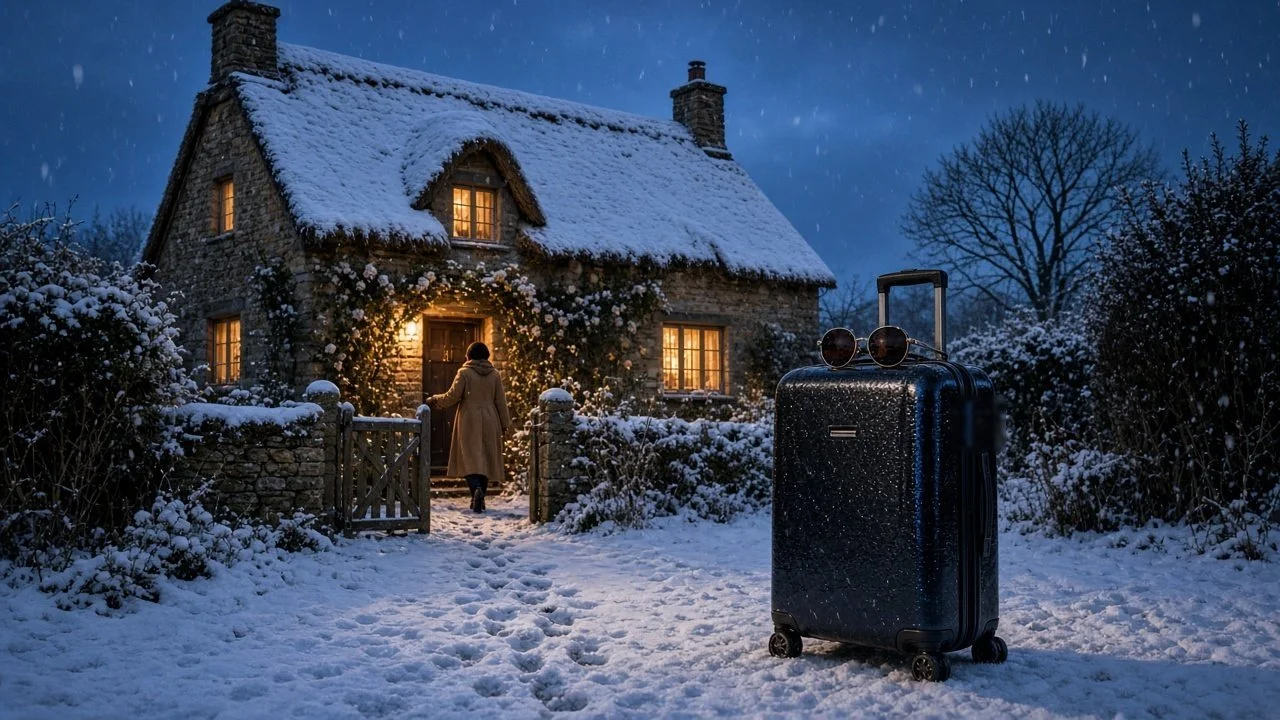
Two Broken Hearts, One House Swap and Two Weeks Before Christmas
Nancy Meyers's The Holiday (2006) starts with two women who need to be anywhere but home. Iris Simpkins, played by Kate Winslet, is a newspaper columnist in Surrey who has spent three years in love with a colleague who keeps her close while seeing other women. Amanda Woods, played by Cameron Diaz, runs a film-trailer company in Los Angeles, has just thrown out her cheating boyfriend and cannot make herself cry about it. Strangers on opposite sides of the Atlantic, they find each other on a home-swap website a few days before Christmas and agree to trade houses for two weeks, starting the next day. Neither is looking for romance. Twenty years on, the film is back in UK cinemas for its anniversary, and the swap still raises the same question: can a change of address actually change your life?
Spoiler warning: the following summary discusses the plot, major twists and ending.
What Happens in The Holiday: Two Heartbreaks and a Website
Iris writes a society column for The Daily Telegraph in London. The colleague she cannot get over is Jasper Bloom, played by Rufus Sewell. He cheated on her years ago and moved on, but he still calls, flirts and asks for favours, which is enough to keep her hoping. At the office Christmas party, Iris learns of his engagement to another woman at the same moment as everyone else, when it is announced to the room. She goes home to her little stone cottage in a snowy Surrey village and cries for days.
In Los Angeles, Amanda is busy and successful, and sleeps badly. Her boyfriend, Ethan, a film composer played by Edward Burns, has cheated on her. When she confronts him, he tells her the real problem is that she is emotionally closed off. He throws her failure to cry back at her. She has not cried since she was 15, when her parents divorced. She does not cry now either. Instead she throws him out, then hears a trailer voice in her head narrating her life as if it were a movie, a running joke that becomes a way into her character.
Amanda decides she needs to get away, somewhere she has never been, for as long as it takes. Searching online, she finds a listing for Rosehill Cottage, Iris's home in Surrey, on a house-swap site. She messages Iris, who has advertised it in her misery. Within minutes they have agreed to swap for two weeks, starting the next day.
The film immediately sets the two journeys against each other. Amanda flies first class; Iris flies economy. Iris arrives at Amanda's enormous gated house in the Los Angeles hills and runs around it like a child, delighted by the electric gates, the lights and the size of everything. Amanda arrives in the dark at a tiny cottage at the end of a snowy lane and nearly gets the hire car stuck. By the next evening she is bored, cold and packing to go home.
Amanda in Surrey: A Drunk Brother at the Door
On Amanda's first night someone knocks on the door. It is Iris's brother, Graham, played by Jude Law, a book editor who has had too much to drink at the local pub and expects to sleep on his sister's sofa. Amanda lets him in. They talk, he kisses her and, since she plans to leave the next morning and will never see him again, she suggests they sleep together.
In the morning Graham leaves, telling her that if she is still around, he and his friends will be at the pub that night. Amanda is on her way to the airport when she changes her mind. She turns up at the pub, and from then on the Surrey half of the film follows her slow decision to stay.
The relationship is easy at first because Amanda thinks it has an end date. Then the phone keeps ringing. Graham takes calls from "Sophie" and "Olivia", and Amanda assumes she is one of several women he is seeing. They spend a long, happy day together in the countryside and at lunch, but at the end of it she will not let him in. She tells herself she is protecting herself; the trailer voice in her head asks whether she simply pushes men away.
What Graham Was Hiding
When Amanda finally turns up unannounced at Graham's house with wine and snacks, the truth is waiting at the door. Sophie and Olivia are his young daughters. Graham is a widower, raising the girls on his own after his wife died.
He explains that he keeps his two lives separate. Being a single working father is overwhelming, and he does not tell women he is seeing about his daughters, because he will not bring anyone into their lives unless the relationship is going somewhere. The girls, though, take to Amanda immediately. The evening turns into the film's warmest sequence: dinner, a tent in the girls' bedroom built from sheets and fairy lights, and Graham's party trick of putting a napkin over his face and becoming "Mr Napkin Head".
The scene works because it reverses what both characters have assumed. Amanda thought Graham was a womaniser; he is a careful, rather lonely father. Graham thought Amanda was a holiday fling; the girls make it obvious she could be more. It also raises the stakes. An affair between a visiting American and a single Englishman could end at the airport with no one hurt. Now there are children involved, and Amanda admits it may be more than she can handle.
Iris in Los Angeles: Arthur and the Leading-Lady Lesson
Iris's half of the film is less about a romance than about recovering her self-respect, and the person who helps her most is 90 years old. Arthur Abbott, played by Eli Wallach, is Amanda's neighbour, a screenwriter from Hollywood's golden age who won an Oscar long ago and now walks with a frame. Iris meets him on his daily walk, helps him home and takes him out to dinner.
Over dinner she tells him about Jasper. Arthur's response is the film's central idea. He tells her that in the movies there are leading ladies and there are best friends, and that she is a leading lady who has been behaving like the best friend. Then he prescribes a course of old films with strong heroines, beginning with Preston Sturges's The Lady Eve, so she can learn how a leading lady behaves.
Iris takes the advice seriously. She watches the films, throws herself into a project of her own, and discovers that Arthur has been invited to a Writers Guild gala in his honour but plans to stay at home because he is embarrassed to be seen with a walking frame. She makes it her mission to get him there on his own feet, coaching him through exercises around the pool.
The film's other Los Angeles relationship begins on the doorstep. Miles Dumont, played by Jack Black, is a film composer who works with Amanda's ex and drops by the house to collect some things. He is warm, funny and plainly taken with Iris, but he has a girlfriend, Maggie, an aspiring actress played by Shannyn Sossamon, who keeps a sharp eye on him. Miles and Iris become friends. He joins her dinner party with Arthur and Arthur's old screenwriter friends, and he kisses her goodnight, politely, on the cheek.
All the while Jasper keeps calling. He wants Iris to read pages of the book he is writing, and he talks to her as though nothing has changed. Even 6,000 miles away, she picks up.
Christmas Eve and the Turn
The two halves of the film meet at Christmas. In Los Angeles, Iris and Miles go to a video rental shop to pick out films. Miles, who cannot walk past a soundtrack without talking about it, enthuses about the score of The Graduate, and Dustin Hoffman appears behind him, an unscripted cameo. Then Miles looks through the shop window and sees Maggie with another man.
Back at the house, Iris and Miles compare notes on the people who have treated them badly, and they spend Christmas Eve eating pasta together on the patio. In Surrey, Amanda spends the same night alone with her own pasta and an old film, having told Graham they should stop.
The days between Christmas and New Year compress into a montage. Iris and Miles take Arthur to a tailor to have a suit made for the gala. Miles writes a musical theme for Arthur, then one for Iris, and plays it for her. Amanda walks the snowy hills and tries, and fails, to cry. Graham works in bed with his daughters and keeps looking at his phone.
On what she intends to be her last night, Amanda packs. Graham turns up at the door, and they spend the night together. Afterwards she gives him a calm list of reasons why they should end it cleanly: distance, his daughters, her history. He tells her he has fallen in love with her. She cannot say it back. She kisses him instead.
What Happens at the End of The Holiday?
The ending runs on two clocks, one in Los Angeles and one in Surrey, and resolves both romances on the same day.
In Los Angeles, it is the day of Arthur's gala. Over lunch, Miles gets a call from Maggie, who wants him back. He goes to see her, promising Iris he will try to make it to the ceremony. Iris goes home alone, and Jasper is standing at the door. He has flown to Los Angeles for Christmas and says he misses her.
For a moment it looks like the old pattern. Then Iris asks the right question and learns that he is still engaged. That is enough. She tells him she is finally over him and throws him out. Freed of him, she races to collect Arthur.
At the gala, Arthur walks down the aisle of a packed theatre without his frame, to a standing ovation. Miles arrives in time, having told Maggie no, and tells Iris that the Maggie thing is over. As Arthur gives his speech, Miles asks if Iris will spend New Year's Eve with him if he flies to England. She says yes, and kisses him.
In Surrey, Amanda says goodbye to Graham and gets into a taxi to the airport. Partway there, she starts to cry for the first time since she was 15. The trailer voice in her head welcomes her back. She tells the driver to turn around, runs up the snowy lane to the cottage, and finds Graham crying too. She asks to spend New Year's Eve with him and his daughters.
The final scene is that New Year's Eve, at Graham's house. Iris, Amanda, Miles, Graham, Sophie and Olivia dance together. The two women who swapped houses to escape Christmas end up celebrating New Year together in the same English house, each with someone new.
The Holiday Ending Explained: Why Amanda's Tears Matter
The ending turns on two moments: Iris throwing Jasper out and Amanda crying in a taxi.
Iris's moment is the more important of the two, and it is not about Miles. She chooses herself before she knows Miles is coming back to her; at that point he has gone to see Maggie. Arthur's lesson about leading ladies is fulfilled in the doorway, when she stops waiting for Jasper to decide what she is worth. The romance with Miles follows from that change rather than causing it. This is why many viewers find Iris the more satisfying character: her story is a recovery, not a rescue.
Amanda's tears are the payoff for a set-up that runs through the whole film. She has not cried since her parents' divorce, and she treats it as a joke and a strength. The film treats it as a symptom. A woman who cannot cry is a woman who cannot let anything hurt her, which is why she leaves relationships before they can leave her. Crying in the taxi is Meyers's simplest way of showing that something has broken open. The trailer voice that has mocked her all film finally narrates a happy beginning instead.
The tears also explain why Amanda turns the taxi round. She is not just choosing Graham; she is accepting that the relationship could hurt her. Finding him crying too matters, because it shows that both are taking the same risk. Graham's careful separation of his life and his love life has failed as completely as her defences have.
The film is honest about what it leaves open. Nothing is settled about where anyone will live. Amanda runs a company in Los Angeles; Graham has two daughters and a job in England. Iris has a flat and a job in London; Miles works in Hollywood. The New Year's Eve party is a beginning, not a wedding, and Meyers does not pretend otherwise.
Critics have pointed out real weaknesses. The Amanda and Graham romance moves fast and depends on a drunk stranger at the door. The Iris and Miles romance arrives late; for most of the film they are friends, and some viewers wish they had stayed that way. Rex Reed, who otherwise loved it, felt that the last 15 minutes undercut the film's good intentions. But the structure is deliberate. Meyers sets the two stories up as mirror images, one woman who feels too much and one who cannot feel at all, and lets them meet in the middle.
Is The Holiday a Christmas Film?
The film is set over the Christmas break, with the swap starting a few days before Christmas and the story ending on New Year's Eve. There are trees, presents, carol singers and snow. It was released in December 2006, on 8 December in both the UK and the US, and it has been shown on television every December since.
Meyers herself never saw it that way. In 2024 she said on the Hollywood Gold podcast that she "never ever saw it as a holiday movie ever in my life". She pointed out that the title refers to the characters taking a holiday, which could just as easily have happened in summer. She said she set it at Christmas because "that can be lonely", and because her characters, apart perhaps from Miles, are all "pretty damaged". She added that she was "a little shocked at how much Christmas was in it" when she watched it again.
That answer is the best explanation of why it works as a Christmas film anyway. It is not about the joy of the season but about how hard the season can be for people who are alone, heartbroken or grieving. Iris's breakdown happens at an office Christmas party; Amanda's comes in a house full of expensive decorations she has no reason to enjoy; Graham is a widowed father. The comfort the film offers is that people can find each other in December even when everything else has gone wrong.
The UK end of the story adds something few Hollywood Christmas films have: a recognisable English winter, with a pub, a parish church, frost and a cottage that looks like a Christmas card. For British viewers it is a Hollywood fantasy of their own country. For American viewers it is the reverse of the usual trip, an LA woman discovering that not everything needs to be big.
The Cottage That Never Existed
The most famous location in The Holiday is not real. Rosehill Cottage, with its stone walls, low beams and tiny bath, was a set.
Meyers and her production designer, Jon Hutman, went looking for a real cottage and found one. But it was more than four hours from London and very isolated, which would have meant taking the whole crew out there. So they built their own in about two weeks in an empty field in Shere, a Surrey village about an hour from London. According to local reporting, the design was based on a real cottage in nearby Holmbury St Mary. The crew put in the garden wall, the path and two full-sized trees, and covered the lot in fake snow.
Meyers said in the DVD commentary that it was "a real tourist attraction while it was there", with hundreds of people coming to see it. It was only a shell, so the interiors were shot on a soundstage in Culver City, California, and the cottage was torn down after filming. Jude Law put it plainly in a 2024 radio interview: Meyers "just hired a field, and drew [the house] and had someone build it".
The rest of the village is real. The parish church of St James and the White Horse pub in Shere appear on screen, while many of the town scenes were filmed in nearby Godalming. Amanda's Los Angeles house was a mix of locations. The gates and exterior belong to a 1920s house in San Marino, near Pasadena, designed by the architect Wallace Neff, while the interiors were built at Sony's studios in Culver City. Miles's home is a modernist house by Richard Neutra in the Silver Lake area of Los Angeles.
Meyers and Hutman have said that the cottage was the house everyone on the film preferred. The LA house was about 8,000 square feet, the cottage closer to 1,000, but, as Meyers put it, "we all liked the cottage better". That is the film's argument in architecture. Amanda has everything and enjoys none of it; Iris has very little and has made it a home.
How the Cast Came Together
Meyers wrote several of the parts for specific actors. She wrote Iris for Kate Winslet, who until then was best known for period dramas such as Titanic and Sense and Sensibility and had never made a romantic comedy. Winslet has said she was nervous about being funny, and that she and Jude Law used to phone each other before filming, worried they would be fired. She prepared by watching 1940s screwball comedies such as His Girl Friday and The Philadelphia Story. Iris is named after Law's daughter.
Meyers also wrote Miles for Jack Black after seeing him in School of Rock. She said she knew he was "not Clark Gable", but wanted to say that this was the right kind of man. Black has said he signed on when he learned he would be playing opposite Winslet. Law, meanwhile, was sent a box of actual Clark Gable films to show him the kind of leading man Meyers wanted. Production accounts say Robert Downey Jr. auditioned for Graham and Jimmy Fallon for Miles.
Cameron Diaz had been a fan of Meyers's work. Asked by the BBC in 2006 whether she related to Amanda's inability to cry, she said she was the opposite: "I love to cry. It's such a great release." She said Meyers considered both Iris and Amanda versions of herself.
Eli Wallach, then 90, nearly steals the film. Meyers has said he was so energetic on set that she had to keep reminding him to slow down and move like an older man. Hans Zimmer wrote the score, which Miles's job as a composer allows the film to joke about.
What Critics Said Then, and Why It Lasted
Reviews in 2006 were mixed. The review site Rotten Tomatoes counts 51 per cent of 160 critics as positive, with a consensus that calls it sweet but "thoroughly predictable". Variety's Justin Chang said the "overlong film isn't nearly as smart as it would like to appear", though he added that "the Brits easily outshine their Yank counterparts". Claudia Puig of USA Today, on the other hand, called it a rare romantic comedy that "doesn't feel cloyingly sweet", and gave the credit to the casting.
Audiences were warmer. The film opened at number three in the US, took about $63 million in North America and more than twice that, about $142 million, in the rest of the world. Its worldwide total was about $205.8 million on an $85 million budget. That international skew suggests it always meant more outside America, where the English half of the story reads as home.
What has kept it going for 20 years is less the plot than the feeling. The film offers a fantasy that is unusually practical: you can leave your life for two weeks, live in someone else's house and come back changed. Real people have tried it. In 2021 two women, one in Bath and one in Boston, swapped homes for Christmas after a social media post, a story that was widely reported as a real-life version of the film.
The Holiday at 20: Re-Release, Sequel Rumours and What's Next
The distributor Park Circus is re-releasing The Holiday in UK cinemas from Friday 4 December 2026, 20 years after it first opened. In late November the GoFilm listings site showed it booked into 287 UK cinemas, with a handful of screenings from Thursday 3 December, and it is also part of Vue's Christmas season. In the US, Sony Pictures announced in October that the film would return to cinemas through Fathom Entertainment from Friday 11 December, with chains such as Harkins listing anniversary screenings from that date. A remastered 20th-anniversary 4K Ultra HD disc from Sony is listed by retailers for Tuesday 29 December, so the film arrives in its best home-video version just after Christmas rather than before it. The certificate is 12A and the running time is 2 hours 16 minutes.
Fans have been asking for a sequel for years, and the rumours have never come true. In December 2022 reports claimed that a sequel was in the works with the original cast. Meyers answered on Instagram: "sorry but it's not true". Winslet said it had "never come up". In December 2024 Law put a napkin on his head at a lunch with Meyers, prompting another round of speculation. Winslet again said a sequel had never been discussed, though she admitted the film "would lend itself quite well to a sequel". Law has said any return would be up to Meyers.
In August 2025 Apple TV+ was reported to be developing a limited series that reboots the premise with new characters, written by Krissie Ducker with Rob Delaney as a consultant and with no involvement from Meyers. Meyers posted that the news was "news to me". There has been no announcement of casting or a release date since.
Meyers is making a new film, though it is not a sequel. Her next comedy for Warner Bros., with Penélope Cruz, Kieran Culkin, Owen Wilson and Jude Law, is due in US cinemas on 25 December 2027. Law's presence has fuelled more confusion, but it is an original story.
The Holiday ends with two women who ran away from Christmas dancing in someone else's house at New Year. Neither of their problems is solved by a man. Iris stops waiting for Jasper before Miles comes back, and Amanda cries before she reaches Graham's door. The house swap does not fix their lives; it gives them two weeks away from the routines that kept them stuck. Meyers says she set it at Christmas because Christmas can be lonely, and that is why people keep watching it in December.
Sources
- The Holiday (2006 film): plot sequence, cast and characters, casting notes (Winslet, Black, Law, Wallach, Downey Jr., Fallon, Hoffman cameo), locations (Neff house, Neutra house, Shere and Godalming), box office and critics' quotes.
- Alexandra Sokoloff: The Holiday story structure breakdown (16 December 2023): scene-by-scene sequence including the flights, Graham's arrival, Arthur's film list, the video store, Christmas Eve, the montage, Jasper's return, the gala, the taxi and the New Year's Eve party.
- Hooked on Houses: How they built Rosehill Cottage for The Holiday (8 October 2018): DVD commentary quotes from Nancy Meyers and Jon Hutman on the real cottage four hours from London, the two-week build, the Culver City interiors and the size of the two houses.
- SurreyLive: Where is The Holiday cottage in Surrey? (Niamh Houston, 23 December 2021): the field in Shere, the Holmbury St Mary inspiration, the White Horse and St James's Church, and Godalming town scenes.
- The Hollywood Reporter: Nancy Meyers didn't intend to make The Holiday a holiday movie (18 December 2024): Meyers's Hollywood Gold podcast quotes.
- BBC Movies: Cameron Diaz interview for The Holiday (December 2006): Diaz on Amanda and crying; UK release on 8 December 2006.
- People: The Holiday director shuts down rumours of a sequel (6 December 2022): Meyers's and Winslet's denials, box office and the real-life Bath and Boston swap.
- Deadline: Kate Winslet on The Holiday sequel status (December 2024): Winslet's comments, Law's "Mr Napkin Head" lunch and his radio comments on the cottage.
- Deadline: The Holiday limited series in works at Apple (1 August 2025) and Deadline: Nancy Meyers says the series was "news to me" (1 August 2025): the reboot series and Meyers's reaction.
- Variety: Nancy Meyers comedy with Penélope Cruz, Kieran Culkin and Jude Law sets release date: the 25 December 2027 Warner Bros. release.
- Pearl & Dean: The Holiday (20th Anniversary) and Movieversalfilm: The Holiday 20th anniversary trailer (21 November 2026): UK re-release from Friday 4 December 2026 through Park Circus.
- UPI: The Holiday returns to theaters this Christmas for 20th anniversary (Fred Topel, 21 October 2026) and Harkins Theatres: The Holiday 20th Anniversary: the Sony and Fathom US re-release from 11 December 2026.
- TheHDRoom on X: The Holiday 4K UHD pre-order (20 November 2026) and Chris At The Movies on X (21 November 2026): the 29 December 2026 street date for Sony's 20th-anniversary 4K disc.
- GoFilm: Classics and re-releases at UK cinemas (accessed 22 November 2026) and Empire Consett listing: 287 cinemas booked, earliest screenings and the 12A certificate.
Next Reads
- The 10 Best New Year's Eve and New Year's Day Films, Ranked: More films that build to midnight on 31 December.
- The Polar Express Ending Explained: Is the Bell Real and Who Is the Hobo?: Another December favourite about learning to believe again.
- Ebenezer vs A Christmas Carol: What Johnny Depp's Scrooge Changes About Dickens' Ghost Story: The oldest Christmas story about a lonely heart opening up.
