Desire, Fear and the Final Night
A New Marriage Cannot Keep an Old Presence Away
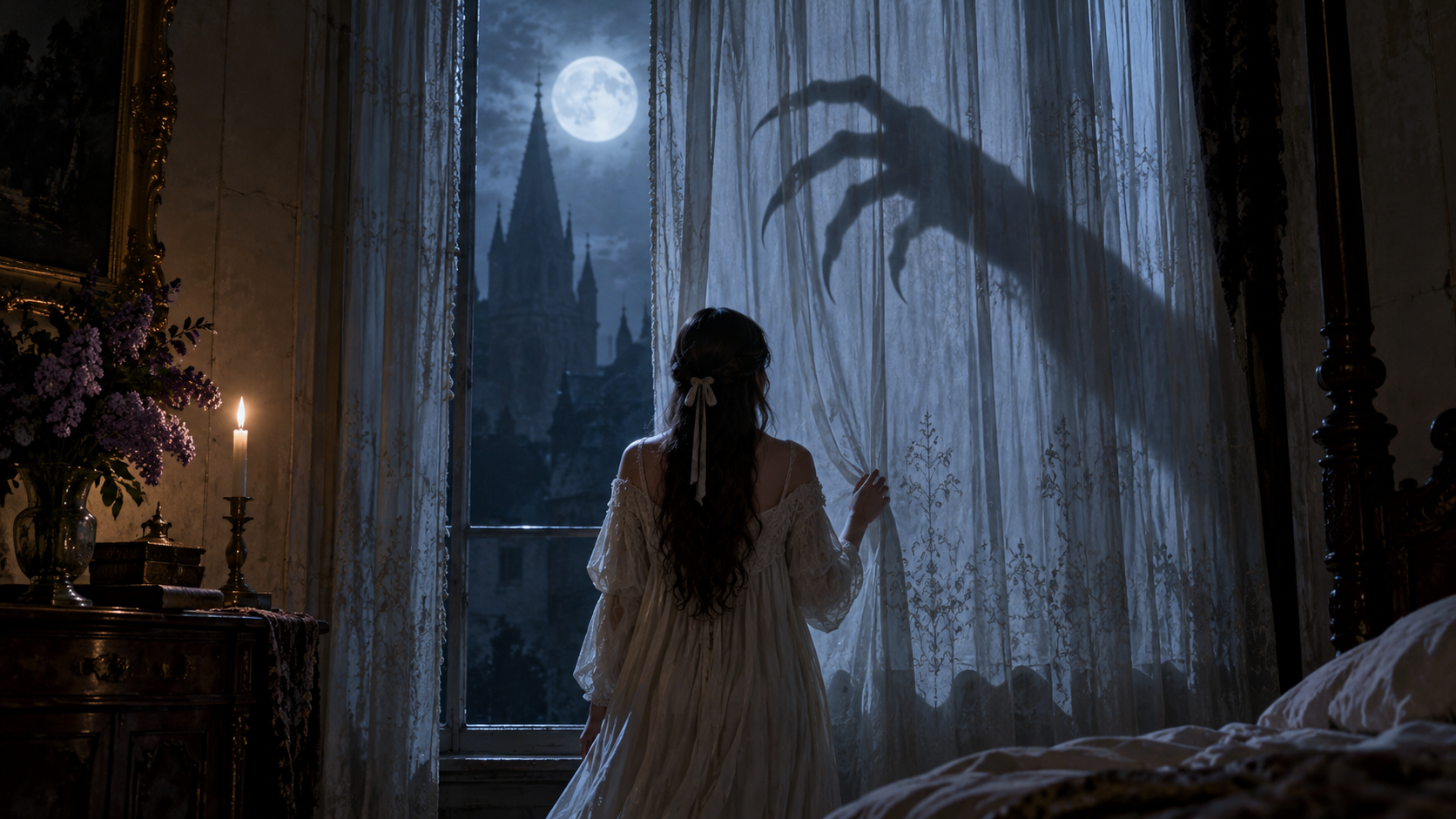
Ellen Hutter wants a life with her husband, Thomas, but an older connection keeps entering her dreams. When Thomas accepts a commission from a distant aristocrat, the opportunity promises the financial security their marriage needs. Ellen experiences his departure as something far more dangerous. Robert Eggers’ Nosferatu, released in 2024, builds its horror around the gap between those understandings: a husband sees a difficult journey towards prosperity, while his wife recognises the return of a presence she has never fully escaped. The vampire story moves between an isolated castle and a German town, connecting private fear with a threat that will reach far beyond one bedroom. Its ending depends on understanding both the creature’s appetite and Ellen’s unusual relationship with it.
Ellen’s Appeal Receives an Answer
The film begins with a younger Ellen calling out for companionship. A supernatural presence answers, and the encounter creates a bond that later returns through dreams, seizures and experiences she cannot comfortably place within ordinary life. Her loneliness provides an opening, but the being that responds is capable of vastly more power than she understands.
That beginning changes the familiar idea of a monster arriving from outside a settled household. Ellen’s marriage does not precede all contact with the threat. She brings an unresolved history into it, and her present happiness exists beside something Thomas has not experienced with her.
The distinction is important when judging her responsibility. A vulnerable person’s appeal for comfort cannot reasonably amount to informed agreement to every subsequent demand. Orlok will treat the earlier bond as an entitlement, turning a moment of need into a continuing claim over her body and life.
Eggers makes that claim both supernatural and intimate. Ellen feels the presence through her body, so the danger cannot be kept safely at the level of an idea. Her experiences disrupt the boundary between dreaming and waking, private desire and external intrusion. Other people can witness the disturbance without understanding the relationship behind it.
Thomas offers another form of attachment. Their marriage is a possible ordinary future, with material worries, affection and plans. The contrast does not require their relationship to be flawless. Its value lies partly in its human scale: a shared household can be negotiated and lived in, while Orlok’s claim seeks to consume the terms on which Ellen exists.
The opening therefore establishes more than a supernatural backstory. It explains why the later conflict cannot be resolved simply by persuading Ellen that the vampire is unpleasant. She already suffers from his presence. What she lacks is a way to end a connection that he insists is permanent.
Thomas Follows the Promise of Advancement
In Wisborg, Thomas works for Herr Knock, who sends him to Transylvania to complete a property transaction with Count Orlok. Thomas wants to prove himself and improve the couple’s circumstances. Ellen fears the journey, but he accepts the assignment.
The practical motive makes his departure more painful than an arbitrary horror-film mistake. He is leaving because he believes work will help their marriage. The activity that appears to serve the household carries him towards the force threatening it.
Knock’s role places the transaction inside a network of obedience. Thomas initially encounters the Count through familiar professional arrangements: an employer, a client, documents and a valuable commission. Those arrangements lend the journey an appearance of legitimacy before he has any basis for assessing the client himself.
The destination gradually removes that reassurance. Local warnings and the unfamiliar customs surrounding death suggest that Thomas has entered a place whose inhabitants recognise dangers his professional instructions cannot explain. He remains committed to the task partly because returning without completing it would mean admitting that the opportunity was a mistake.
At the castle, hospitality becomes confinement. The Count controls the surroundings, the timing and the conversation. Thomas’s attempt to behave as a competent visitor leaves him dependent on a host whose rules are obscure and whose interest extends beyond the sale.
The imbalance is visible even before its full nature is explained. A property agent normally mediates between a buyer and a transaction. Here, the supposed intermediary becomes another object being moved. The paperwork gives Thomas a role while concealing how little authority he has over what that role will accomplish.
Orlok’s interest in Ellen’s likeness and personal connection draws the distant castle back towards the marriage. The journey has not taken Thomas away from the domestic story. It has brought him to another participant in it, one who understands the purpose of the meeting more fully than he does.
The Castle Turns Business Into Captivity
Orlok’s nocturnal behaviour, Thomas’s physical deterioration and the discovery of the Count’s resting place reveal that the host is a vampire. Thomas encounters a body associated with death that nevertheless exerts an active, predatory will. His professional problem becomes an immediate struggle to leave alive.
The creature’s interest in blood converts a guest’s vulnerability into a resource. Thomas has travelled to exchange documents and secure a future; Orlok treats him as something available to be used. Even the polite framework of their meeting becomes grotesque once the host’s appetite is understood.
Thomas’s escape requires abandoning the confidence that brought him there. The commission cannot be completed in a way that leaves the danger neatly behind. He eventually gets away and receives help from religious women, but escaping the building does not prevent the Count’s journey towards Ellen.
This reversal limits the conventional rescue narrative. Thomas can recognise the monster, suffer because of it and act bravely without gaining the power to stop it. Knowing that a danger exists is only one stage in confronting it. He still lacks the method that would make that knowledge effective.
The castle also gives material form to the age of Orlok’s claim. Its isolation, decay and ritualised routines suggest a world that continues by consuming life from outside itself. The Count’s aristocratic position does not soften his predation; it gives him a vocabulary of possession through which to express it.
There is little comfort in treating him as a misunderstood romantic figure. He can desire Ellen intensely while remaining indifferent to the destruction required to reach her. The film makes obsession compelling as an image without requiring us to confuse its intensity with care.
Thomas returns from the journey with a different understanding of the opportunity he accepted. His wish to provide for Ellen has been exploited. That failure makes his later determination understandable, but it also encourages him to seek a direct confrontation in which physical action might repair what the transaction enabled.
Ellen’s Distress Exceeds the Available Explanations
While Thomas is away, Ellen stays with Friedrich and Anna Harding. Her worsening condition unsettles the household. Dr Wilhelm Sievers examines her and eventually consults his former mentor, Professor Albin Eberhart von Franz, whose interest in the occult makes him an unconventional source of help.
The men around Ellen possess different kinds of authority, but authority does not guarantee that they understand what she is describing. Her distress can be treated as a bodily malfunction, an embarrassment or a threat to domestic order. Each interpretation influences what she is allowed to say and what other people are prepared to hear.
Anna’s companionship supplies something those competing explanations cannot: proximity without immediate mastery. Ellen’s experiences unfold within a relationship between women, rather than exclusively as a problem passed between male experts. That relationship gives the later danger an emotional reach beyond the marriage.
Friedrich’s confidence represents the security of someone accustomed to a comprehensible world. A house, a family and an established social position should make events manageable. Ellen’s condition threatens that confidence because it cannot be reduced to a problem he can settle by insisting on ordinary explanations.
Von Franz takes her connection to Orlok seriously. His willingness to recognise the supernatural makes him useful, but the film does not turn him into an all-knowing rescuer. He must still interpret the situation and confront the cost of the method that becomes available.
The question of whether evil comes from within Ellen or reaches her from outside should not be treated as a simple diagnostic puzzle. The film gives Orlok an independent presence and consequences witnessed by others. Ellen’s shame concerns how she understands her connection to him; it does not establish that she has imagined the entire threat.
Her body becomes the place where other people’s explanations compete. What makes her increasingly important is her ability to connect those experiences to knowledge. She understands aspects of the relationship that cannot be acquired by observing her from a position of professional or marital authority.
Orlok Brings a Private Claim Into the Town
Orlok travels by sea with the rats and disease associated with his presence. The voyage brings death to the crew before the ship reaches Wisborg. His arrival expands the scale of the danger from the Hutters’ marriage to the surrounding population.
The plague gives visible social consequences to the vampire’s appetite. People who know nothing about Ellen’s earlier contact with him become vulnerable to the same arrival. The town is drawn into a relationship it never consented to join.
This is why describing Nosferatu only as a love triangle misses so much. The Count’s demand is enforced through harm to others. His desire reorganises public life around suffering, making private possession inseparable from collective destruction.
The property transaction also reaches its intended destination. A place inside the town becomes available to him through the ordinary systems Thomas helped navigate. The supernatural intruder does not remain outside modern social arrangements; he uses ownership, employment and service to establish himself within them.
Knock’s devotion illustrates the attraction of proximity to overwhelming power. He serves a master whose favour promises meaning or reward, while the audience can see how little reciprocal loyalty the relationship contains. He interprets service as a route towards privilege in a system built around one appetite.
Vampire stories often make a community vulnerable through the connections that normally sustain it. In ’Salem’s Lot, neighbours and familiar places become routes through which the threat spreads. Nosferatu concentrates that process around a much older claim, then allows its consequences to contaminate an entire town.
The spreading deaths also narrow Ellen’s options. Remaining apart from Orlok no longer appears to protect the people around her. He turns their lives into pressure on her decision, creating a situation in which refusal and surrender both seem capable of producing catastrophe.
The Count Demands a New Pledge
Orlok tells Ellen that she must renew her bond with him, giving her three nights and threatening the people she loves. He wants her participation in the fulfilment of the claim, even while constructing conditions that make a free decision impossible.
That apparent contradiction is central to his behaviour. He insists that her willingness matters, but he uses terror to obtain it. The demand reveals an interest in domination that physical access alone cannot satisfy. He wants her to recognise his entitlement.
The film can therefore depict attraction, shame and desire without treating coercion as romance. Ellen’s responses to him are complicated, but complexity does not remove the threat. His power to injure other people remains part of every encounter.
Thomas’s return cannot simply close the connection. He is confronted by a history that existed before he knew Ellen and by experiences that he cannot fully share. His desire to protect her is genuine, yet protection becomes difficult when it requires accepting knowledge that unsettles his understanding of their marriage.
Ellen’s insistence on intimacy with Thomas challenges the Count’s claim over her. Within the film’s troubling sexual imagery, the marriage remains a relationship she actively wants. Orlok’s presence does not cancel that desire or reveal it to have been false.
The pressure becomes devastating when Orlok kills Anna and her children. Friedrich’s subsequent collapse and death beside his wife show how the vampire destroys entire attachments, rather than merely removing individual obstacles. The household that had represented stability becomes another site of grief.
These deaths establish the seriousness of the Count’s threat, but they should not be converted into blame directed at Ellen. He chooses to kill. Her inability to prevent a powerful aggressor’s actions does not transfer authorship of those actions to her. The story’s emotional cruelty comes from forcing her to feel responsible for consequences he deliberately creates.
Ellen and Von Franz Recognise the Available Strategy
The means of defeating Orlok depends on keeping him occupied until sunrise. Ellen’s particular hold over his attention makes that possible. She must invite him to feed and prevent his appetite from giving way to the instinct to retreat before daylight.
Sunlight is the destructive condition; Ellen’s action supplies the means of bringing him into it. This distinction explains why merely knowing that dawn is dangerous to him does not solve the problem. A creature capable of seeking shelter can avoid a predictable sunrise unless something holds him elsewhere.
Von Franz understands what Ellen intends. He takes Thomas and Sievers towards Orlok’s resting place, allowing them to pursue what appears to be the direct solution. The expedition also keeps Thomas away from Ellen at the moment when he would try to stop her.
This arrangement makes von Franz morally uncomfortable. He recognises her agency more readily than the other men, yet he also participates in a deception that permits her death. His usefulness does not remove the sorrow or ethical difficulty of what he helps bring about.
Thomas’s opposition would be understandable. Loving Ellen gives him every reason to reject a strategy that requires losing her. However, the film positions his wish to rescue her beside her knowledge of what the Count can be made to do. Their purposes align in wanting Orlok destroyed, while their acceptable costs differ.
Ellen’s choice is powerful because she acts with understanding in a situation that previously overwhelmed her. It is tragic because the available field of action remains brutally narrow. Calling the decision empowering should not make the sacrifice sound desirable or imply that death is the ideal expression of her freedom.
The strategy turns Orlok’s defining quality against him. His appetite has enabled him to dominate others, but it also creates a concentration of attention that Ellen can exploit. She does not become physically stronger than the vampire. She understands the desire that prevents him from protecting himself.
What Happens at the End of Nosferatu?
Ellen keeps Orlok feeding until dawn, and the sunlight destroys him. She also dies from the loss of blood. Thomas returns too late to save her, while von Franz identifies her sacrifice as the act that has ended the vampire’s threat to Wisborg.
The men’s parallel expedition reaches the coffin, where Knock has taken the place of the master he served. Killing the servant cannot achieve the rescue Thomas expects. When Thomas realises that Ellen has been left to face Orlok, he rushes back as von Franz destroys the vampire’s refuge.
In the bedroom, Ellen’s invitation appears to fulfil Orlok’s demand. That appearance is necessary to her strategy. She holds him within the encounter until the passing night becomes the force he cannot overcome.
His death is therefore neither a spontaneous change of heart nor proof that their bond was harmless. He is defeated because his appetite makes him fail to respond to an approaching limit. The same fixation through which he controls Ellen leaves him vulnerable to her timing.
Thomas’s arrival preserves the emotional relationship at the centre of the loss. He reaches Ellen, but reaching her is no longer equivalent to rescuing her. The tragedy refuses the comforting assumption that devotion will always arrive in time to undo a necessary action.
The final arrangement of Ellen and Orlok’s bodies connects beauty, decay and death. Eggers has described the image in relation to the artistic motif of Death and the Maiden. Its stillness makes the result disturbing in a different way from the preceding threat: the movement has stopped, but the bodies remain entangled.
That image does not require a single romantic interpretation. It can hold victory, violation, intimacy and exhaustion together. Orlok’s destruction ends his claim in practical terms, while the physical composition refuses to separate Ellen neatly from the price of defeating him.
Why Ellen’s Victory Is Still a Tragedy
Nosferatu gives Ellen decisive knowledge after repeatedly showing others interpret her from outside. She understands the connection, recognises its vulnerability and chooses the action that ends it. The progression makes her the central agent of the resolution rather than an object waiting for the men’s expedition to succeed.
Yet the film also leaves a difficult question about the possibilities it grants her. Her importance culminates in self-sacrifice. That can feel like an elevation of her courage and a continuation of the conditions that make women responsible for absorbing the costs of other people’s violence.
Both readings have support in the outcome. The strongest account does not erase one to protect the other. Ellen makes a purposeful decision, and the world of the film fails to offer her a survivable route to the same result. Her agency operates within a tragedy rather than cancelling it.
The Count’s destruction also exposes the emptiness of his promised union. His version of togetherness consumes the person he wants. Ellen can only turn that demand towards a different purpose by allowing it to approach its fatal completion, then keeping him there beyond the point his own body can endure.
Nosferatu ends with daylight returning to a town that cannot repay its rescuer. Ellen has stopped the being that claimed her, but Thomas must live with the absence left by that success. The final image holds those consequences in one place: a monster reduced to a corpse, a woman whose knowledge became action, and a victory that arrives without the shared future she wanted.
The final image also changes the significance of looking. Throughout the film, Ellen is examined by people trying to decide what her distress means. Medical attention, domestic concern and occult interpretation each place her within someone else’s account. At the end, the audience confronts the physical cost of the decision those accounts could not make for her. The composition holds attraction and repulsion together without allowing either to erase her death. Its stillness is unsettling because the narrative has stopped moving while the questions about her freedom, responsibility and treatment by others remain active.
Sources
Nosferatu — Focus Features: official film identity, credits and premise.
Nosferatu — The Movie Spoiler: plot sequence and the parallel actions in the finale.
Nosferatu Ending Explained — GamesRadar+: independent ending corroboration.
Robert Eggers and Lily-Rose Depp Discuss Nosferatu’s Ending — SYFY: creator commentary on the final image and Ellen’s sacrifice.
Nosferatu (2024 Film) — Wikipedia: supplementary plot and credit cross-checks.
