The Missing Children and the Search for Answers
A Classroom Disappears, Leaving One Child Behind
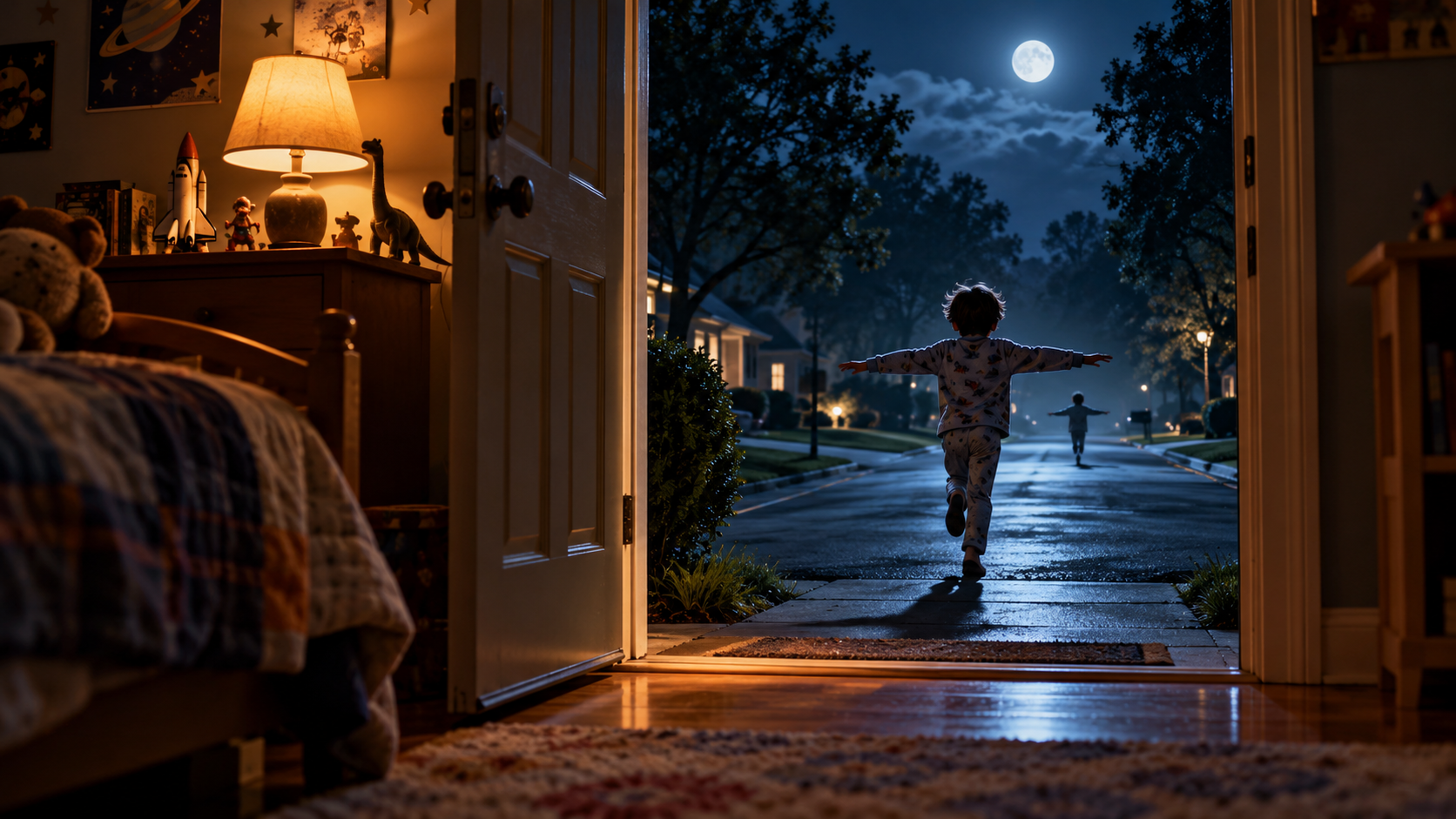
Seventeen children leave their homes in the middle of the night, running into the darkness with their arms outstretched. All belong to the same class. One pupil remains, and the adults around him cannot agree on what his survival means. In Zach Cregger’s 2025 horror film Weapons, that unexplained absence turns a school into a gathering place for grief, accusation and increasingly desperate investigation. Teacher Justine Gandy wants to understand what happened to her pupils, while one father becomes convinced that understanding requires someone to blame. The mystery develops through overlapping lives, gradually revealing how apparently disconnected encounters belong to the same catastrophe. Its most unsettling question concerns the child everyone can still see, yet nobody properly understands.
The Teacher Becomes the Town’s Explanation
At 2.17 a.m., seventeen pupils from Justine’s class vanish from their homes in Maybrook. Alex Lilly is the sole exception. The departure is synchronised, but there is no obvious adult escort and no explanation that makes ordinary sense of the children’s behaviour.
That shared classroom gives the community a place to concentrate its fear. Justine becomes the most visible connection between the missing children, and parents start treating the connection as evidence of responsibility. The school meeting establishes the emotional imbalance: she is expected to produce an answer because the people demanding it cannot bear another person admitting ignorance.
There is a practical reason to investigate the teacher. She knows the children and occupies a common position in their lives. However, the town quickly moves beyond investigation into punishment. Threatening calls and vandalism turn her own home and movements into extensions of the crisis. She loses the ordinary protection of being recognised as a concerned adult.
Justine is also an imperfect person. Her drinking, unstable boundaries and involvement with a married former partner make it easy for others to construct an unflattering portrait. Cregger lets those weaknesses remain visible without making them a solution to the disappearance. Being capable of a bad decision does not make someone responsible for every terrible event nearby.
The resulting tension is more interesting than a straightforward story about an innocent saint persecuted by a mob. Justine can be professionally questionable and genuinely worried about Alex. She can make a situation worse while still identifying something that needs attention. The film asks the audience to evaluate her observations separately from its judgement of her character.
Her suspension leaves her in a particularly difficult position. She still feels responsible for the children but no longer possesses an accepted role through which to act. Following Alex looks intrusive, especially after she has been told to stop. Yet withdrawing entirely would leave the one surviving pupil inside a home that gives her increasing cause for concern.
The classroom is particularly effective as the origin of the mystery because it is a system built around knowing where children are. Registers, assigned places and familiar routines turn absence into something measurable. Seventeen missing pupils should produce a clear administrative fact, yet that fact offers almost no explanation. The school can establish who failed to arrive without explaining why they left home together. That gap between a precise record and an incomprehensible event helps explain the town’s desperation to find a person it can blame. Justine is visible within the system; the force exploiting it is not.
Alex’s House Offers No Reassurance
Justine’s visits to the Lilly home produce a disturbing mismatch between appearance and behaviour. Alex says that things are all right, while his parents sit unnaturally still. The house has the outline of a functioning household without the responses that would normally make it reassuring.
Alex’s resistance to questioning initially makes him difficult to read. A child repeatedly approached by an adult might understandably want to be left alone. Equally, reassurance offered under pressure can conceal a situation the child cannot safely describe. The film holds those possibilities together before showing the circumstances behind his silence.
This is one reason the school connection is so misleading. The adults keep looking outward from the classroom for a single event that affected all the children. Alex directs attention towards an individual household, where the routines of care have become strange. He is available to be interviewed, but availability does not mean freedom to speak.
The horror also depends on the limited usefulness of looking through a window. Justine can see enough to recognise that something is wrong, but seeing seated adults does not tell her what has happened to them. The image denies her both ordinary reassurance and an immediately persuasive accusation.
In a different domestic mystery, The Others also makes a child’s account difficult for the adults around them to interpret. Here, however, the central obstacle is the pressure surrounding Alex’s ability to disclose his circumstances. His behaviour is a response to the household’s danger, not simply a clue waiting to be decoded by someone clever enough.
Principal Marcus Miller occupies the uncomfortable space between concern and procedure. He has reasons to restrict Justine’s contact with a pupil, particularly after earlier boundary problems. The tragedy is that a rule capable of protecting children can also prevent a specific warning from receiving the attention it deserves. The film does not offer a tidy professional decision that would have made everything safe.
Archer Tries to Turn Grief Into a Map
Archer Graff, whose son Matthew has disappeared, watches the recording of his child leaving home. The camera supplies a concrete event: Matthew runs away. It cannot explain the intention behind that movement or tell his father what happens beyond the frame.
Archer’s repeated viewing expresses the frustration of possessing evidence without an answer. The recording is devastating because it preserves the last visible moment while refusing to extend it. He can study Matthew’s direction, posture and timing, but he cannot make the image return his son.
His anger finds an available target in Justine. He suspects her, confronts her and is revealed to have vandalised her car. His status as a grieving father explains the force of that hostility, but it does not turn the accusation into a reliable conclusion. He inflicts suffering on someone who is also trying to understand the loss.
Archer’s more useful work begins when he treats the departures as movements through space. He seeks footage from another affected household and compares the directions in which the children ran. Their routes can suggest a destination even when their motives remain inaccessible.
That change gives the investigation a necessary causal step. He does not solve the mystery merely by becoming more determined. He asks a different question of the available evidence. Instead of demanding that one recording reveal everything, he compares it with another and looks for a shared geographical relationship.
His nightmares belong to another register. The immense rifle marked with the departure time makes his fear visible, but a dream is not a map of the crime. It connects the image of a weapon with parental helplessness before the film supplies the literal explanation of its title.
The distinction between dream and investigation is useful throughout Weapons. Emotional images can tell us what the loss feels like without establishing how it happened. Archer’s feelings are real; the conclusions he draws from them still require testing. His progress depends on recognising evidence beyond the story his anger has already built.
Separate Lives Begin to Cross
Weapons shifts between characters rather than following one investigator continuously. Justine’s former partner Paul Morgan, a police officer, and James, a man whose attempts to steal bring him into dangerous places, initially appear to occupy different stories. Their encounters gradually reveal routes into the same hidden situation.
Paul’s authority does not make him a dependable centre of the film. His private behaviour and interactions with James complicate the assumption that the police officer will provide order. James, meanwhile, is not someone the town would instinctively recognise as a credible witness. The film distributes useful observations among people whose reputations encourage dismissal.
This structure changes the meaning of an interruption. What looks incidental during one person’s chapter can become the central event of another. The audience learns to wait before assigning a complete explanation to a brief appearance or unexplained absence.
The repeated movement through time also separates knowledge from moral worth. Someone can discover an important fact while doing something selfish. Someone trying to behave responsibly can miss what is happening. No character earns an unrestricted claim to truth merely by occupying the respectable side of a social division.
James’s entry into the Lilly house brings him into contact with the missing children. His discovery matters because the film’s answer is physically close to the community that has been searching for it. The children have not necessarily travelled into an impossibly distant realm. An ordinary address contains what the town cannot find.
The house therefore becomes a meeting point for several kinds of vulnerability. Justine is exposed by her isolation, Archer by his desperation, James by precarious circumstances and Paul by decisions that compromise his professional role. Their routes converge without requiring them to share a motive.
There is a cost to this construction. Delaying a central explanation can make the film feel as though it is withholding the answer more actively than its investigators are uncovering it. Its strongest justification is that each return changes who appears vulnerable, threatening or informed. The chapters work when they revise our understanding, rather than merely postponing a reveal.
A Familiar Adult Becomes Unrecognisable
The mystery turns openly supernatural when people begin acting with a violent purpose that cannot be explained by their ordinary relationships. Marcus attacks Justine, and Archer intervenes. Marcus is then killed by a vehicle during the pursuit.
This encounter gives Archer a reason to reconsider the situation he thought he understood. Justine is no longer simply the person he has decided to suspect. He sees her become the target of something immediate and inexplicable. The experience allows cooperation to replace confrontation.
Their alliance is practical rather than sentimental. They do not need to resolve every earlier injury before recognising that they require each other’s help. Archer has been pursuing patterns in the children’s movements; Justine has repeatedly noticed the strangeness of Alex’s home. Each holds information that becomes more useful beside the other’s.
Marcus’s transformation also establishes a new kind of threat. A recognisable person can become dangerous without announcing a change of allegiance. The body remains familiar while its behaviour serves another purpose. That makes identification a poor guarantee of safety.
For the audience, the violence forces a revision of genre expectations. A human criminal investigation might still explain the missing children, but it no longer explains all the evidence comfortably. Weapons has been teaching us to distinguish suspicious people from dangerous actions; now even that distinction becomes unstable when an action can be imposed on someone.
The film’s title begins to acquire a literal meaning. A weapon is something directed towards an end by another agent. Here, people themselves can be deprived of choice and made to perform that function. The horror lies partly in the damage done and partly in the separation between the person who acts and the person who decides.
What Alex Has Been Living With
Alex’s chapter finally reveals Aunt Gladys, an elderly relative who enters the Lilly household in poor health. Her apparent need for care becomes a means of taking control. Alex’s parents are placed under her influence, leaving him dependent on the person responsible for their condition.
Gladys tells him that obtaining items belonging to his classmates will help her. Alex takes their name tags, and she uses those personal connections in the ritual that summons the children. The disappearance follows from a specific act of coercion within the home, rather than a secret desire shared by seventeen pupils.
Alex’s involvement is therefore crucial without making him the villain. He is a child responding to an adult who controls his parents and the possibility of their recovery. His choices occur within a situation designed to make refusal feel catastrophic.
Gladys also turns the language of family assistance against him. An ill relative supposedly needs a favour; the child is asked to contribute to making things better. The request disguises exploitation as helpfulness. Once he has complied, the consequences make disclosure even more frightening.
Her restored vitality suggests that she draws sustenance from the people under her power. The film establishes this relationship through her condition and the victims’ deterioration, without supplying a complete supernatural biology. She is consuming something they need in order to remain fully themselves.
The relatives’ presence is especially cruel. Alex has not simply lost his parents; he must remain beside them while they no longer provide protection. The ordinary household reverses its responsibilities. A child manages adults who cannot care for him, while another adult uses that dependence to demand further obedience.
Gladys’s appearance contains grotesque comedy, but the mechanism of control is recognisable. She minimises danger, promises improvement and makes Alex responsible for solving a problem she has created. The supernatural premise intensifies that arrangement. It does not make the child’s constrained position difficult to understand.
How Gladys Turns People Into Weapons
Gladys’s magic uses personal material, branches from her small tree, blood and ritual actions. Hair can identify a target. A branch prepared and broken as part of the ritual directs an attack, while her bell is associated with control. The film gives these objects enough consistency for Alex’s eventual response to be intelligible.
It is useful to separate two effects. Gladys can hold people in a subdued state and draw on them, and she can send controlled people towards a person she wants harmed. The children’s disappearance and the later adult attacks belong to the same system of domination, but they do not perform precisely the same task.
The salt boundary inside the house supplies another restriction. Alex has been warned not to cross it. When he does, his parents become a direct threat to him. His attempt to move beyond the place assigned to him triggers the violence of the very adults who should make the home safe.
These mechanics explain why observation becomes valuable. Alex has spent time watching Gladys work. What looks like passive endurance also leaves him with knowledge of the objects and actions she relies on. That knowledge is partial, but it concerns a process he has seen produce results.
The film does not establish a universal handbook of witchcraft. It leaves Gladys’s origins, the full extent of her powers and the deeper significance of the time 2.17 unexplained. Giving that time a definitive occult meaning would add an answer the story does not supply. It functions clearly as the synchronised moment of the children’s departure.
The limits of the explanation are appropriate to Alex’s position. He needs to understand enough to act; he does not need access to centuries of supernatural history. His practical familiarity with the ritual matters more than a grand account of where its power began.
What Happens at the End of Weapons?
Alex turns Gladys’s magic against her, directing the seventeen children to attack her. They pursue and kill her, ending her control. Justine survives, Archer is released from the spell that has turned him against her, and the missing pupils can return to their families.
The rescue develops through two struggles inside the Lilly house. Justine and Archer encounter Paul and James under Gladys’s control, while Alex attempts to reach the room containing her ritual materials. Archer finds the children but is himself controlled, making his reunion with Matthew another opportunity for Gladys to use him.
Alex obtains a branch, uses his own blood and hair from Gladys’s wig, and reproduces the relevant ritual. His success follows from recognising that her power can target her as well as protect her. The children become the pursuing force, and Gladys’s confident command of the household collapses into flight.
The chase changes the emotional balance. The children’s outstretched running had initially expressed something terrifying because nobody understood its destination. Now their movement has a visible target, and the person responsible cannot stop them. An image of collective helplessness becomes an image of overwhelming retaliation.
However, the final narration refuses to make Gladys’s death a complete restoration. Alex’s parents require institutional care, and he goes to live with another aunt. The children return home, but their recovery is slow; the suggestion that some have only recently begun speaking makes the passage of time painfully clear.
Being released from an instruction is different from recovering everything that was taken. Archer’s brief possession ends quickly, while prolonged captivity leaves other victims profoundly affected. The film does not need to specify a precise supernatural medical rule for that contrast to carry emotional force.
Why the Rescue Leaves an Uneasy Feeling
Weapons gives its villain a decisive defeat while denying the town an uncomplicated happy ending. That combination prevents the final violence from settling every earlier question. Alex escapes the person controlling him, but he cannot simply resume the family life that existed before her arrival.
His victory also borrows the method of the threat. He saves the children by directing them, briefly, as Gladys has directed others. Within the emergency, this is the available means of resistance. It leaves the title attached to the rescue as well as the abuse, making the action more troubling than a conventional restoration of individual freedom.
The child narrator adds distance. The catastrophe has become a story someone can tell, with a beginning, an explanation and an aftermath. That structure supplies a kind of order the people inside the events did not possess. It also leaves room for uncertainty around what recovery will eventually mean.
Justine and Archer reach the house only after moving beyond their initial conflict. Yet the decisive action belongs to Alex, whose silence had allowed others to mistake him for a peripheral witness. The film finally gives him the role the adults’ investigations could not recognise: someone already living inside the answer.
Gladys’s defeat brings the missing children back into view, but the closing emphasis falls on the work of living afterwards. Weapons begins with a community demanding an explanation for an absence. It ends with an explanation that cannot erase the damage. Alex has gained safety through his own observation and courage, while the other children’s gradual return to speech makes recovery feel fragile, individual and unfinished.
Sources
Weapons — BBFC: film identity, director and release classification.
Weapons — The Movie Spoiler: plot sequence and ritual mechanics.
Weapons Ending Explained — Radio Times: independent corroboration of the climax and aftermath.
Weapons Ending Explained — Variety Australia: disappearance, personal objects and final narration; minor naming errors in this account were checked against other sources.
Weapons Ending Explained — NME: corroboration of Gladys’s role and the children’s fate.
