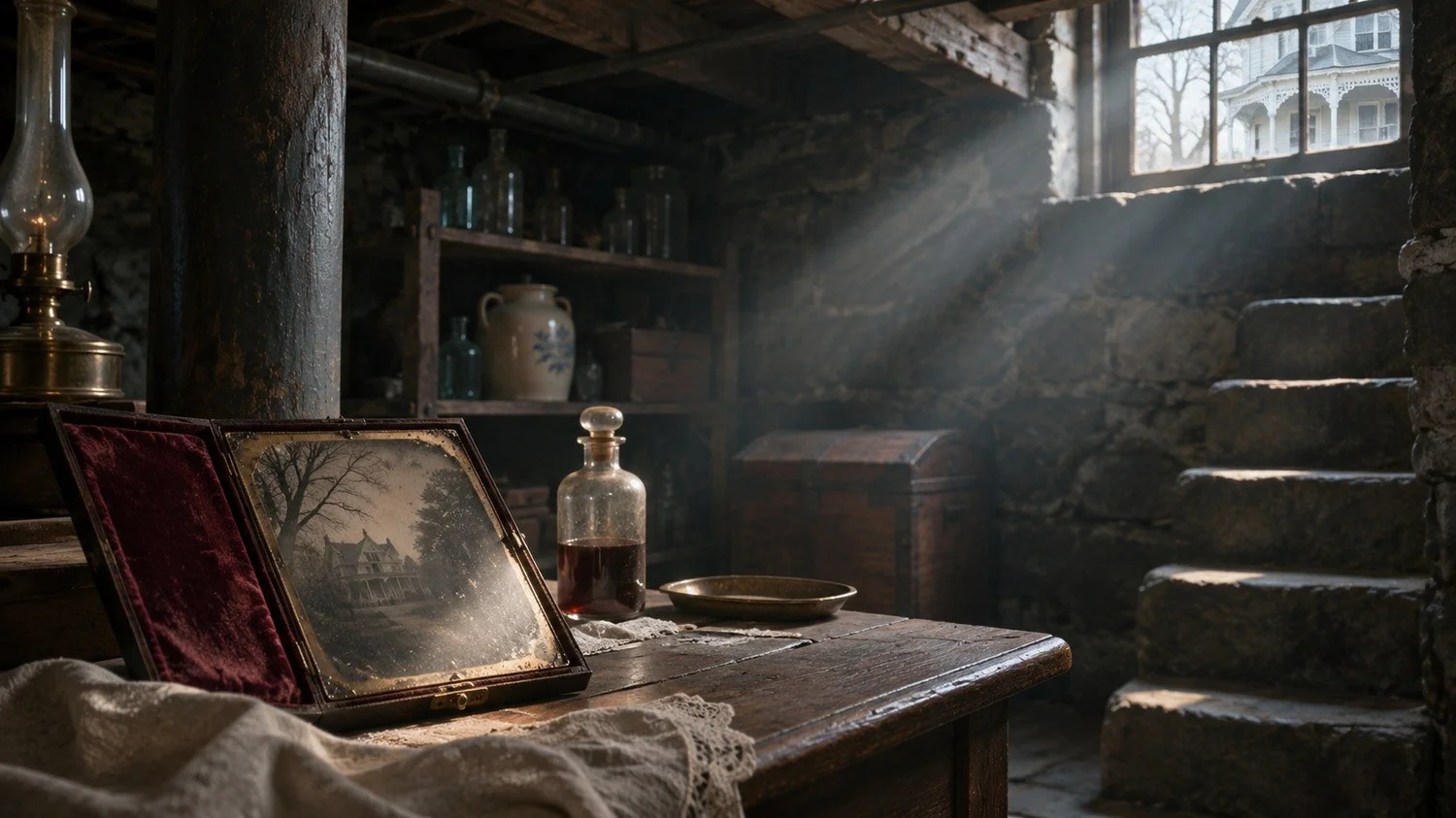
A Shorter Journey To Hospital Brings The Campbells To A Former Funeral Home.
The house in The Haunting in Connecticut has one extraordinary advantage before anyone opens the basement door. It is near the hospital. Sara Campbell has been driving her son Matt to and from cancer treatment, and every difficult mile afterwards makes a local rental look better. Peter Cornwell’s 2009 horror film begins with a decision an exhausted parent might easily make. A teenager who feels desperately sick needs somewhere to lie down. His mother finds him somewhere, and only gradually discovers what else she has brought within reach.
The film draws on claims made by the Snedeker family after they rented a former funeral home in Southington in 1986. The Campbells are fictional characters. Their story gives a precise answer to a question the real case leaves open. To see how the two became associated, it helps to follow Matt through the house first, then look at what was actually reported about the people who lived in Connecticut.
Spoilers follow for the entire 2009 film, including the final scene and the closing titles.
Why Sara Takes The House
A haunted-house story usually has to explain why people stay. This one begins by showing why they come. Sara can do little about the disease inside her son, but she can do something about the journey after treatment. Renting the house is a modest exercise of parental power in circumstances that have left her with very little. It means that admitting something is wrong with the house will cost her more than the bother of moving. She will have to give up one of the few ways she has found to help him.
The offer looks unusually attractive because the landlord is prepared to make concessions. Matt can rest immediately, and the rest of the family can follow. Sara learns enough about the building's former use to understand why it might put other tenants off. A former funeral business is an intelligible reason for a discount. On the information available to her, it is quite a leap from disliking what once happened in a building to deciding that a sick child will be safer spending hours in a car.
Matt chooses the basement. For the adults it is the part of the house most intimately associated with a trade people generally prefer to encounter behind closed doors. For a teenager living under constant medical and parental supervision it also offers privacy. There is a poignant practical difference between a hospital bed, where people are entitled to check on you, and a bedroom that you have chosen for yourself. The arrangement turns against Matt when it gives him experiences he must try to communicate to people sleeping elsewhere.
The partition and the locked room make that problem visible. The basement has apparently been offered to him as a domestic space, yet all the family has really done is put a bed on one side of an earlier workplace. A closed door can keep the physical remains of a business out of sight. It does very little to explain them once somebody has heard a sound or seen something on the other side. Matt is already learning how much of his new home belongs to other people's decisions.
Why Matt Hesitates To Describe The Visions
Matt sees an older man and bodies marked with strange signs. He has an excellent reason to keep at least some of what he experiences to himself. He is receiving an experimental treatment, and anything that looks like a serious adverse effect could jeopardise his place on it. When adults ask a child in his position how he feels, the answer can determine what they allow to happen next. A truthful description of what he saw might produce exactly the decision he most fears.
That makes him a particularly effective witness for this story. Viewers can take his terror seriously while understanding why Peter and Sara might take it for a consequence of his illness or treatment. The parents have seen what cancer is doing to him. They have considerable reason to distrust an explanation that would direct them away from the hospital. In another kind of film, their insistence on a medical explanation would be the act of love that kept a vulnerable child safe.
The treatment gives the adults a timetable against which every change in Matt is measured. Did he feel like this before the latest visit? Did anything unusual happen on the journey back? The house has a much longer history, and Matt does not yet know its dates. His task as a witness is to show that a change everybody can date to recent weeks may have a cause that was in place before he was born.
Matt meets the Reverend Nicholas Popescu through treatment. Nicholas knows something about the territory on both sides of the conversation. He understands being a patient, including what it means to have people worried about what you might say. His religious vocation also gives him a vocabulary in which an apparition can have a purpose. He encourages Matt to consider what a spirit might want. It is the first question in the film that treats the vision as a communication somebody might be struggling to make.
Nicholas's willingness to listen does not make every conclusion he draws reliable. In fact, it matters enormously that the film gives this generous quality to someone capable of making a mistake. He can help Matt think about his experience without knowing the history of the house. When his interpretation eventually acquires the force of action, the difference between those two things will matter to every person living there.
What The Photographs Show
The family find images of a young medium named Jonah taking part in séances. In one of the most memorable, a pale substance appears to issue from his mouth. The photograph looks like evidence of the impossible. Its immediate value to Matt is more personal. Another young man once occupied the centre of a room full of adults waiting for his body to do something extraordinary. Whatever the picture means, Matt can recognise the position Jonah has been put in.
The medium worked with Ramsey Aickman, who ran the funeral business and conducted séances. Those were distinct activities with a troubling practical connection. One put Aickman in a position of trust with the bodies of people whose relatives had left them in his care. The other offered him an audience prepared to believe that he possessed unusual access to the dead. Nothing in either arrangement gave the deceased or their families a say in how he might use that access.
The evidence the children uncover includes preserved eyelids. It is a much uglier discovery than a photograph. A photograph might have been staged to impress a paying audience. There is no similarly innocent reason for a collection of human tissue to be waiting among the relics of a family house. It forces the question away from whether people at a séance believed what they saw and towards what Aickman did when the audience went away.
Matt and Wendy's investigation gives the younger characters different kinds of work. Matt recognises things because he has seen them in terrifying flashes. Wendy can help look for connections that will make sense outside the basement. This matters in a household inclined to treat everything Matt reports as evidence about his health. Once the children have physical objects to examine, they can begin to ask questions about the adult who left them there.
The adults meanwhile have difficulties that the supernatural explanation cannot settle for them. Peter's struggles with alcohol strain the household. Sara has been holding together a family around appointments whose outcome she cannot control. Even the discovery that Matt has been frightened for good reason could not restore a parent's lost confidence in an instant. Cornwell lets that ordinary disorder continue alongside the ghost story. There is no single door the family can open that will make them well.
Why Removing The Remains Makes Things Worse
Nicholas concludes that Aickman tried to bind the dead to the property. The bodies and their markings belong to a system of control. An undertaker who should have helped families part with the people they loved instead kept them at his disposal. That reversal explains why the house's former occupation matters far more than its general air of age and decay. Aickman could interfere with the passage from death to burial because his customers had entrusted precisely that passage to him.
Nicholas discovers remains and takes them away. His decision follows an understandable line of reasoning. Something with a burned face has approached Matt. The family are increasingly frightened. Removing what seems to be the source of the disturbance ought to give them some peace. What he cannot yet distinguish is a frightening appearance from a hostile intention. Judging the intentions of the dead by the condition in which they died turns out to be a terrible error.
Afterwards the signs associated with Aickman's victims appear on Matt's skin. He is taken to hospital, a place that had always represented the family's best chance of bringing his body back under control. Now the physical signs carry one meaning for the medical professionals and another for the people who have looked at the old photographs. The fact that they can all see the injuries does not mean they agree about what has happened.
The past becomes clearer to Nicholas and Matt. A séance ended catastrophically, with the people attending it burned. Jonah tried to escape and became trapped in the crematory. The burned figure who frightened Matt bears the marks of his own death. For much of the film the audience has seen the aftermath of an injury as if it were a threat. Once the sequence is understood, it becomes possible to look at the same figure and see a boy who once needed help himself.
Jonah had been protecting the family. Removing his remains deprived them of that protection while leaving Aickman's other victims where they were. Nicholas tries to warn the Campbells. His original question about what a spirit wanted was better than his first answer. Jonah's persistence makes sense once Matt understands that leaving the house, even with his entire family safe beside him, would leave something unfinished inside it.
What Matt Finds In The Walls
The doctors tell the parents that treatment has failed to have the effect they hoped for. Matt leaves the hospital and returns home. He takes an axe to the walls and finds the bodies hidden behind them. All the time the Campbells have been trying to turn the property into an ordinary rental, those walls have been doing exactly what Aickman intended them to do. They have allowed people to go about their lives without seeing what happened to the dead.
The physical scale of the discovery changes the nature of the haunting. A single apparition suggested a single unresolved life. The bodies reveal a whole group whose expected burials have been stolen. People who should once have been mourned in public have spent years concealed in private. A conventional funeral makes an absence visible to a community. What Aickman did allowed the appearance of proper disposal to conceal the continued presence of the people themselves.
Matt gets Wendy and the younger children outside. Then he sets the bodies and the house alight. His actions are inseparable from Jonah's presence, and the film depicts their connection as something approaching possession. Yet what he accomplishes is the opposite of Aickman's project. Aickman wanted to retain power over people after their deaths. The fire ends his capacity to keep them there. What looks from the street like the destruction of a home looks very different from the point of view of the people held in its walls.
Fire also repeats the manner of Jonah's own death. The first fire left a terrified boy trapped in a chamber built for the dead. The second opens a way out. This does not make the earlier suffering necessary, or turn Matt into someone who planned the whole sequence independently. It gives the two boys a shared action in a story that has largely required them to endure what older people decide to do with their bodies.
Sara still wants her son back. While others try to revive him, Matt sees Jonah in a graveyard, now without the burns that made him look menacing. Sara's voice calls him back. Jonah can leave and Matt can return. That separation is important. The family's deliverance does not depend on substituting one dead boy for another. Jonah finally has an existence apart from the injuries Matt first saw, and Matt has the chance to live beyond the identity of a patient.
The closing titles say Matt's cancer subsequently disappeared and that the rebuilt house brought no further reports of haunting. This is how the film completes the Campbells' story. It also creates the greatest risk of confusion for viewers, because the typography of a factual update follows a climax involving a medium, a crematory and bodies concealed inside walls. A written statement at the end of a fictional drama still needs independent support before it can describe a real family's medical history.
What The Snedekers Reported In Connecticut
Allen and Carmen Snedeker rented a property in Southington in 1986 while their son was receiving treatment for cancer. The building had served as a funeral home. Those facts give the fiction its powerful starting point. There was a family in need of a convenient home, a child undergoing treatment and a property with a past that would unsettle many people even in broad daylight. They do not establish that anyone practising necromancy had ever lived there.
Family members described disturbing experiences in the house. Accounts attributed to Carmen include water changing colour while she cleaned and an overpowering smell. Members of the family reported apparitions, and the parents made allegations of sexual assaults by supernatural entities. These are claims made about experiences. Reporting them accurately includes identifying who made them and recognising that neither an apparition nor its alleged cause was independently demonstrated.
Paranormal investigators Ed and Lorraine Warren became involved, and horror writer Ray Garton worked on the 1992 book In a Dark Place. The book is important to the history of the story because it helped give a collection of claims a coherent narrative that other people could repeat. Garton subsequently described difficulties reconciling the interviews and acknowledged inventing material. That admission changes what the book can establish. A detail that appears consistently in later accounts may simply have been taken from the same published telling.
The distinction has consequences for real people. The screen family has different names and a meticulously resolved supernatural mystery. The people who later lived at the actual property had strangers taking photographs because of a film made about other occupants' claims. A convincing shot of hidden bodies can make a viewer curious about a real address, even though the shot supplies no evidence of bodies at that address. The property continued to be somebody's home after the credits rolled.
The film invents the machinery that makes its ending satisfying. Jonah's history explains his appearance. Aickman's methods explain the bodies. The removal of the wrong remains explains the escalation, and the fire releases the dead. No comparable chain of established events connects the Snedekers' tenancy to such a discovery. The most revealing change is therefore larger than a renamed family or an invented medium. Cornwell gives Matt a task he can finish. The real family left accounts whose differences cannot be resolved by breaking open one last wall.
Sources
- The Haunting in Connecticut
- The Real Story Behind 'The Haunting in Connecticut' | Live Science
- What really went down? We look at both sides of the 'Haunting'
