Could China Survive a Blockade? The Oil Routes Behind Its Superpower Ambitions
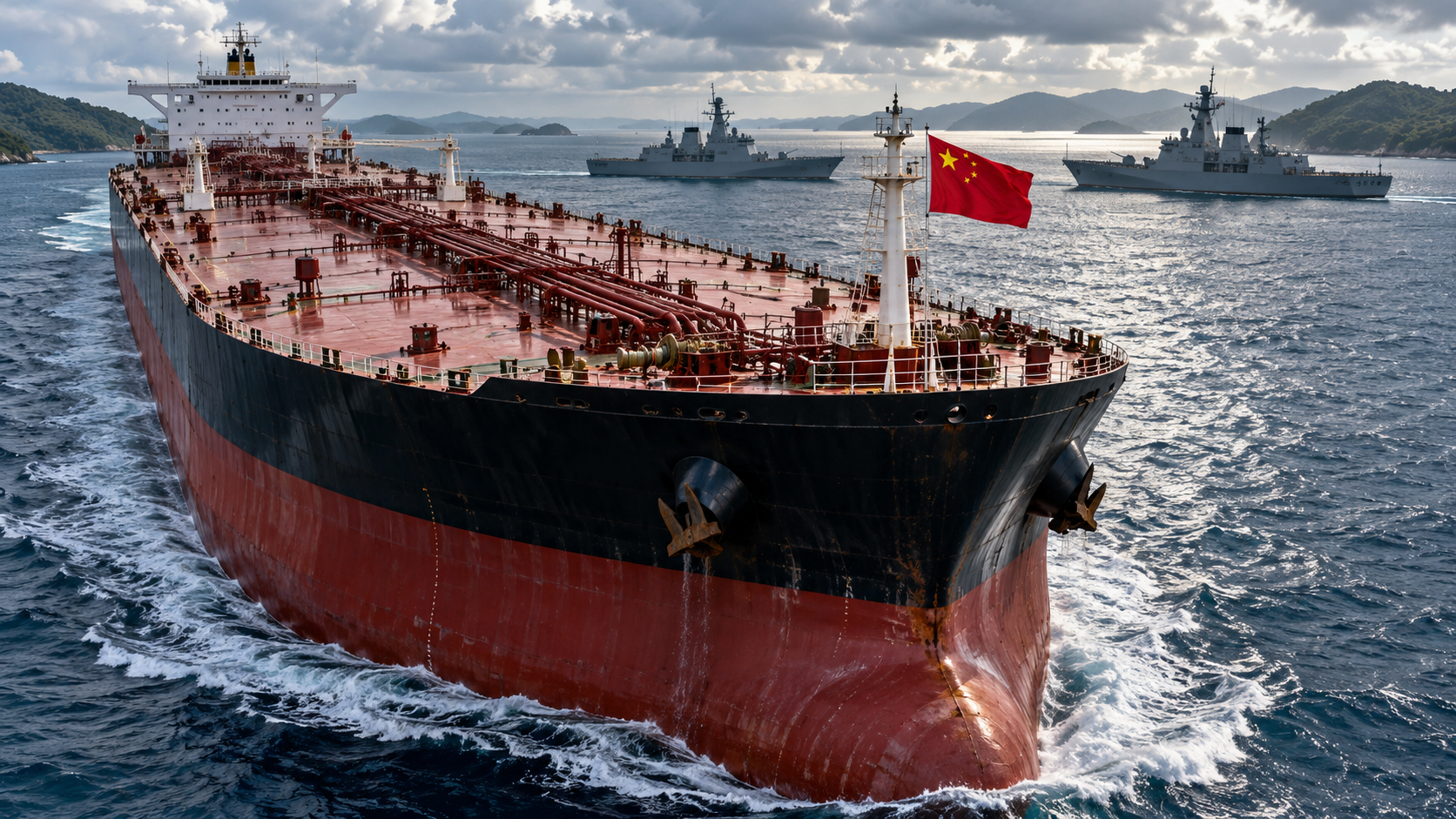
China’s Oil Lifeline: What a Blockade Could Really Do
Could America Cut Off China’s Oil?
Domestic energy, oil reserves and overland pipelines give Beijing time, but none can fully replace the maritime trade that sustains its economy.
China imported roughly 11.6 million barrels of crude oil a day in 2025. Each arriving cargo helped sustain an economy whose ambitions extend well beyond its coastline. The same trade exposes a constraint on Chinese power: much of the fuel must cross seas Beijing cannot assume it will always control.
Could China survive a blockade? It could probably absorb a short commercial interruption and keep essential services operating through a much longer emergency. A sustained military campaign that removed most seaborne oil imports would impose a different order of damage. China could ration, draw down stocks and protect selected activities. It could not preserve its normal economy indefinitely.
There is no credible public countdown to collapse. The answer depends on what is blocked, how much trade continues and what Beijing is prepared to sacrifice. A diverted tanker, an uninsured cargo and a ship intercepted by a navy represent different problems. Treating them as one obscures both China’s vulnerability and the difficulty of exploiting it.
China’s Oil Problem Is Bigger Than Its Electricity Problem
China’s dependence on imported oil is substantial, but it is often described too broadly. An oil interruption would not automatically switch off the country’s electricity. China generates power mainly from other sources, including coal, hydroelectricity, wind, solar and nuclear reactors.
That distinction matters for daily life and industrial resilience. Electric railways, charging stations and electrically powered factories do not directly require imported crude to operate. Their ability to keep working would depend on the wider power system, maintenance and supply chains, rather than simply the number of tankers entering port.
Oil performs other tasks that remain harder to replace. It supplies transport fuels and raw materials for chemicals. Aircraft, much heavy machinery and large parts of freight transport still depend on liquid fuels. A reliable electricity supply cannot instantly turn those machines into electric equipment.
China also produces significant oil itself. Its National Bureau of Statistics put 2025 crude production by enterprises within its reporting coverage at 216.05 million tonnes. Domestic production provides a continuing flow, unlike a reserve that shrinks as it is used. But imports remain much larger than that domestic base.
The strategic question is therefore about the gap between what China can supply and what it needs to maintain chosen activities. Keeping hospitals, food distribution and priority transport running is a less demanding task than sustaining normal travel, construction, manufacturing and exports together. Survival and prosperity require different amounts of fuel.
Malacca Matters, but It Is Not a Master Switch
The Strait of Malacca links the Indian Ocean with the waters leading towards East Asia. For many cargoes travelling from the Middle East to China, it offers the shortest practical passage. Concentrated traffic makes it commercially efficient and strategically conspicuous.
The US Energy Information Administration estimated that 23.2 million barrels of oil a day passed through Malacca during the first half of 2025. That was a global flow, not China’s consumption. China accounted for 48 per cent of the crude import volumes passing through the strait during that period.
Those figures describe exposure. They do not establish that closing Malacca would remove an equivalent share of China’s supply permanently. Ships can take other routes through or around the Indonesian archipelago, including the Lombok Strait. Suitability depends on vessel size, draught and the passage concerned.
A temporary closure would initially create delays and logistical disorder. Longer voyages would keep tankers occupied for more days, reducing the carrying capacity available from the same fleet. Freight charges could rise even if the oil ultimately arrived. Refiners might draw on inventories while waiting for replacement deliveries.
A military campaign aimed at China-bound cargoes would be different. A ship that avoided Malacca might still face interception elsewhere. The alternative route would solve the geographical obstruction without necessarily solving the political threat. Malacca is a useful shorthand for vulnerability, but the real issue is access across a much wider maritime system.
Hormuz Creates a Different Kind of Dependence
Oil loaded inside the Persian Gulf generally has to pass through the Strait of Hormuz before it can begin its journey towards Asia. Sailing around Indonesia cannot help a tanker that has not yet escaped the Gulf. Some producers have pipelines to alternative export terminals, but those routes cannot move every barrel normally shipped through Hormuz.
This is why supplier diversification and route diversification must be considered separately. Buying from several Gulf producers reduces dependence on any one government or oilfield. It may still leave the cargoes dependent on the same narrow exit.
Crude from Brazil, West Africa or Russia’s Pacific coast has a different geographical exposure. None offers a universally secure route, but each changes which interruption would matter. A portfolio that looks diverse when measured by national flags can remain concentrated when measured by waterways.
The uncertainty surrounding attacks on shipping near Hormuz also illustrates the importance of commercial confidence. Operators must decide whether crews and vessels can travel safely before every detail of an incident has been established.
China’s vulnerability to a Gulf crisis therefore differs from its vulnerability to a China-specific blockade. In the first case, other buyers also compete for replacement supply. In the second, oil might remain available internationally while access to Chinese ports becomes the central obstacle. The remedy for one would not necessarily work against the other.
Commercial Disruption Can Hurt Without a Naval Blockade
A shipping route can become commercially unattractive before it becomes physically impassable. Owners may suspend voyages, insurers may change terms and banks may refuse transactions. Charterers can face demands for higher compensation or different contractual protections.
These decisions can compound one another. A buyer may locate available crude but struggle to secure a tanker. A tanker may be available while its owner refuses the destination. A willing owner may still need payment arrangements and cover acceptable to lenders and counterparties.
The initial effect is often a price shock rather than a complete disappearance of supply. Large buyers with financial resources can bid for replacement cargoes, pay higher freight rates or use stocks while shipping patterns adjust. Smaller refiners with narrow margins may struggle much sooner.
China’s state companies and government have tools to support those adjustments. They can redirect purchasing, coordinate domestic distribution and accept costs that a private firm might reject. That capacity is meaningful, although absorbing losses does not create additional tankers or repair damaged infrastructure.
The dispute over conditions for passage through Hormuz shows why a political announcement alone cannot restore normal trade. Companies need workable rules and confidence that those rules will hold. Commercial recovery depends on repeated safe voyages, not simply a declaration that a route is open.
A Military Blockade Would Be an Escalation Against China
A blockade intended to prevent ships reaching Chinese ports would involve force, or a credible threat of force, against maritime access. It should not be treated as a more vigorous version of ordinary trade restrictions. It could bring the enforcing state into direct confrontation with Chinese forces.
The political objective would shape the operation. Stopping selected sanctioned cargoes, restricting military supplies and attempting to remove most oil imports are different undertakings. Each raises different questions about identification, enforcement, neutral shipping and the response to vessels that refuse instructions.
A campaign against oil access would also need sustained political cooperation. Ships may have owners, flags, crews, financiers and cargo interests from several countries. Governments that dislike Chinese policy might still resist interference with their commerce or reject the risks of a wider war.
International humanitarian law also constrains naval warfare. Civilian protection remains relevant, and a blockade does not create an unrestricted permission to attack merchant vessels. The legal status of any actual operation would depend on its circumstances and conduct, including its humanitarian consequences.
Nor would China remain passive. It could contest enforcement, protect selected shipping or retaliate in other domains. Those possibilities make predictions of a cheap, bloodless energy squeeze implausible. A blockade’s effectiveness cannot be assessed separately from the conflict it might provoke or expand.
Stockpiles Buy Time, but Public Estimates Are Incomplete
China has spent years building oil inventories. These stocks are among its strongest protections against a sudden interruption because the oil is already closer to where it will be processed and consumed. They allow decisions to be made over weeks rather than under pressure from the next delayed cargo.
The public numbers require caution. In a January 2026 analysis, Columbia University energy researcher Erica Downs cited an estimate of 1.206 billion barrels in onshore storage in early January. That was equivalent to about 104 days of net crude imports at the 2025 rate. It was a dated inventory estimate, not a verified statement of holdings today.
It also was not a promise that China could operate normally for 104 days with no imports. Total inventories include oil needed to keep commercial systems functioning. Some barrels may be less readily accessible, and the rate at which stocks can be withdrawn and distributed matters alongside their volume.
Storage capacity must also be distinguished from stored oil. An announced tank, a completed tank and a filled tank represent three different stages of preparedness. Adding the volume of every proposed facility to an estimate of existing reserves would produce a misleading total.
The remaining uncertainty cuts both ways. Outside observers may underestimate some stocks, but they may also overstate how much can be used quickly. A careful assessment treats reserves as a substantial buffer whose precise wartime usefulness cannot be established from public inventory estimates alone.
Why There Is No Honest Countdown to Collapse
The simplest calculation divides usable stocks by the daily shortfall. The difficulty is that both quantities would change during a crisis. Imports might continue through some routes, while rationing and falling economic activity would reduce consumption.
Consider an illustration rather than a forecast. If a country had 900 million usable barrels and a daily shortfall of nine million barrels, the arithmetic would give 100 days. If the shortfall fell to six million barrels, the same stock would cover 150 days. These are hypothetical inputs, not estimates of China’s available reserve or a predicted blockade.
Even that calculation leaves out distribution. Crude must reach a refinery capable of processing it, and finished fuels must reach users. A national balance can look manageable while a particular region or industry experiences shortages. Having oil somewhere within the country is not the same as delivering the right product everywhere.
Policy choices would alter the figures further. Restricting private driving might save petrol while leaving an urgent need for diesel or aviation fuel. Cutting refinery runs could conserve crude while reducing supplies of products that remain essential. Fuel categories cannot always be exchanged freely.
Economic contraction would also extend apparent endurance. If factories closed and freight volumes fell, less oil would be consumed. A reserve lasting longer under those conditions would demonstrate conservation through hardship. It would not show that the blockade had failed to damage the economy.
Russia Offers a Land Connection, Not Unlimited Replacement
Russia gives China access to oil and gas across their continental frontier. Direct pipeline deliveries avoid maritime passages entirely. That makes them strategically different from cargoes bought from the same country and delivered by tanker.
The distinction is often lost when total Russian exports are discussed. Oil loaded at a Pacific port bypasses Malacca, but it remains seaborne trade. It still needs a vessel, a safe voyage and a receiving terminal. Only the overland portion offers protection from a broad maritime interruption throughout its journey.
Existing pipelines also have finite capacity. Increasing deliveries requires available upstream production, pipeline space and compatible receiving infrastructure. A producer cannot necessarily divert output from one export system into another simply because its political priorities have changed.
Gas adds another source of resilience. Gazprom’s Power of Siberia agreement provides for annual deliveries of 38 billion cubic metres. Such supplies help diversify China’s energy system, but a gas pipeline is not an oil pipeline. More gas cannot immediately replace aviation fuel or the full range of petroleum feedstocks.
New continental connections could improve resilience over time. During a sudden emergency, however, operational infrastructure would matter far more than proposed projects. The relevant question would be how much additional energy could actually flow that month, rather than how much a future agreement might eventually promise.
Central Asia and Myanmar Reduce Different Risks
Connections through Central Asia give China additional access to oil and gas without a direct ocean voyage into its ports. They also distribute dependence across more suppliers and transit relationships. Their value is greater than a simple comparison with the largest tanker routes might suggest.
Yet diversification does not eliminate constraints. Each route depends on production, maintenance and political cooperation beyond China’s border. Spare capacity may already be limited by normal deliveries. A pipeline’s maximum rating should never be counted automatically as unused emergency supply.
Myanmar presents a particularly important distinction. Its oil pipeline allows crude landed on the Bay of Bengal coast to travel into south-western China. This bypasses Malacca, but the imported crude still has to reach Myanmar by sea. It is a route around one chokepoint rather than independence from maritime trade.
Its usefulness would therefore vary with the emergency. A Malacca closure could make the connection especially valuable. A wider campaign against tankers carrying oil ultimately destined for China could leave the maritime approach exposed. Security and operations within Myanmar would create another set of uncertainties.
Railways and roads offer flexibility for selected deliveries, but replacing tanker-scale oil flows would require an enormous transport effort. Track capacity, wagons, border procedures and competing freight would all matter. A line drawn across a map cannot establish that a route has the throughput needed to transform China’s national balance.
Electrification Is Reducing the Amount China Needs
China can improve security by changing demand as well as supply. An electric vehicle replaces recurring purchases of liquid fuel with electricity consumption. Where that electricity comes from domestic sources, part of the transport system becomes less exposed to imported oil.
The International Energy Agency estimated that China’s electric vehicle fleet displaced about one million barrels a day of oil demand in 2025. This is an estimate of oil use avoided compared with a counterfactual transport fleet. It is not a reserve that could be released during a crisis.
The distinction makes the benefit no less real. Avoided consumption reduces the volume that must be purchased, shipped and protected each day. Electric rail and the electrification of suitable commercial transport can make the same strategic contribution, although substitution varies greatly between activities.
The transition takes time because new sales are only part of the fleet. Existing petrol and diesel vehicles remain on roads for years. Aircraft, ships and industrial processes face different technical and economic constraints. Oil dependence can decline in some uses while remaining stubborn in others.
Electrification also creates infrastructure requirements of its own, including reliable grids and charging access. For blockade analysis, the key point is narrower: every activity already able to operate without petroleum gives Beijing more choices when allocating scarce liquid fuels. Those choices improve resilience without making the economy immune.
Rationing Would Decide Who Bears the Shortage
In a severe interruption, Beijing would have strong incentives to protect food supply, emergency services, essential freight and military operations. It could restrict discretionary consumption and redirect fuel through administrative decisions. The precise order of priorities would be a political choice, not an automatic technical outcome.
That would produce uneven effects. An essential operator might receive dependable allocations while a private business faced delays or closure. Civilian travel could be curtailed before the state exhausted its ability to move critical supplies. National endurance would conceal substantial differences between sectors and households.
Petrochemicals would complicate the allocation problem. Oil is used to make materials as well as transport fuels. Preserving deliveries to one refinery or plant could protect downstream production, while diverting the same barrels elsewhere might serve a more urgent immediate need.
There would also be a trade-off between using stocks now and preserving them against a longer conflict. Releasing oil rapidly could soften the initial shock but reduce later flexibility. Holding it back could conserve options while imposing greater economic pain early. Neither decision would be cost-free.
The effectiveness of rationing would depend on implementation. Authorities would need timely information about inventories, demand and transport bottlenecks. Hoarding, local incentives and uncertainty could undermine national plans. Strong administrative powers would help direct fuel, but successful allocation would still require a functioning logistical system.
The Countries Enforcing a Blockade Would Also Pay
China sits inside global manufacturing and trade networks. A conflict that severely disrupted its economy would affect customers, suppliers and financial markets elsewhere. The scale would depend on whether restrictions targeted oil alone or expanded into a broader maritime confrontation.
An oil-focused campaign would create uncertainty over the destination of cargoes and the willingness of firms to handle them. A wider interruption could also constrain Chinese exports. Other countries might then face missing components and higher costs alongside the energy effects of the conflict.
The oil-price outcome would not be straightforward. Falling Chinese demand could weaken prices, while threats to shipping or producing regions could push them higher. The balance would depend on how the conflict developed. Assuming a single, predictable market response would be unsafe.
Coalition politics would become part of the calculation. Governments would need to justify the purpose, duration and domestic cost of enforcement. Exporters might resist losing customers. Importers might fear retaliatory restrictions or disruption to other trade. Military capability alone would not settle those decisions.
This does not mean economic interdependence would prevent a blockade. States can accept large losses for objectives they consider vital. It does mean that the strategy would test the endurance of both sides. Pressure on China would have to be weighed against the cost of maintaining that pressure.
The Real Test Is How Much Normal Life Beijing Could Preserve
A brief commercial disruption would be a serious management problem for China, but one it has substantial tools to address. Longer voyages, replacement purchases and inventory releases could absorb part of the shock. Prices and individual businesses could suffer even while national supply remained adequate.
A prolonged loss of a particular supplier would be harder, especially for refiners dependent on its crude grades or discounts. But losing one supplier would still differ from losing access to most maritime imports. Other exporters and routes could remain available.
A sustained military blockade against China would combine the largest energy challenge with the danger of a much wider war. Domestic production, land pipelines and conservation would continue to matter. They would provide a basis for maintaining selected functions while the broader economy operated under growing strain.
There is no sound basis for promising either rapid Chinese surrender or effortless Chinese endurance. The decisive evidence in an actual crisis would be continuing import volumes, usable stocks, refinery output and the depth of consumption cuts. Political objectives would determine whether the resulting hardship changed Beijing’s decisions.
China’s next increment of security may arrive as a filled storage tank, a reliable pipeline delivery or a freight vehicle that no longer needs diesel. Each reduces what must cross the sea. None removes the final task: getting enough usable fuel to the people and industries Beijing chooses to keep running.
Sources
US Energy Information Administration — World Oil Transit Chokepoints — Malacca flows, alternative passages and the geography of oil-route dependence, using data through the first half of 2025.
Erica Downs, Columbia University Center on Global Energy Policy — Where China Gets Its Oil: Crude Imports in 2025 Reveal Stockpiling and Changing Fortunes of Certain Suppliers, Including Those Sanctioned — 29 January 2026. Import dependence, supply routes and the early-January inventory estimate; this is a historical baseline, not a current stock audit.
International Energy Agency — Global EV Outlook 2026: Executive Summary — Estimated oil demand displaced by China’s electric vehicle fleet and the role of electrification in energy security.
Next Reads
Iran Says Container Ship Has Sunk Near Hormuz: Could It Trigger a Wider War? — How uncertain maritime incidents can affect shipping confidence and escalation.
Iran Demands Control of Hormuz Before Ships Can Return — The political conditions that can complicate access to a strategic waterway.
Iran War Explained: What Led to It, What Has Happened, and Why Hormuz Could Decide What Comes Next — Background on the conflict’s maritime and energy dimensions, written in April 2026.
