US–Cuba: From Revolution And Nuclear Brinkmanship To Trump And Rubio — How 65 Years Of Hostility Led To Today’s Confrontation
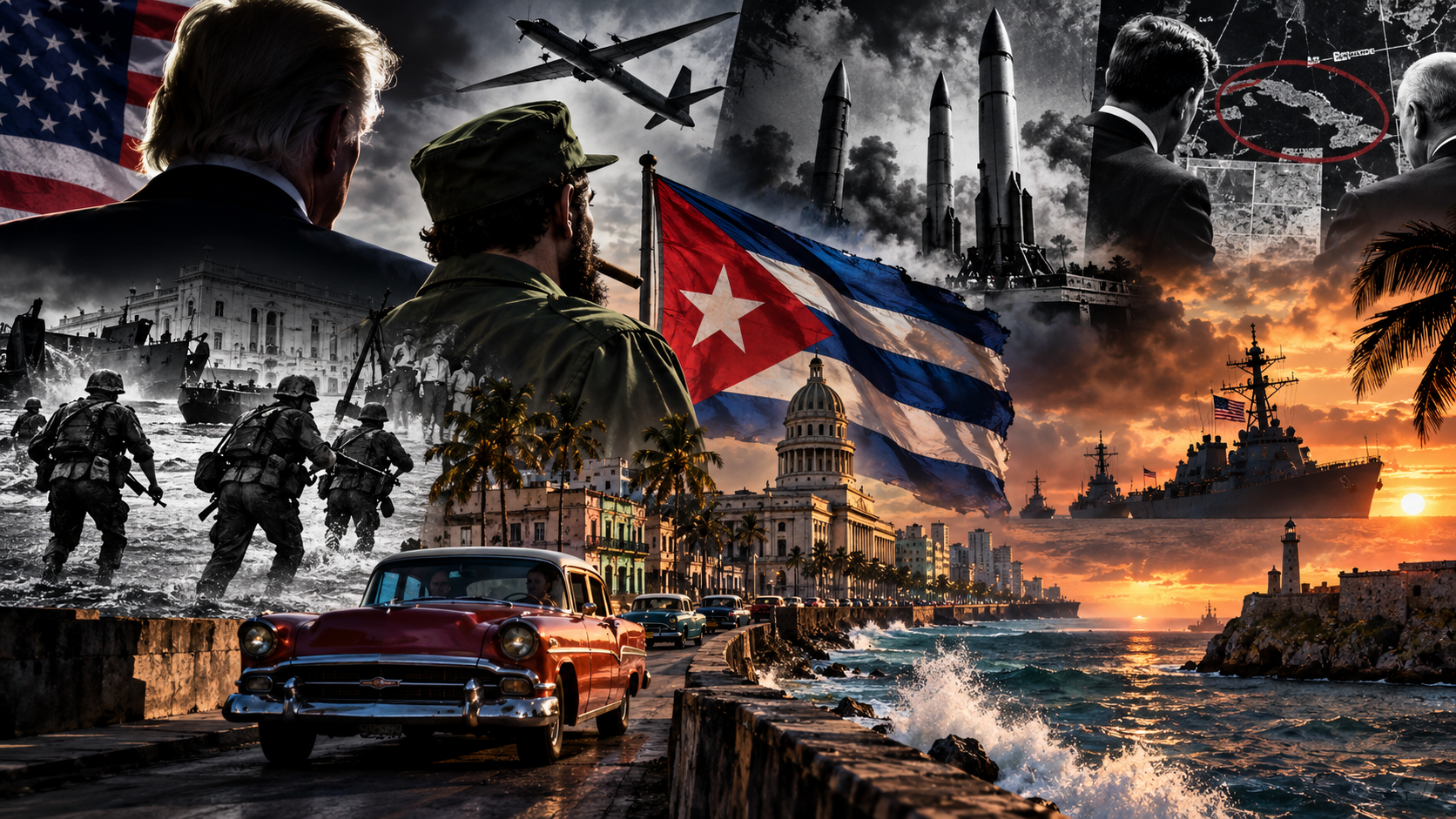
The 65-year confrontation between the United States and Cuba explained
The 90 Miles That Changed The World — How Cuba Took America To The Nuclear Brink And Why The Crisis Is Back
A revolution, a failed invasion, secret sabotage, nuclear missiles, six decades of sanctions and one extraordinary diplomatic thaw have brought Washington and Havana back to another moment of pressure — with Donald Trump predicting a deal and Marco Rubio warning Cuba that waiting him out could end badly.
Rubio’s Warning Has More Than Six Decades Behind It
Marco Rubio’s latest message to Havana sounds contemporary, but the history behind it is extraordinarily old. On September 28, 2026, the US secretary of state said Washington hoped Cuba would choose “a different path” and warned those who believed they could simply wait for Donald Trump’s administration to disappear that they could learn the lesson “the hard way”.
The warning arrives during one of the sharpest escalations in American economic pressure on Cuba in years. Trump’s January 29 executive order declared a national emergency over the Cuban government and created a mechanism allowing additional tariffs on imports from countries that directly or indirectly provide oil to Cuba. Further measures followed: a new sanctions framework in May expanded potential exposure for foreign companies and financial institutions supporting targeted Cuban sectors, while Washington sanctioned Cuba’s state oil company, CUPET, in June.
Trump has combined that pressure with strikingly different language about what might happen next. At the United Nations on September 22 he said “freedom will be coming to Cuba”, part of a broader declaration that the United States would reassert its power in the Western Hemisphere. Four days later, asked about possible military action, he predicted that Washington and Havana would make a deal and said: “I don’t think we’ll need the military.”
Those statements contain the central contradiction of the latest confrontation: extraordinary pressure paired with the possibility of negotiation.
But another contradiction is older.
The United States has regarded Cuba as strategically important for generations. Cubans have repeatedly resisted the idea that this strategic importance should give Washington a special claim over their country.
That collision — security against sovereignty, influence against nationalism, pressure against resistance — existed long before Fidel Castro walked into Havana.
Before Castro, Washington Already Believed Cuba Mattered
Look at a map and much of the story immediately makes sense.
Cuba stretches across the entrance to the Gulf of Mexico, positioned between Florida, the Yucatán Peninsula, the Caribbean and the Atlantic approaches to the United States. At their closest points, Cuba and Florida are separated by little more than 90 miles.
For a rising American power during the nineteenth century, an island that large, that close and that strategically positioned could never be politically insignificant.
Cuba remained a Spanish colony while much of Latin America broke from European rule. By the late nineteenth century, Cuban independence movements had repeatedly challenged Spanish authority, while American investors and politicians were becoming increasingly interested in the island’s sugar economy, trade and strategic location.
Then came 1898.
The explosion of the USS Maine in Havana harbour, amid an existing Cuban war for independence, helped propel the United States into war with Spain. Spain was defeated. Cuba did not simply move from Spanish rule into completely unrestricted independence, however. American forces occupied the island until 1902, and Washington made acceptance of the Platt Amendment a condition surrounding the new Cuban political order.
The amendment gave the United States a continuing right of intervention under specified circumstances. Agreements concluded soon afterwards also established the American naval presence at Guantánamo Bay. Although the intervention provisions were later abandoned under the 1934 Treaty of Relations, the Guantánamo arrangements survived.
Here was the contradiction in its earliest recognisable form.
From Washington’s perspective, American involvement was tied to stability, commerce and strategic security close to the US mainland.
From the perspective of Cuban nationalists, formal independence had arrived while extraordinary American influence remained embedded in the country’s political and economic life.
American capital became deeply intertwined with Cuba. Sugar, utilities, mining, infrastructure, tourism and banking connected the two economies. By the 1950s, US officials were discussing hundreds of millions of dollars of American private investment and a Cuban economy heavily dependent on sugar exports and access to the American market.
Havana meanwhile became internationally famous for hotels, casinos, nightlife and tourism. American visitors poured in. Organised crime figures also developed interests around casinos and entertainment, adding another layer to the image of pre-revolutionary Havana as a playground closely connected to the United States.
For some Cubans, that prosperity was real.
So was the resentment.
A country could be legally independent while still feeling economically subordinate. That distinction would matter enormously when one of the most consequential figures of the twentieth century emerged from the mountains of eastern Cuba.
Batista Offered Washington Stability — Until The System Collapsed Beneath Him
Fulgencio Batista had dominated Cuban politics in different forms for years before seizing power in a 1952 coup. His government became increasingly authoritarian, relying on censorship, repression and security forces while maintaining a broadly cooperative relationship with Washington.
American officials did not necessarily regard Batista’s political system as admirable. Internal US documents acknowledged that his government was dictatorial and doubted that it commanded majority support.
But they also regarded him as friendly to the United States, anti-communist, supportive of American interests and connected to an economic system in which major US investments were deeply embedded.
That mattered during the Cold War.
Yet Batista’s stability was increasingly deceptive.
Opposition expanded across Cuban society. Corruption, political exclusion, inequality and resentment towards the regime fed a revolutionary movement whose most recognisable figure became Fidel Castro.
After the failed attack on the Moncada Barracks in 1953, imprisonment and exile, Castro returned to Cuba aboard the Granma in 1956 with a small insurgent force. Survivors retreated into the Sierra Maestra mountains and built a guerrilla campaign that became both a military struggle and an enormously powerful political narrative.
The movement was not initially reducible to a simple Soviet communist project. It drew on Cuban nationalism, hostility to Batista, demands for political reform, social inequality, land redistribution and resentment of external influence.
That distinction is essential.
If the US–Cuba rupture is explained only as “Cuba became communist and America opposed communism”, the forces that made the revolution possible disappear from the story.
By 1958, even Washington understood Batista was in serious trouble. The United States halted combat-arms deliveries while the conflict intensified. Batista fled Cuba on January 1, 1959. Castro’s forces emerged victorious, and Washington formally recognised the new government within days.
The confrontation that followed was not inevitable on the morning Batista escaped.
But the conditions for it were already everywhere.
Castro Did Not Arrive In Washington As A Soviet Puppet
One of the easiest mistakes in retelling the Cuban Revolution is to start at the end.
Castro eventually created a communist state closely allied with Moscow. But Washington did not greet January 1959 already knowing exactly where the revolution would lead.
American diplomatic assessments from early 1959 reveal uncertainty. One State Department report described Castro as critical of the United States in specific respects but “not generally unfriendly”. US officials understood his anger over American support for Batista and believed relations could potentially stabilise.
Castro visited the United States in April 1959.
Yet the revolution was rapidly transforming Cuba’s social and economic structure.
Agrarian reform challenged large landholdings. Nationalisations affected American-owned property. Political power consolidated. Revolutionary tribunals and executions alarmed Washington. The government increasingly attacked what it regarded as American economic domination while strengthening relations with the Soviet bloc.
The economic confrontation accelerated dramatically.
American sugar interests worried about their Cuban properties. Washington debated how access to the US sugar market could be connected to compensation for expropriated American assets. Cuba moved towards greater state ownership while expanding trade with the Soviet Union.
Neither side saw this merely as a commercial disagreement.
For Castro, economic control was tied to the revolution’s claim that Cuba had finally achieved genuine sovereignty.
For Washington, uncompensated nationalisation, Soviet penetration and an increasingly anti-American government 90 miles from Florida were merging into a strategic threat.
By early 1960, the Eisenhower administration had moved from uncertainty towards covert action.
The psychological line had been crossed.
The Moment Washington Decided Castro Had To Go
In March 1960, President Dwight Eisenhower authorised a covert programme against Castro’s government.
The CIA began organising Cuban exiles into a force intended to overthrow the revolutionary regime.
The basic theory was seductive: Cubans hostile to Castro would land on the island, establish a foothold, trigger wider resistance and create political conditions in which the government could fall without an unmistakable American invasion.
Then John F. Kennedy won the presidency.
The operation became his inheritance.
By the time Kennedy entered the White House in January 1961, US diplomatic relations with Cuba had been severed. Planning for the exile invasion was already advanced. Kennedy was wary of openly deploying American forces but allowed the operation to continue.
The result was the Bay of Pigs.
On April 17, 1961, more than 1,000 Cuban exiles landed on Cuba’s southern coast. They expected to ignite a rebellion. Instead, Castro’s forces isolated them.
The invasion force was badly outmatched. Crucial assumptions collapsed. Local revolt did not materialise on the scale planners required. Air support became a political and operational disaster. Within days, the operation had failed and large numbers of the invaders had been captured.
Kennedy accepted public responsibility.
For Washington, it was a humiliation.
For Castro, it was transformative.
The United States had tried to remove him and failed. The revolution could now present itself not simply as a domestic political transformation but as a government that had defeated a US-backed invasion.
The psychological consequences were even larger than the military consequences.
Castro now had compelling evidence that Washington was prepared to remove him.
Washington now had a Cuban leader strengthened by surviving the attempt.
Moscow now had an ally with every reason to fear another invasion.
That triangular logic would take the world closer to nuclear war than almost anything before or since.
Operation Mongoose Turned Failure Into A Secret War
The Bay of Pigs did not persuade Washington to abandon the objective.
It intensified it.
Kennedy ordered a reassessment, and by late 1961 the United States had authorised a new covert programme: Operation Mongoose.
Its scope was extraordinary.
Official US historical records describe plans involving political operations, propaganda, intelligence collection, sabotage, support for resistance groups and proposals connected to assassination attempts against Cuban leaders. The programme was designed to destabilise Castro’s government and prepare conditions that planners hoped could eventually produce its removal.
This is one of the most important pieces of context for everything that happened next.
When Soviet leader Nikita Khrushchev and Castro considered how to protect Cuba in 1962, they were not reacting to an imaginary possibility of American interference.
The Bay of Pigs had happened.
Operation Mongoose was happening.
The question was what level of deterrence might convince Washington that another invasion would be too dangerous.
Khrushchev’s answer changed world history.
Then Cuba Became The Place Where The World Nearly Ended
During the summer of 1962, the Soviet Union secretly began placing nuclear-capable missiles in Cuba.
From Moscow’s perspective, there were several attractions. Soviet missiles on Cuba could alter the strategic balance, answer American nuclear deployments closer to Soviet territory and, crucially, make another American attack on Castro vastly more dangerous.
For Cuba, Soviet military protection offered insurance against another Bay of Pigs.
For Washington, nuclear missiles in Cuba were intolerable.
On October 14, a US U-2 reconnaissance aircraft photographed Soviet missile installations under construction. The images reached the White House the following day.
Kennedy convened advisers.
The options included bombing the missile sites, invading Cuba or imposing a naval quarantine while demanding withdrawal.
Any of them could end in war.
Some could end in nuclear war.
Kennedy chose the quarantine. On October 22 he told the American public that Soviet offensive missiles had been discovered in Cuba and announced that US naval forces would intercept further deliveries of offensive weapons. American strategic forces moved to extraordinary levels of readiness.
For several days, the superpowers stared at catastrophe.
Soviet ships approached the quarantine line.
Missile sites continued moving towards operational readiness.
A US reconnaissance aircraft was shot down over Cuba.
Military commanders prepared for scenarios that could rapidly escape political control.
The crisis eventually broke through diplomacy. Khrushchev agreed to withdraw the Soviet missiles. Kennedy publicly committed not to invade Cuba under the settlement’s terms, while the United States also privately agreed to remove Jupiter missiles from Turkey.
The immediate nuclear confrontation ended.
The hostility did not.
The Cuban Missile Crisis instead locked several lasting ideas into the relationship.
Washington would not tolerate a hostile power turning Cuba into a strategic military platform.
Cuba would never forget that fear of American invasion had helped bring Soviet missiles there in the first place.
And both sides had learned that their confrontation was capable of threatening far more than Cuba itself.
The Embargo Became A Permanent Battlefield
Economic pressure had already begun before the missile crisis.
By 1962, Kennedy had prohibited Cuban imports and the United States had constructed the basic architecture of the embargo. American exports were heavily restricted, with limited humanitarian exceptions.
The embargo was more than punishment.
It became a theory of political change.
If Cuba could be economically isolated, denied resources, weakened internationally and separated from Western finance and trade, perhaps the revolutionary system would eventually become unsustainable.
Havana developed the opposite theory.
If Cuba could survive American pressure, deepen Soviet ties and make resistance itself central to national legitimacy, then Washington’s pressure could become evidence supporting the government’s claim that the revolution remained under external siege.
This feedback loop became one of the defining characteristics of the relationship.
Pressure strengthened the argument for resistance.
Resistance strengthened the argument for more pressure.
The Soviet Union helped keep the Cuban economy functioning through trade, oil and subsidies while Cuba became an active Cold War player far beyond the Caribbean. Havana supported revolutionary movements and deployed forces abroad, most dramatically in Africa, while Washington regarded Cuba as a vehicle for Soviet influence across the developing world.
US policy evolved. By the early 1970s, internal American assessments acknowledged that immediate overthrow was no longer the practical operating objective in the same way it had been during the early Kennedy period. Containment, isolation and limiting Cuba’s regional influence became central.
Yet the confrontation remained.
Presidents changed.
The system survived.
Miami Became Part Of The Conflict
The revolution also transformed American politics.
Large numbers of Cubans fled the island after 1959, many settling in Florida. Miami became one of the most important centres of the Cuban exile community.
For those who had lost homes, businesses, relatives or political freedom, Cuba policy was not an abstract Cold War debate.
It was personal.
Successive migration waves deepened those connections.
The 1980 Mariel boatlift brought another dramatic movement of Cubans to the United States. In 1994, another migration crisis produced bilateral arrangements intended to create more orderly legal routes and discourage dangerous sea crossings.
Cuba consequently became something unusual in American foreign policy: an international dispute with a powerful domestic political geography.
Decisions about Havana could reverberate through Florida elections, exile organisations, families split across the Florida Straits and debates over whether engagement strengthened ordinary Cubans or rescued the government.
That domestic dimension helps explain why Cuba policy became so durable even after the global system that created it began disappearing.
The Soviet Union Collapsed — Castro Did Not
If Washington’s strategy depended on history eventually exhausting the Cuban revolution, 1991 looked like the moment history had finally arrived.
The Soviet Union disappeared.
Cuba lost its principal geopolitical patron and much of the economic system that had sustained it.
The result was the “Special Period”, an extraordinary economic contraction marked by shortages, fuel scarcity, transport disruption, falling consumption and deep hardship.
A system built around Soviet trade suddenly had to survive without the Soviet Union.
Castro did survive.
Cuba cautiously opened parts of the economy to tourism, foreign investment and limited private activity. Dollars played a greater role. International visitors returned. The state adapted without abandoning one-party political control.
Washington, rather than dismantling the sanctions system after the Cold War, strengthened and codified parts of it.
The 1996 Helms-Burton Act was especially consequential. It wrote major elements of the embargo into federal law and sought to increase pressure on foreign investment connected to property confiscated after the revolution. Crucially, that reduced the ability of any future president simply to dismantle the entire embargo alone.
A Cold War policy had survived the Cold War.
That fact would haunt every later attempt at normalisation.
Obama Tried The Experiment America Had Avoided For Half A Century
By the time Barack Obama entered the White House, Washington had spent decades waiting for isolation to produce decisive political change.
Castroism remained.
Obama concluded the strategy had failed.
On December 17, 2014, he and Raúl Castro announced the beginning of a normalisation process. Diplomatic relations were restored. Embassies reopened. Travel and commercial opportunities expanded. Cooperation increased in areas including migration, health and law enforcement.
The philosophy was almost the reverse of traditional containment.
Instead of weakening the Cuban system by isolating it, Washington would expose Cuba to American people, commerce, information and diplomatic engagement.
Obama visited Havana in March 2016, becoming the first sitting American president in nearly 90 years to visit Cuba.
His argument was straightforward: decades of isolation had not produced the political transformation Washington wanted.
Opponents saw the same evidence and reached the opposite conclusion.
To them, engagement rewarded an authoritarian government without extracting sufficient political change, weakened American leverage and normalised a system that still restricted political opposition.
That disagreement was not really about whether Cuba had changed enough.
It was about the mechanism most likely to produce change.
Engagement or pressure.
That dispute would return the moment Donald Trump took office.
Trump Reversed The Thaw — Then Washington Hardened Again
Trump’s first administration began rolling back major parts of Obama’s approach.
Travel and financial restrictions tightened. Washington focused particularly on economic entities connected to Cuba’s military and security apparatus.
Then, in January 2021, the United States restored Cuba to its list of state sponsors of terrorism, citing its assessment that Havana had repeatedly supported acts of international terrorism and provided safe haven to designated individuals. Cuba had previously been removed from the list in 2015.
Joe Biden inherited that harder relationship rather than simply returning to the peak of the Obama thaw.
The environment had changed.
Cuba experienced major anti-government demonstrations in July 2021 amid shortages, economic hardship and anger over political conditions. Havana blamed American pressure and what it described as externally encouraged destabilisation; critics of the Cuban government pointed to repression, arrests and restrictions on dissent.
Migration surged again.
The pandemic deepened economic problems.
Cuba’s electricity system suffered repeated failures and fuel shortages.
By the time Trump returned to the White House in 2025, Washington and Havana were far removed from the optimism surrounding Obama’s visit nine years earlier.
Trump immediately had a political framework waiting.
Trump’s Second-Term Cuba Strategy Is Built Around Leverage
On June 30, 2025, Trump issued a new presidential memorandum re-establishing and strengthening his Cuba policy.
It restricted transactions involving entities controlled by Cuba’s military apparatus, reinforced the statutory prohibition on American tourism and presented US policy as an attempt to direct resources towards the Cuban people rather than the state.
Then the pressure moved directly towards energy.
On January 29, 2026, Trump declared that actions by the Cuban government constituted an “unusual and extraordinary threat” to American national security and foreign policy. His executive order created a tariff mechanism targeting countries that directly or indirectly supplied oil to Cuba.
The importance of that mechanism goes beyond bilateral trade.
A traditional American embargo tells US companies what they cannot do.
Secondary pressure tells foreign companies and governments that doing business with Cuba may affect their own access to the American market.
That dramatically increases leverage.
In May, Executive Order 14404 created another Cuba-related sanctions programme, allowing penalties against foreign persons involved in specified Cuban sectors or providing support to targeted entities. OFAC explicitly warned foreign financial institutions about sanctions exposure.
Then came increasingly specific targets.
CUPET, Cuba’s state oil company, was designated in June.
GECOMEX and GEMAR — entities connected to foreign commerce and maritime transport — were targeted in July.
The Cuban Ministry of Construction was designated in August.
Washington was no longer relying only on the old embargo.
It was building additional pressure around energy, finance, shipping and the willingness of third countries to keep doing business with Cuba.
Venezuela Changed The Calculation Again
The confrontation cannot be separated from the wider transformation of American policy in the Western Hemisphere.
Cuba and Venezuela developed a deep strategic relationship under Hugo Chávez and Fidel Castro, built around political alignment, economic cooperation and Venezuelan energy supplies.
For years, that relationship gave Havana an important cushion.
But Venezuela itself became the target of immense American pressure.
Taylor Tailored has tracked how US action in Venezuela moved from pressure towards direct military confrontation and an extraordinary leadership crisis.
That matters enormously for Cuba.
The island’s ability to resist American economic pressure has historically depended partly on external patrons willing to absorb costs Washington could impose.
Spain once mattered.
Then the Soviet Union.
Later Venezuela became crucial.
The narrower that support network becomes, the more powerful secondary US economic pressure can become.
The 2026 Cuba strategy therefore belongs inside a larger picture of an American administration attempting to reassert strategic dominance across its hemisphere.
Trump made that philosophy explicit at the United Nations when he declared that Washington would no longer allow threats to the United States to gain a foothold in the Western Hemisphere.
Taylor Tailored has seen the same combination of coercion and negotiation in another theatre: Washington has simultaneously applied extreme pressure on Iran while reopening direct diplomatic channels.
That pattern matters when interpreting Cuba.
Pressure does not necessarily mean negotiations are impossible.
Under Trump, pressure can be the method by which negotiations are pursued.
Cuba Sees The Same History In Completely Different Terms
Havana’s interpretation begins somewhere else.
Cuban officials describe the US embargo as a blockade and argue that American sanctions are intended to cause deprivation severe enough to create political collapse.
Foreign Minister Bruno Rodríguez used his September 2026 address at the United Nations to denounce the intensified restrictions and present Cuba as the victim of economic coercion. At the same time, Havana has continued signalling that it is prepared for dialogue with Washington.
That combination — resistance and negotiation — is not new either.
Cuba has spent decades insisting that sovereign political decisions cannot be dictated by Washington while periodically negotiating migration, security, diplomatic and economic questions with American administrations.
The disagreement therefore goes deeper than whether sanctions “work”.
Washington sees a one-party government it has spent generations trying to pressure towards political and economic change.
Havana sees a neighbouring superpower that intervened in Cuban affairs before Castro was born, tried to overthrow the revolutionary government, backed an invasion, conducted covert operations and maintained economic pressure for generations.
Both narratives contain real history.
They lead to radically different interpretations of the same action.
When Washington speaks of pressure for democratic change, Havana hears intervention.
When Havana invokes sovereignty, Washington points to political prisoners, restrictions on opposition and decades of one-party rule.
Neither side enters a negotiation carrying only the present.
They bring 1898, 1959, 1961, 1962 and everything that followed with them.
The Oil Question May Be More Important Than The Military Question
That is why Trump’s remark that he does not expect to need the military should not be mistaken for a declaration that the confrontation has become mild.
Military force is only one form of power.
The United States possesses extraordinary influence over the global financial system, trade relationships, shipping, sanctions compliance and market access.
The 2026 oil measures exploit exactly those advantages.
Cuba imports much of the fuel required to keep transportation, industry and electricity generation functioning. Restricting the willingness of outside suppliers to provide that fuel can therefore transmit pressure throughout the economy without an American soldier entering Cuba.
Energy pressure is particularly potent because electricity shortages are already politically explosive.
A blackout is not an abstract macroeconomic statistic.
It means food refrigeration failing.
Businesses closing.
Public transport becoming harder.
Families spending hours without power.
Hospitals and essential infrastructure relying more heavily on backup systems.
Economic coercion can therefore create enormous civilian consequences even when the policy is formally directed at a government.
That is one reason Cuba calls the strategy collective punishment.
Washington’s counterargument is that Havana’s political and economic system is responsible for much of the island’s long-term stagnation and that exemptions and licences continue to exist for humanitarian activity.
Both questions matter.
How much of Cuba’s hardship comes from domestic policy and infrastructure failure?
How much is intensified by American restrictions?
The intellectually serious answer cannot reduce a sixty-year economic relationship to one cause.
But the strategic logic of the current campaign is clear: the administration wants the Cuban government to face fewer external options and a higher cost for refusing American demands.
The Ghost Of 1962 Still Defines What Nobody Wants To Say Out Loud
Whenever Cuba and the United States return to confrontation, the Cuban Missile Crisis sits in the background.
The circumstances are completely different today.
There are no Soviet nuclear missile installations being secretly constructed on the island.
There is no US-Soviet nuclear standoff.
There is no equivalent superpower crisis underway in Cuba.
But geography has not changed.
Cuba remains close to the United States.
Washington remains exceptionally sensitive to hostile military or intelligence activity in the Western Hemisphere.
Havana remains extraordinarily resistant to anything that resembles an American claim to determine Cuba’s political future.
That is the historical trap.
The United States has overwhelming material power.
Cuba has an unusually long institutional memory of surviving American pressure.
Washington can therefore believe greater pressure will finally produce concessions precisely when Havana believes yielding under pressure would undermine the principle on which the revolutionary state built much of its legitimacy.
Both sides can consequently interpret persistence as rational.
That is how long confrontations become self-sustaining.
Rubio Makes The 2026 Moment Different
Marco Rubio gives the confrontation another dimension.
The secretary of state is Cuban-American, born in Miami to Cuban immigrants, and his political identity has been shaped in part by the experience of the exile community.
Cuba is therefore not merely one foreign-policy file among dozens surrounding the administration.
For Rubio, it occupies a unique place in the political history of the community that produced him.
His September warning matters because it attacks one of Havana’s oldest strategic assumptions: endurance.
Cuba survived Eisenhower.
Kennedy.
Johnson.
Nixon.
Ford.
Carter.
Reagan.
Both Bush presidencies.
Clinton.
Trump’s first term.
Even the Soviet Union itself disappeared before the Cuban political system did.
Waiting has often worked.
Rubio’s message is that the government should not assume it will work this time.
That is the deeper meaning behind “the hard way”.
It is less interesting as an isolated threat than as a challenge to the governing survival strategy Cuba has used for generations.
Trump Is Betting Pressure Can Produce A Deal
Trump’s public position creates one of the strangest combinations in the entire history of US–Cuba relations.
His administration has imposed some of the strongest modern mechanisms for pressuring Cuba.
He has openly predicted political change.
He has described the island as failing.
Yet he has also predicted a deal.
That combination resembles a wider pattern in his foreign policy: maximum leverage first, negotiation second.
Taylor Tailored has examined the same dynamic in the Middle East, where extreme military and economic pressure against Iran has repeatedly existed alongside attempts to reopen negotiations.
Energy has repeatedly been central there too. The battle over the Strait of Hormuz showed how control over fuel flows can become geopolitical leverage far beyond the battlefield.
Cuba is different in scale, geography and military capability.
But the negotiating theory may be similar.
Create conditions in which the other side believes refusing a deal will become more expensive than accepting one.
The difficult question is what “a deal” with Cuba actually means.
Sanctions relief?
Economic reforms?
Political prisoner releases?
Greater space for private enterprise?
Changes to relations with American rivals?
A broader political transition?
The president has not publicly laid out a complete negotiating package.
That ambiguity may be deliberate.
Pressure works differently when the target does not know precisely how much pressure will disappear after the first concession.
But it also creates risk.
A government cannot make a deal if it believes the ultimate demand is its own disappearance.
History Offers Two Completely Different Lessons
Supporters of engagement can look at sixty years of sanctions and make an obvious argument.
Castro survived.
Raúl Castro succeeded him.
The communist political system continued.
The embargo did not produce the transformation Washington originally hoped for.
Obama explicitly used that history to justify changing course in 2014.
Supporters of pressure can look at the same history differently.
They can argue the problem was not excessive pressure but inconsistent pressure: Cuba repeatedly received support from the Soviet Union, Venezuela, European trade and foreign investment that reduced the consequences of American sanctions.
Both interpretations are genuinely consequential in 2026.
If the first is correct, another pressure campaign may deepen suffering without fundamentally altering the Cuban political system.
If the second is correct, Cuba may be entering a uniquely vulnerable period because the external support structures that previously allowed it to absorb American pressure are weaker.
Nobody can responsibly declare in advance which outcome will occur.
History does not repeat mechanically.
But it does reveal the central variables.
External support.
Economic resilience.
Elite cohesion.
Public tolerance.
Migration.
The willingness of Washington to sustain pressure.
And whether a negotiated exit exists that both governments can politically survive.
The Most Dangerous Mistake Would Be To Think This Began With Trump
Donald Trump did not invent the US–Cuba conflict.
Marco Rubio did not invent it.
Fidel Castro did not even create its deepest foundations.
The relationship carries layers of history stretching from Spanish colonial rule through American intervention, the Platt Amendment, Guantánamo Bay, Batista, revolution, expropriation, covert warfare, the Bay of Pigs, Operation Mongoose, nuclear brinkmanship, the embargo, Soviet patronage, migration crises, Helms-Burton, the Obama thaw and the reversals that followed.
That is why Cuba can look simultaneously like a Cold War relic and an intensely contemporary geopolitical problem.
The technology changed.
The Soviet Union vanished.
Castro died.
Embassies reopened.
Presidents came and went.
Yet the original collision remained remarkably recognisable.
Washington still believes events in Cuba can affect American security and the political order of the Western Hemisphere.
Havana still insists that Washington does not possess the right to dictate Cuba’s system.
Everything else sits on top of that.
The Next Turning Point May Not Look Like The Last One
In 1961, the turning point arrived on a beach.
In 1962, it appeared in U-2 photographs.
In 2014, it came through simultaneous presidential announcements.
The next one could be quieter.
An oil shipment that does not arrive.
A foreign bank that refuses a transaction.
A negotiation conducted privately.
A concession hidden inside technical economic reforms.
A sanctions waiver.
A political release.
A rupture inside the Cuban leadership.
Or simply another failed attempt to force a breakthrough in a confrontation that has repeatedly outlived predictions of its imminent end.
Trump says America and Cuba will make a deal.
Rubio says Havana should not assume it can wait.
Cuba says it will talk but will not surrender its sovereignty.
Those positions leave a narrow space between coercion and compromise.
For more than six decades, that space has repeatedly opened and closed.
And that may be the most extraordinary fact in the entire story.
The world that created the original US–Cuba confrontation has almost completely disappeared.
The Soviet flag no longer flies over the Kremlin.
The Cold War ended.
Fidel Castro is gone.
Generations of Americans and Cubans have been born who never experienced the revolution or the missile crisis.
Yet across roughly 90 miles of water, Washington and Havana are once again testing the same question that has defined their relationship for more than a century:
How much influence can the United States exert over the future of Cuba — and how much pressure can Cuba absorb before something finally changes?
In 2026, neither side knows the answer.
That is precisely why this moment matters.
