

Houthis Launch Huge Attack on Saudi Arabia as 73 Are Wounded and Oil Facilities Burn
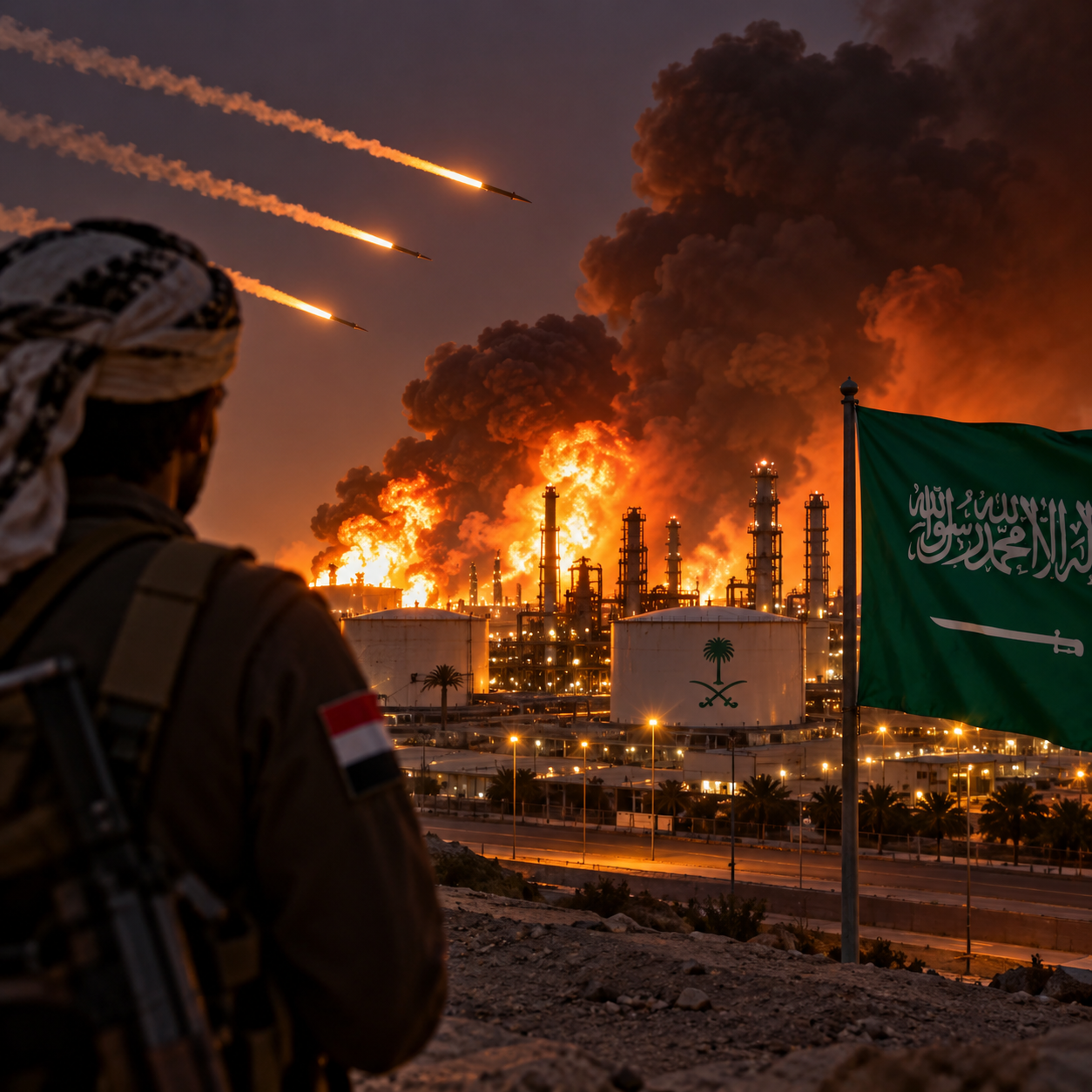
Saudi Arabia’s Oil Front Is Burning
The Attack That Could Reignite the Saudi-Houthi War
Yemen’s Houthis have launched a major missile and drone offensive against Saudi Arabia, wounding at least 73 civilians and setting fires at energy facilities across the kingdom’s south. Saudi authorities say women and children are among the injured, while operations at some affected energy installations were temporarily halted as emergency teams fought the fires and assessed the damage.
The scale of the attack marks another dangerous step in the rapid collapse of the uneasy Saudi-Houthi calm. Houthi military spokesman Yahya Saree said the group used dozens of ballistic missiles and drones against Aramco facilities in Abha, Najran and Jazan as well as Khamis Mushait Air Base, while Saudi Arabia has promised operational measures to confront further attacks.
Four Saudi Areas Come Under Attack
Saudi-led coalition spokesman Major General Turki al-Maliki said attacks struck civilian and economic targets in Abha, Khamis Mushait, Jazan and Najran. The coalition put the number of wounded at 73 and described the offensive as a dangerous escalation threatening Saudi citizens, residents and national infrastructure.
Saudi Arabia’s Energy Ministry said fires broke out at several energy facilities and utilities in the southern region, forcing some operations to be suspended temporarily. Emergency teams were sent to contain the fires, secure the sites and determine the extent of the damage.
Exactly how much Saudi production or refining capacity has been affected remains unclear. The kingdom’s southern region includes strategically important energy infrastructure, including the large Jazan refining complex, but Saudi authorities have not publicly provided a complete installation-by-installation damage assessment.
That distinction matters. The fires and shutdowns are confirmed, but claims about the precise scale of physical damage should remain separate from the Houthis’ own account of the operation until Saudi authorities or the affected operators provide further detail.
The Houthis Say This Was a Deliberate Large-Scale Offensive
The Houthis are not presenting the attack as an isolated missile launch. Saree described it as a large-scale military operation involving dozens of ballistic missiles and drones and said Aramco facilities and military targets deep inside Saudi territory had been selected deliberately.
He claimed the strikes were accurate and caused extensive damage, although that part of the Houthi account has not been independently established in full. What is confirmed from the Saudi side is serious enough: multiple locations were attacked, energy facilities caught fire, operations were interrupted and dozens of civilians were wounded.
The Houthis say the offensive came in retaliation for Saudi attacks inside Yemen. They have accused Saudi Arabia of carrying out 121 strikes across Marib, Al-Bayda, Al-Hudaydah, Taiz and Al-Jawf over three days and have also blamed Riyadh for a deadly strike on a detention facility in Al-Hazm. Those claims remain politically important because they reveal how the Houthis are justifying the decision to take the conflict back onto Saudi territory.
The deadly Yemen prison strike blamed on Saudi Arabia had already raised fears of retaliation. Saudi Arabia had not publicly accepted responsibility for that particular attack when the allegation was made, meaning the competing accounts of what triggered the latest escalation remain important.
The Saudi-Houthi Truce Is Rapidly Unravelling
For years, one of the few stabilising features of the Middle East was the dramatic reduction in direct fighting between Saudi Arabia and the Houthis. A United Nations-mediated truce in 2022 formally expired after six months, but the broad reduction in cross-border attacks largely survived, allowing Saudi Arabia to move away from the intense phase of its Yemen intervention.
That arrangement has now deteriorated badly.
The warning came in July when Houthi missiles again threatened Saudi Arabia, breaking years of relative calm along the border. What was initially a renewed exchange of threats has since escalated towards direct attacks on economic infrastructure, cities and shipping.
The latest barrage is therefore more significant than the casualty figure alone suggests. It demonstrates that the Houthis are once again willing to impose direct economic and civilian costs on Saudi Arabia and that Riyadh’s long effort to separate itself from Yemen’s battlefield is under severe pressure.
Saudi Arabia now faces an uncomfortable choice. A large military response could restore some deterrence but could also restart a conflict Riyadh spent years trying to leave behind. A restrained response could reduce the immediate risk of escalation but may encourage the Houthis to believe Saudi infrastructure can be attacked without a sufficiently costly consequence.
Saudi Arabia Promises a Firm Response
The Saudi-led coalition has left little ambiguity about its public position. Al-Maliki said it would take the operational measures necessary to deter the Houthis and confront what Riyadh regards as the sources of the threat.
That does not automatically mean a return to the enormous Saudi air campaign seen during earlier stages of the Yemen war. Riyadh has strong reasons to avoid another open-ended conflict, including the economic transformation being pursued at home and its desire to present the kingdom as a secure destination for investment, tourism and international business.
But attacks on energy installations create a particularly difficult threshold.
Saudi Arabia can potentially tolerate sporadic border incidents without fundamentally changing its strategy. Repeated strikes against Aramco facilities are different because they threaten the infrastructure at the centre of the kingdom’s economy and potentially affect customers far beyond the Middle East.
The Houthis appear to understand that vulnerability. Oil infrastructure gives them a target whose political significance greatly exceeds the physical area actually struck.
The Oil Market Is Already Reacting
The consequences have moved beyond Saudi Arabia and Yemen. Brent crude climbed towards $100 a barrel on Tuesday as investors confronted renewed fears about energy supplies from a region already under extraordinary pressure.
The danger is not simply that one refinery or utility could temporarily stop operating. Saudi Arabia is one of the world’s pivotal oil exporters, meaning any sustained campaign against its production, processing or export infrastructure can rapidly change expectations about future supply.
That pressure comes on top of instability surrounding the Strait of Hormuz and the Red Sea. The global energy system is increasingly confronting risk at both ends of the Arabian Peninsula: disruption around Hormuz threatens the principal Persian Gulf export route, while Houthi operations expose Saudi infrastructure and shipping approaching the Bab al-Mandeb.
The growing pressure on both major Middle Eastern shipping corridors creates an unusually dangerous combination. Saudi Arabia can redirect some energy flows away from the Persian Gulf towards its Red Sea coast, but the Houthis are capable of threatening precisely that western route.
That means the two crises cannot be treated independently. Pressure on one shipping route increases the importance of the other, while simultaneous instability around both makes the global oil system less resilient.
The Wider Iran War Makes This More Dangerous
The Houthi attack is also unfolding inside a much larger regional confrontation involving Iran and the United States. That makes what might once have remained a Saudi-Yemeni exchange considerably harder to contain.
The Houthis have longstanding political and military ties to Tehran, although the movement also has its own Yemeni leadership, objectives and decision-making structure. Their ability to launch sophisticated missiles and drones gives Iran an aligned force positioned beside one of Washington’s most strategically important Gulf partners.
Energy infrastructure has consequently become one of the most dangerous pressure points in the regional conflict. Threatening oil facilities can impose economic costs on Saudi Arabia, pressure international energy markets and complicate American military calculations without requiring an attack directly from Iranian territory.
This is particularly significant because Gulf energy infrastructure has increasingly become part of the wider confrontation. What once looked like separate fronts — Iran, Yemen, the Red Sea and Saudi Arabia — are becoming increasingly connected.
The strategic danger is cumulative. Every additional actor and battlefield creates another opportunity for a strike, retaliation or miscalculation to pull several conflicts together.
Why The Jazan Region Matters
Jazan sits close to Yemen but carries significance far beyond the border. Its energy infrastructure includes a major refining complex capable of processing hundreds of thousands of barrels of crude each day, making attacks in the region potentially important to both Saudi domestic supply and international energy markets.
Its proximity to Houthi-controlled territory creates an obvious vulnerability. Long-range drones and missiles do not need to cross the vast distances required to threaten Saudi facilities farther north, while repeated attacks can force Riyadh to dedicate expensive air-defence assets to protecting a broad range of installations.
That produces an asymmetric problem.
Saudi Arabia possesses vastly greater conventional military and economic power than the Houthis. But the Houthis do not need to destroy the Saudi oil industry to create pressure. They need only demonstrate repeatedly that strategically important infrastructure can be reached.
Even unsuccessful attacks force interceptions, shutdowns, emergency responses and heightened security. Successful strikes can add fires, casualties and market anxiety to that burden.
A Much Bigger Test Is Coming
The next Saudi response may determine whether this remains an intense but contained exchange or develops into another sustained Saudi-Houthi war.
Riyadh could strike missile launch sites, drone infrastructure, command facilities or other Houthi military positions inside Yemen. It could also increase support for Yemeni government forces already fighting the Houthis on the ground. The greater the Saudi response, however, the stronger the Houthi incentive may become to launch another wave against Saudi cities and energy targets.
The Houthis have already indicated that they intend to continue operations deep inside Saudi territory unless what they describe as Saudi aggression and blockade measures end.
That makes the immediate question less about whether another missile can be launched than whether either side still possesses an effective mechanism for stopping the cycle once retaliation begins.
Saudi Arabia spent several years attempting to escape that cycle. The Houthis spent those same years expanding the missile, drone and maritime capabilities that allow them to impose costs well beyond Yemen.
Now those two realities have collided.
Seventy-three wounded civilians and burning energy facilities represent the immediate consequences. The larger danger is that Saudi Arabia’s southern border, Yemen’s civil war, the Red Sea confrontation and the struggle over Gulf oil infrastructure are no longer separate crises. If Riyadh answers this attack with major force and the Houthis respond by escalating again, one of the Middle East’s longest wars could return as part of something much larger.
