Passengers Foil Alleged Attempt To Crash Flydubai Jet After Pilot Is Stabbed Mid-Flight
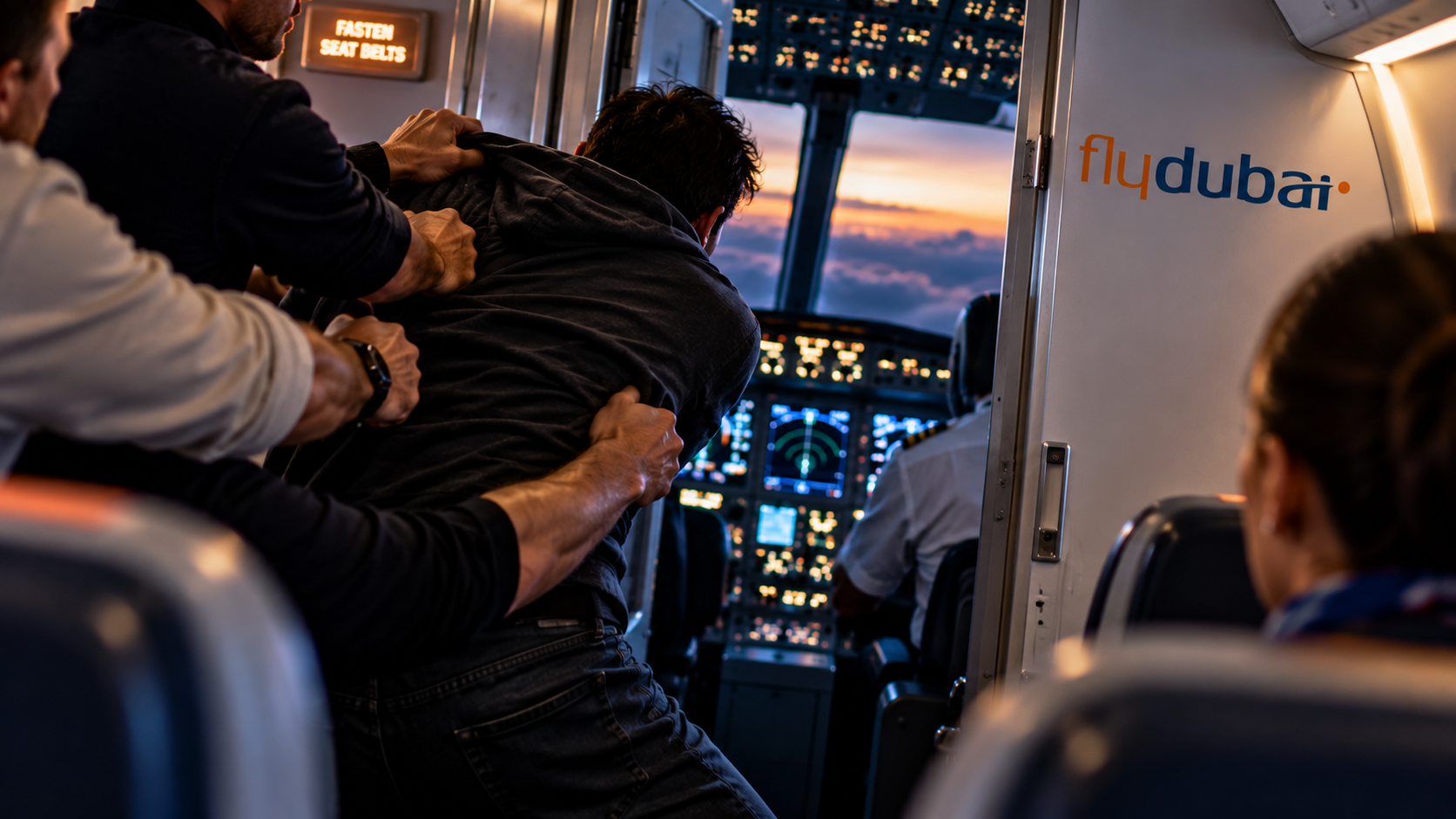
The Flydubai Flight That Nearly Ended In Disaster
Inside The Flydubai Cockpit Crisis
Flight FZ1073 plunged sharply before passengers and crew intervened and other pilots brought the aircraft safely into Tabuk, Saudi Arabia.
Passengers and crew aboard a Flydubai flight from Dubai to Tel Aviv helped overpower a co-pilot after the captain was stabbed during a violent cockpit confrontation on 30 September 2026.
The Boeing 737 then made an emergency landing at Tabuk in Saudi Arabia. Everyone on board survived.
The most serious allegation is that the co-pilot deliberately tried to crash the aircraft. Israeli Prime Minister Benjamin Netanyahu said the attacker stabbed the captain and apparently attempted to bring the plane down. Flydubai has confirmed that an altercation occurred on the flight deck, but has urged against speculation over the motive while the investigation continues.
That distinction matters. The emergency itself is not in doubt. The reason behind it is still being established.
What Happened On Flydubai Flight FZ1073
Flight FZ1073 left Dubai International Airport bound for Ben Gurion International Airport near Tel Aviv on Wednesday morning.
There were 174 people on board.
At some point during the journey, a violent confrontation broke out inside the cockpit. The captain, Smit Machchhar, was seriously injured after being stabbed.
The aircraft then entered a sudden and extremely steep descent.
Flight tracking data showed the jet losing roughly 14,000 feet in less than 30 seconds. For those in the cabin, the change would have been immediate. A routine commercial flight had turned into a struggle for control of the aircraft.
Passengers and members of the crew moved towards the cockpit.
Accounts from the flight describe passengers helping to restrain the co-pilot while the injured captain remained conscious and assisted in opening access to the cockpit.
Two additional Flydubai pilots travelling on the aircraft were then able to take control.
The flight diverted west towards Saudi Arabia.
At 8:44 a.m. local time, air traffic control at Tabuk received a distress call. Around an hour later, the aircraft landed safely.
The Captain Who Stayed In The Fight
Captain Smit Machchhar has emerged as one of the central figures in the incident.
He suffered stab wounds during the cockpit struggle but survived.
Despite his injuries, he reportedly remained involved long enough to help other people gain access to the cockpit. That intervention was crucial because the aircraft still had to be stabilised and landed.
Machchhar was taken to hospital after the emergency landing and was later described as being in a stable condition.
Indian Prime Minister Narendra Modi praised his actions, while Israeli leaders also publicly thanked him and the passengers who intervened.
The incident is an extraordinary example of why aviation emergencies rarely turn on a single action.
The captain survived the initial attack. Passengers moved forward. Crew members helped restrain the alleged attacker. Additional qualified pilots were already on board. Air traffic controllers in Saudi Arabia then received the aircraft and prepared for the diversion.
Any one of those elements could have changed the outcome.
How Passengers Became Part Of The Emergency Response
Commercial passengers are normally told not to interfere with the flight deck.
This was not a normal emergency.
Video recorded by a passenger before landing showed people inside the aircraft after the confrontation, with one passenger describing how those on board had helped the injured pilot.
Other accounts describe several passengers moving towards the cockpit and physically assisting in restraining the co-pilot.
That intervention appears to have created the space for the relief pilots to take control.
It is difficult to overstate the danger inside the cabin at that point. A commercial jet was descending rapidly, one of the operating pilots had been wounded, and the people on board did not initially know whether the aircraft itself had suffered a technical failure.
Yet the confrontation did not end with an uncontrolled aircraft.
The people on board reached the cockpit.
The alleged attacker was restrained.
The descent was arrested.
And the jet remained flyable.
Why The 14,000-Foot Descent Matters
A rapid loss of altitude does not by itself prove an attempt to crash an aircraft.
Aircraft can descend sharply for several reasons, including decompression, weather avoidance or a flight-control emergency.
The context here is different because the descent occurred during a confirmed cockpit altercation.
Flight tracking data indicate the aircraft lost approximately 14,000 feet in less than 30 seconds at one stage of the emergency.
That rate of descent is extraordinary for a passenger flight.
It also helps explain why the incident immediately attracted international scrutiny. A violent confrontation between pilots would already be a severe aviation-security event. A violent confrontation combined with a sudden multi-thousand-foot descent raises a much more serious question: whether the aircraft was intentionally being placed in danger.
That is the allegation now being investigated.
Why The Motive Is Still Unclear
Israeli officials have described the incident in the language of terrorism.
Israel's defence minister called it a jihadist terror attempt. Israeli security services are investigating the possibility of a deliberate attack.
Those statements are important, but they are not the same as a completed investigation.
Flydubai has taken a more cautious position.
The airline confirmed an altercation on the flight deck and said the underlying reasons and motives remained unknown pending a formal investigation.
That is the strongest position the available evidence currently supports.
There was a violent cockpit incident.
One pilot was stabbed.
Passengers and crew restrained the other pilot.
The aircraft descended dramatically and diverted to Saudi Arabia.
What investigators still need to establish is why.
The Emergency Landing In Saudi Arabia
The aircraft landed at Tabuk in north-west Saudi Arabia rather than continuing to Israel.
That created an unusual diplomatic situation.
Saudi Arabia and Israel do not maintain formal diplomatic relations, yet the passengers were now on Saudi territory after an aviation emergency.
The priority remained the aircraft and the people aboard it.
The alleged attacker was taken into custody in Saudi Arabia. The injured captain also received medical treatment there.
Flydubai later sent replacement aircraft to collect the stranded passengers.
More than ten hours after the original emergency, the travellers reached Ben Gurion International Airport.
For an aviation incident that had involved a wounded pilot, a sharp uncontrolled-looking descent and a struggle inside the cockpit, the final outcome was remarkable.
No passengers were killed.
The aircraft landed intact.
And the people who boarded in Dubai eventually reached Israel.
What Happens Next
Investigators now face several separate questions.
The first is criminal: what happened between the two pilots, and was there a deliberate attempt to destroy the aircraft?
The second is operational: how did the cockpit confrontation develop, what systems were touched or disabled, and how did the relief pilots recover the aircraft?
The third is security-related: whether existing airline screening, crew monitoring and cockpit safeguards need to change.
Israel has already said it intends to increase security checks around pilots operating flights into the country.
Any wider changes will depend on what investigators establish about the suspect's motive and preparation.
That work matters because commercial aviation security is built in layers. Airport screening is only one of them. Airlines also rely on crew vetting, cockpit procedures, medical oversight, internal reporting systems and the assumption that qualified flight crew will protect the aircraft rather than become the threat.
The Boeing 737 MAX disasters showed how quickly a cockpit can become overwhelmed when control of an aircraft changes unexpectedly. The circumstances here are entirely different, but the same fundamental reality remains: at altitude, seconds matter.
The incident also recalls why the history of aircraft hijacking and cockpit security continues to shape modern aviation.
Flight FZ1073 did not end in disaster.
The captain survived.
The passengers survived.
The aircraft landed safely.
But the most important question is still unresolved.
Investigators now have to determine whether the people aboard that jet survived an attempted mass-casualty attack, or whether the full explanation for the cockpit violence is more complicated than the first public accounts suggest.
Sources
Flydubai — Updates on FZ 1073 DXB-TLV on 30 September 2026 — Airline confirmation of the incident, safe landing at Tabuk and passenger safety.
Reuters — Passengers Foil Bid To Crash Dubai-Tel Aviv Flight, Israel Says, After Co-Pilot Stabs Pilot — Detailed chronology, passenger intervention, descent data and official statements.
ABC News Australia — Netanyahu To 'Ramp Up' Aviation Security After Pilot Stabs Colleague And 'Tries To Crash Plane' — Flight details, distress-call timing, passenger testimony and Flydubai's caution over motive.
Next Reads
The Boeing 737 MAX Disaster Explained: MCAS, Two Crashes And What Boeing Knew — How cockpit systems, human response and seconds of decision-making became central to two aviation disasters.
D.B. Cooper Explained: The Hijacking, Evidence And Theories — A detailed look at one of the most famous hijackings in commercial aviation history.
Lockerbie Bomber: The Pan Am 103 Case Explained — The investigation into the destruction of Pan Am Flight 103 and the evidence that shaped the case.
