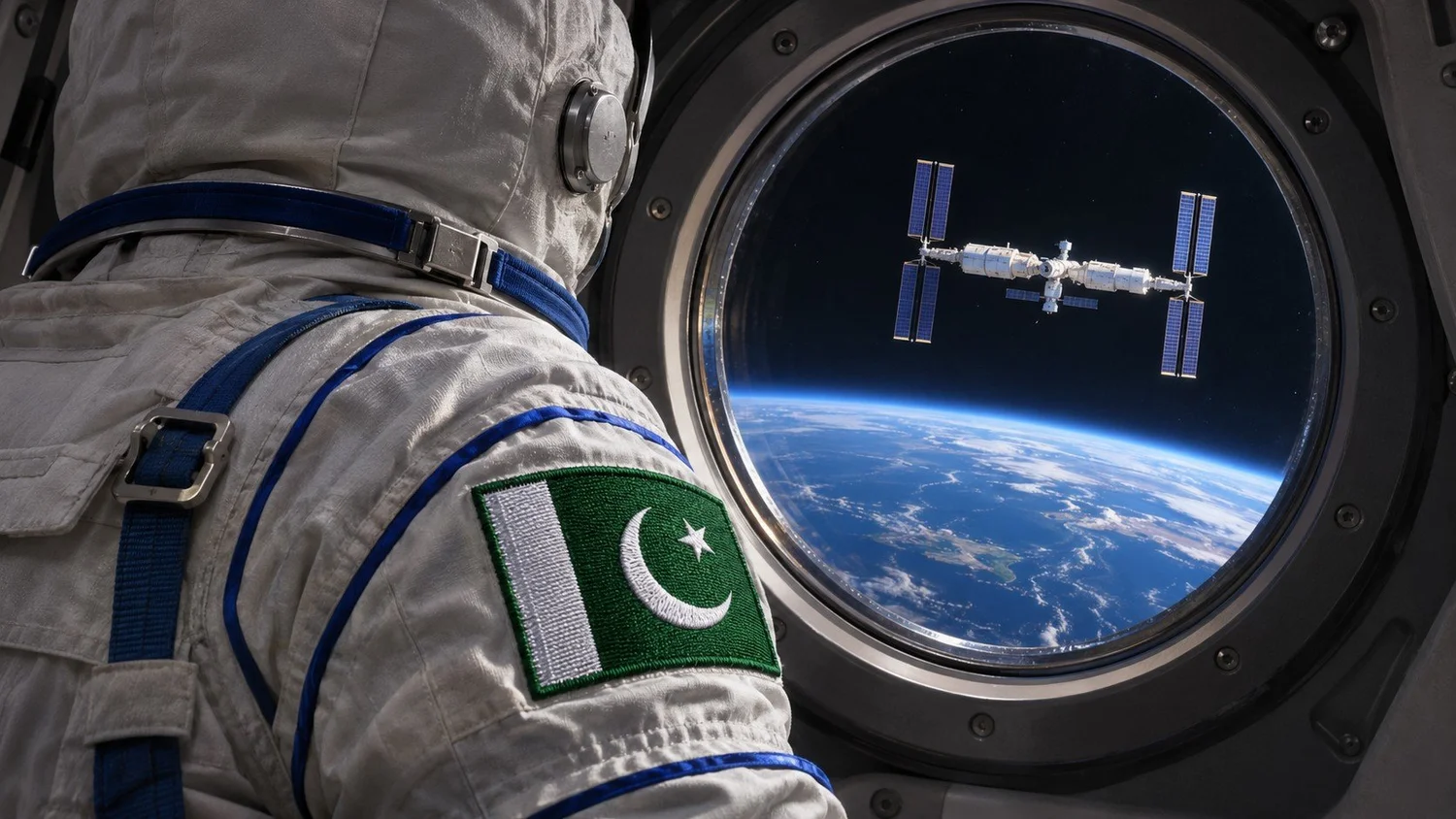
Why Is a Pakistani Astronaut Aboard a Chinese Spacecraft Such a Big Moment?
At 8.18am Beijing time on Wednesday (00.18 GMT), a Long March-2F rocket climbed away from the Jiuquan Satellite Launch Centre in the Gobi Desert carrying three people. Two of them were Chinese. The third, 40-year-old Muhammad Zeeshan Ali, is Pakistani, and his seat on Shenzhou-24 marks the first time China's crewed space programme has flown a foreign astronaut.
According to Pakistan's Dawn newspaper and the Associated Press, the spacecraft separated from its rocket and entered its planned orbit. Its destination is Tiangong, the Chinese space station that, until now, has been staffed exclusively by Chinese astronauts. Once Shenzhou-24 docks, Ali is set to become the first foreign national to step aboard.
The flight is a personal milestone for Ali and a national one for Pakistan, which has never before sent one of its citizens into orbit. But it is also a statement of intent from Beijing: Tiangong is no longer a purely domestic outpost, and China wants the world to know that its station is open to partners.
What Happened on Wednesday Morning
The mission lifted off on schedule from Jiuquan, the north-western launch site that has hosted every Chinese crewed flight. Dawn, reporting the launch time as 5.18am Pakistan time, said the spacecraft reached its preset orbit after lift-off. The AP's report from Jiuquan likewise described the craft separating from the rocket and entering its planned orbit.
At the time of writing, neither source had reported docking with the station. Chinese crewed missions in recent years have typically used a fast rendezvous profile that brings the spacecraft to Tiangong within hours of launch, and this article will be updated once docking is confirmed.
The Crew
- Tang Hongbo, 51, commander. A veteran of two previous missions, Tang is set to become the first astronaut to board Tiangong three times, according to Chinese state broadcaster CCTV as reported by the AP.
- Wu Yi, 39, described by Dawn as the mission pilot (other outlets use the term flight engineer). This is his first spaceflight.
- Muhammad Zeeshan Ali, 40, payload specialist, representing Pakistan's space agency, Suparco. It is his first spaceflight.
What the Mission Will Do
The China Manned Space Agency (CMSA) says the crew will carry out roughly 90 scientific experiments and technology tests, according to Dawn; the AP, citing Xinhua, puts the figure at more than 90. The stated objectives are a crew rotation with the Shenzhou-23 astronauts already on the station, routine maintenance and operations, and continued space science research using onboard payloads.
Ali's own stay will be short. Dawn reports that he is expected to spend about one week in space, and he will not fly home on the spacecraft that carried him up. Instead, he will return to Earth aboard Shenzhou-23 alongside members of the outgoing crew, a detail first reported by CCTV when his selection was announced earlier this month. According to the AP, one of his tasks in orbit is an experiment involving photosynthetic cyanobacteria, organisms of interest to researchers studying how future life-support systems might produce oxygen.
The handover carries a second notable storyline. Dawn reports that Shenzhou-23's commander, Zhu Yangzhu, will remain on Tiangong for about a year to support research into how the human body copes with long-duration spaceflight. That would give him the record for the longest single stay in orbit by a Chinese astronaut.
Tang Hongbo and Wu Yi will then continue the main Shenzhou-24 expedition on the station.
Who Is Muhammad Zeeshan Ali?
Relatively little has been published about Ali's career before his selection. What is on the record is the route he took to the launch pad. In April, he and a second Pakistani candidate, Khurram Daud, were chosen to begin training in China, according to Dawn. Both trained at the China Astronaut Research and Training Centre in Beijing, Al Jazeera reported, in a programme combining operational exercises with intensive Chinese-language lessons.
That language preparation began earlier still. Pakistan's state news agency, APP, quoted an official from Beijing Language and Culture University as saying both astronauts had previously studied Chinese at the Confucius Institute in Islamabad. At a press conference before the launch, Ali spoke Mandarin well enough to quote Chinese poetry, the AP reported, likening his training to "day after day, reaching new heights."
China's space agency announced on 7 November that a Pakistani payload specialist would join Shenzhou-24, initially without naming him. At a press briefing in Jiayuguan on Tuesday, the eve of the launch, Ali told reporters he was "deeply grateful" to the Chinese government and described the flight as "not a finish line; it is a launch pad", according to Dawn. He added that he was carrying the hopes of 250 million Pakistanis.
The China–Pakistan Space Agreement
The flight is the product of a cooperation agreement signed in February 2025 between Suparco and the CMSA. Under its terms, as summarised by Dawn and the AP, two Pakistanis would train in China and one of them would fly to Tiangong. Chinese state media framed the selection as part of bilateral cooperation under the Belt and Road Initiative, Al Jazeera noted.
It is not the only joint space project between the two countries. Al Jazeera reports that the China National Space Administration also plans to deploy Jinnah-1, Pakistan's first lunar rover, a 35kg vehicle designed to study plasma behaviour, radiation and the composition of lunar soil.
Pakistan's prime minister, Shehbaz Sharif, marked the launch on X, writing that "Pakistan-China friendship is surpassing the heights of the Himalayas in its journey to outer space," as quoted by the AP.
Why It Matters for Tiangong and Chinese Space Diplomacy
The following section is Taylor Tailored analysis.
For most of the past quarter-century, the International Space Station has been the default destination for any country wanting to put an astronaut in orbit without building its own spacecraft. Dozens of nationalities have flown there through partnerships with the United States, Russia, Europe, Japan and Canada, or through commercial seats. China was excluded from that partnership and built Tiangong alone.
Shenzhou-24 changes the shape of that picture. By flying a Pakistani astronaut, China demonstrates that it can offer the same thing the ISS partners have long offered: a route to orbit for countries that cannot get there on their own. With the ISS scheduled to be retired around the end of the decade, Tiangong could become one of the few permanently crewed stations available, and a foreign-crew precedent strengthens Beijing's pitch to prospective partners.
The choice of Pakistan is unsurprising. The two countries are longstanding strategic partners, and China is Pakistan's largest trading partner and a major investor, as Al Jazeera notes. A first international flight with a close ally carries less political and operational risk than one with a newer partner, and gives the CMSA a template for training, language preparation and mission integration that it can reuse.
There is also a competitive dimension. China is targeting a crewed lunar landing by 2030, while NASA aims to return astronauts to the Moon in 2028, the AP reports. Space cooperation has become a measure of geopolitical reach as well as engineering capability, and China is now visibly building its own network of partners alongside the US-led Artemis Accords.
It is worth keeping the scale in perspective. A one-week payload-specialist visit is a modest operational role, similar to the short visits that many first-time national astronauts made to Soviet and later Russian stations. The significance lies less in what Ali does on board than in the precedent his presence sets.
What Happens Next
- Docking: The immediate milestone is Shenzhou-24 docking with Tiangong and the crew entering the station. That had not been reported by the sources consulted at the time of writing.
- Handover: The Shenzhou-24 and Shenzhou-23 crews will conduct an in-orbit rotation, with Zhu Yangzhu staying on for his extended mission.
- Ali's return: After about a week, Ali is due to return to Earth on Shenzhou-23 with the departing crew. No landing date has been published.
- Contingency: APP reported last week that a backup Long March-2F rocket and the Shenzhou-25 spacecraft were on standby at Jiuquan to support a rapid rescue launch if one were needed.
Beyond this mission, the questions are whether Khurram Daud will get his own flight, and which country might be next to send an astronaut to Tiangong.
A Small Seat with Large Symbolism
Zeeshan Ali's flight will last only days, but it marks a turning point for both countries involved. Pakistan gains its first astronaut, and China gains proof that its station can host international crew. If docking and the return go to plan, Shenzhou-24 is likely to be remembered as the moment Tiangong became a destination other countries could reach too.
For more on how crewed stations cope when plans change, read our report on a space station mission cut short by an astronaut's medical issue.
Sources
- Dawn: Zeeshan Ali becomes first Pakistani astronaut to enter orbit aboard China's Shenzhou-24 (25 November 2026)
- Associated Press (via Yahoo News): China launches Shenzhou 24 spacecraft carrying 2 Chinese and a Pakistani astronaut (25 November 2026)
- Al Jazeera: Pakistani astronaut to join China's next space station mission (7 November 2026)
- Associated Press of Pakistan: China prepares Shenzhou-24 mission to carry first Pakistani astronaut to space station (18 November 2026)
- The China-Global South Project (Reuters): Pakistani astronaut on Shenzhou-24 launch details (23 November 2026)
