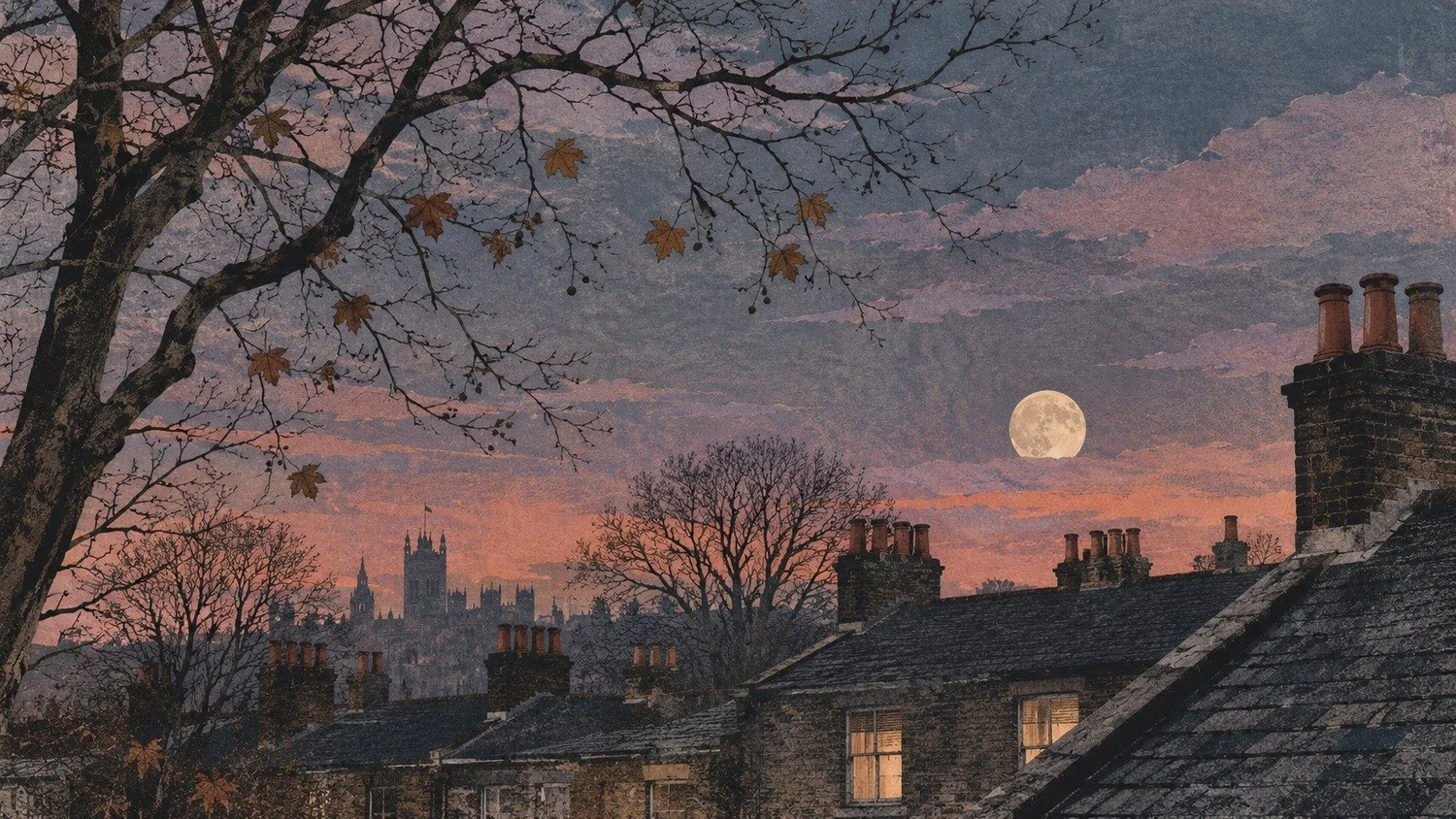
London’s Beaver Moon Rose Shortly After the Full Phase on 24 November.
London had an unusual appointment with the Moon on Tuesday. The November full Moon reached its peak at about 2.54pm GMT, while it was still below the capital’s horizon. It rose at 3.17pm, towards the north-east. Anyone who missed that moment can look later in the evening. The Moon changes phase gradually enough to appear full for hours on either side of the calculated peak.
On the commonly used list that counts near-perigee full Moons this winter, the November Beaver Moon is the first of four in succession. For UK viewers, the first decision is more practical than astronomical. Find a clear view towards the north-east for moonrise, or wait for the Moon to climb above the things that block your view. The Virtual Telescope Project also scheduled free coverage from Italy starting at 3.30pm GMT, weather permitting.
Which Way Should You Look From the UK?
London’s moonrise bearing was about 46 degrees, almost exactly north-east. If you have a compass app, the bearing gives you a better starting point than scanning the entire eastern skyline. Your own arrival time for the Moon depends on where you live. Use a local moonrise table if you are outside London, particularly if you want to catch the lunar disc beside a familiar building.
The time in a table assumes a clear horizon. An upstairs window can have the same published moonrise time as a garden across the street, yet the first observer may see the Moon several minutes earlier. A neighbouring roof, a hill or a stand of trees can hide a low Moon long after it has risen astronomically. If the sky is clear above the roofs, give it time.
There is no need for a telescope. A full Moon is bright enough to see from a town or city. Binoculars help distinguish the darker plains on the disc. If the pleasure is seeing the Moon in the context of a landscape, the unaided view gives you something a tightly framed telescope image cannot, the whole skyline at once.
Why Are There Two Different Times for the Same Moon?
The full phase is an instant defined by the positions of the Sun and Moon as seen from Earth. Astronomical tables give it one time that can be converted between time zones. Moonrise, by contrast, happens when Earth’s rotation brings the Moon above a particular observer’s horizon. People at different longitudes and latitudes can share the same full Moon and experience moonrise at quite different local times.
Timeanddate gives the full phase as 2.53pm GMT and NASA lists 2.54pm. For someone planning a photograph, that minute makes no practical difference. In London the Earth was still in the way at either time. What matters for a photograph of the Moon rising behind a landmark is the local rise time, the direction and whether the landmark is actually visible from where you stand.
London’s table also offers a second chance. On Wednesday 25 November, moonrise there is at 4.07pm towards the north-east, a little further north than on Tuesday. The phase will have passed its peak, but the change in the illuminated shape over one day is small. A clear Wednesday evening may give a better view than a cloudy Tuesday at the mathematically perfect moment.
What Makes the Beaver Moon a Supermoon?
The Moon follows a slightly elongated orbit. Its distance from Earth changes over the course of a circuit, reaching a nearest point called perigee and a farthest point called apogee. When a full Moon falls sufficiently near the closer part of its orbit, it occupies a little more of the sky and is commonly called a supermoon. The exact cut-off is a convention, so lists can differ at their edges.
The size difference is real but modest. Comparisons that give an especially large percentage generally use a full Moon from the far end of the orbit as the reference. Your memory of last month’s Moon is a much less precise measuring instrument. A striking impression of size as the Moon clears a chimney or a distant tree can also owe something to the Moon illusion, which occurs even in months without a supermoon.
Try keeping the same camera lens and zoom setting for two photographs, one as the Moon clears the skyline and one a few hours later. Compare the width of the disc in the two frames before cropping them. The landscape may make the early photograph feel much more dramatic, even when the Moon occupies much the same number of pixels.
How Can You Watch If the Sky Is Cloudy?
The Virtual Telescope Project’s WebTV planned to use robotic telescopes at Manciano in Italy for its online broadcast. The feed offers a view from a different patch of weather, with commentary from astronomer Gianluca Masi. Its scheduled start was 3.30pm UK time on 24 November. The camera’s Italian horizon also means the scenery and timing will differ from the view through a London window. Local cloud in Italy can affect that view just as cloud over Britain can affect yours.
There is another date worth keeping. NASA lists the next full supermoon for 1.28am GMT on 24 December. For a UK observer hoping to catch that one high in the sky near its fullest, the relevant evening starts on 23 December. A date printed in an astronomy calendar can be perfectly correct and still send you outdoors a night too late.
Sources
- Timeanddate — Moonrise, Moonset, and Moon Phase in London, November 2026 — London’s moonrise times, bearings and full phase.
- NASA — Supermoons - NASA Science — Supermoon dates and the effect of orbital distance.
- Space.com — Watch November's full Beaver Moon live online today with supermoon livestream | Space — The Italian webcast and the sequence of four supermoons.
Next Reads
- The Moon Illusion and November’s Supermoon Explained — Why the Moon can appear larger near the horizon.
- What Is a Fireball, and Why Can the Taurids Produce One on a Quiet Meteor Night? — Another November observing guide for UK skies.
- The Antikythera Mechanism Explained: Ancient Gears, Astronomy, Imaging And Reconstruction — How an ancient instrument represented astronomical cycles.
