The Mafia Boss Who Picked Up a Megaphone
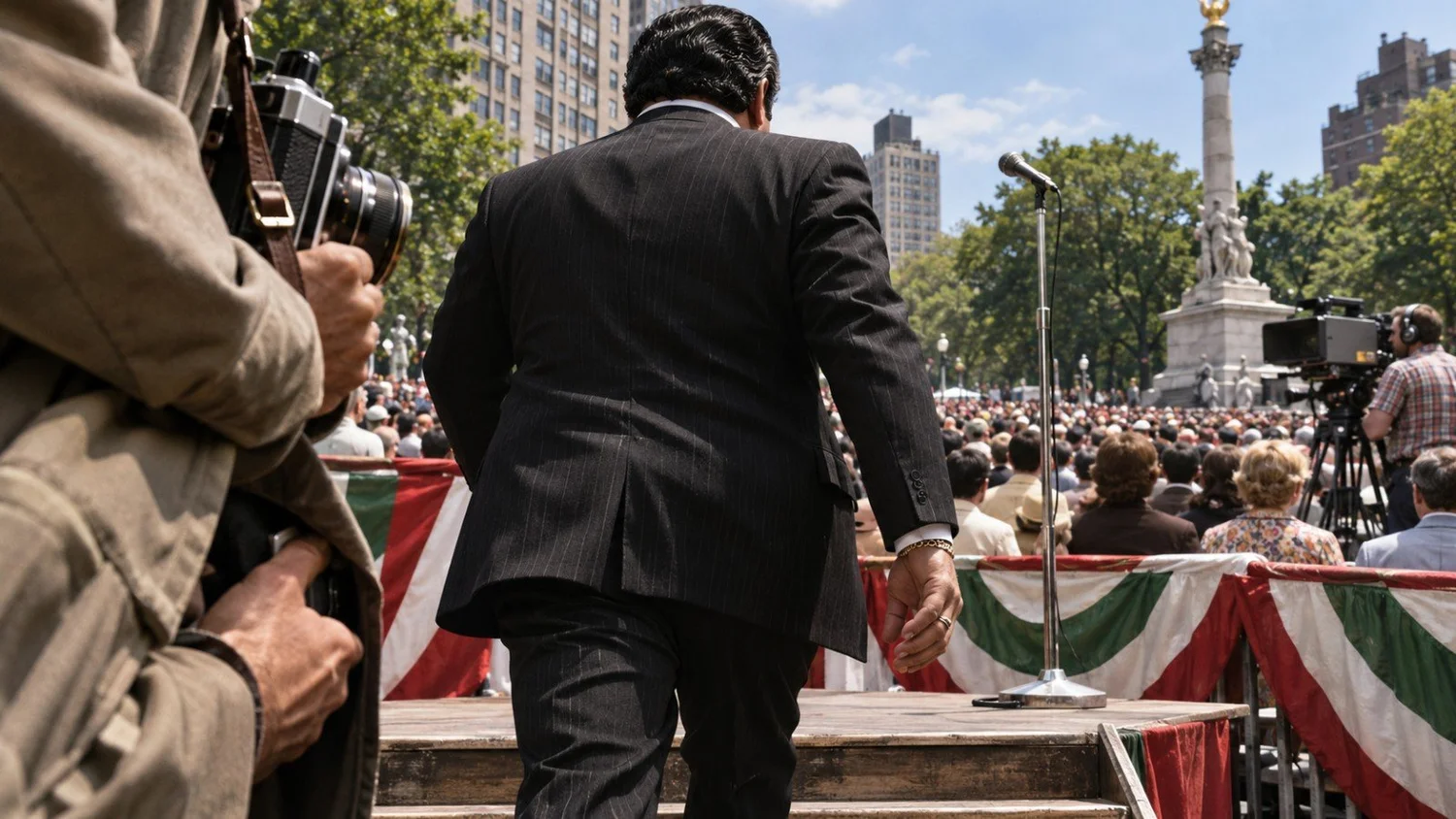
On the afternoon of 28 June 1971, tens of thousands of people filled Columbus Circle in Manhattan for a rally against prejudice. There were red, white and green banners, a stage for politicians and entertainers, and television cameras waiting for the man who had organised it all. Joseph Colombo, a 48-year-old Brooklyn real estate salesman by his own description, made his way through the crowd smiling and shaking hands.
Minutes later he lay on the pavement with three bullets in his head and neck. The man who shot him, posing as a press photographer, was himself shot dead within seconds by a gunman who has never been identified. Colombo survived, but he never spoke publicly again. He spent seven years paralysed before dying in 1978.
Joe Colombo was the boss of one of New York's Five Families, the crime family that still bears his name. He was also something no Mafia boss had been before: a public campaigner who picketed the FBI, led mass rallies, persuaded the Justice Department to stop using the word "Mafia" and forced the makers of The Godfather to cut it from their script. This is the story of how he rose, why he went public, who may have wanted him dead and why his shooting remains one of the great unsolved mysteries of American organised crime.
The Short Answer
- Who he was: Joseph Anthony Colombo Sr. (1923–1978) became boss of the former Profaci crime family in 1964, aged about 41. It is now known as the Colombo crime family.
- How he got the job: he was handed a contract to murder rival bosses in 1963 and betrayed the plot to its targets instead. The Commission rewarded him with his boss's family.
- Why he is famous: in 1970 he founded the Italian-American Civil Rights League, picketed the FBI and drew huge crowds to Columbus Circle, claiming the Mafia was a myth used to smear Italian Americans.
- What happened: on 28 June 1971 he was shot three times at the League's second Unity Day rally by Jerome A. Johnson, who was immediately killed by an unidentified gunman.
- The aftermath: Colombo was left paralysed and died on 22 May 1978. Joe Gallo, the rebel suspected by many in the family, was shot dead in Little Italy in April 1972.
- The mystery: nobody was ever charged. Theories point to Joe Gallo, Carlo Gambino, the informant Gregory Scarpa Sr. and even the FBI, but none has been proven.
Who Was Joe Colombo?
Joseph Anthony Colombo was born in Brooklyn on 16 June 1923. His father, Anthony Colombo, was an early member of the crime family run by Joe Profaci, one of the founding bosses of New York's Five Families. In 1938, when Joe was a teenager, his father was found strangled in a car alongside a woman companion. It was an early lesson in how the family dealt with problems.
Colombo spent two years at New Utrecht High School before dropping out to join the US Coast Guard. He was discharged in 1945 after being diagnosed with neurosis. For years afterwards he held ordinary jobs on paper: about a decade as a longshoreman, six years selling for a meat company and, later, work as a real estate salesman. That last occupation would become his public cover story.
In 1944 he married Lucille Faiello. They had five children, including sons Anthony, Joseph Jr. and Christopher, all of whom would later be drawn into his public crusade and, in some cases, his criminal world. The family lived in a modest home in Bay Ridge, Brooklyn, and later also kept a five-acre estate at Blooming Grove in upstate New York.
Rising Through the Profaci Family
Like his father before him, Colombo joined the Profaci family. He became one of its most trusted enforcers and eventually a capo, running a crew involved in gambling and other rackets. Despite that, his criminal record stayed remarkably thin. The Mob Museum notes that before his rise to boss he had only two minor infractions on his record, each punished with a one-dollar fine.
The Profaci family was not a happy one. Joe Profaci was a notoriously greedy boss who demanded tribute even from his own soldiers. In 1961 a faction from Red Hook led by the Gallo brothers, Larry, Joey and Albert, rebelled. On 27 February 1961 the Gallos kidnapped four senior Profaci men, including underboss Joseph Magliocco, and released them only after negotiations.
The peace did not last. In August 1961 Profaci ordered the murders of Gallo associates. Joseph Gioielli was killed, and Larry Gallo narrowly survived a garrotting attempt in a Brooklyn bar, an assault carried out by Carmine Persico, a Gallo crew member who had switched sides. The first Colombo war, as it is now known, produced nine murders and three disappearances. Joey Gallo was sentenced to seven to fourteen years in prison in late 1961, and Profaci died of cancer on 6 June 1962. Magliocco took over, but the Mafia Commission never formally endorsed him.
The Double-Cross That Made Him Boss
Colombo's big break came from an act of betrayal. In 1963 Joseph Bonanno, boss of the Bonanno family, devised an audacious plan to seize control of the Commission by killing several of its members: Tommy Lucchese, Carlo Gambino and Stefano Magaddino, along with the Los Angeles boss Frank DeSimone. Bonanno recruited Magliocco, who was bitter at being denied his seat on the Commission.
Magliocco handed the contract to one of his best hitmen: Joe Colombo. Colombo instead went to the intended targets and told them about the plot. The Commission summoned Bonanno and Magliocco. Bonanno fled to Canada. Magliocco appeared, confessed, was fined $50,000 and forced into retirement. He died of a heart attack a few months later.
As a reward, the Commission gave Colombo control of the Profaci family. He was around 41 years old, one of the youngest bosses in the country and the first American-born boss of a New York family. Not everyone thought he deserved it. In a 1969 conversation recorded by the FBI, Frank Majuri, underboss of New Jersey's DeCavalcante family, asked how they could make a guy like Colombo sit on the Commission. Many in the underworld believed the real power behind him was Carlo Gambino, whose life he had saved.
Boss of a Brooklyn Crime Family
As boss, Colombo ran a family involved in gambling, loansharking, hijacking and union rackets across Brooklyn and Long Island. In public he remained a real estate salesman with no connection to anything called the Mafia.
Law enforcement pressure grew steadily. In May 1966 he was jailed for 30 days for contempt after refusing to answer a grand jury's questions about his finances. It was the only prison sentence he ever served. In September 1966 he was among 13 men arrested at a meeting at the La Stella restaurant in Queens, a gathering the press called a "Little Apalachin". Bail was set at $100,000 each, and the total of $1.3 million was posted the next day.
In March 1971 Colombo was convicted of perjury for lying on an application for a real estate broker's licence and sentenced to two and a half years, although the sentence was put on hold during his appeal. By then, though, he had found a very different way to fight back.
The Picket Line Outside the FBI
In April 1970 federal agents arrested Colombo's son, Joseph Jr., on charges of melting down silver coins to sell as ingots. A traditional Mafia boss would have hired the best lawyer available and kept quiet. Colombo did hire a lawyer, but then did something no boss had done before. On 30 April 1970 he sent around 30 people to picket the FBI's New York headquarters on Third Avenue, protesting what he called the persecution of Italian Americans.
The picketing went on for weeks, with Colombo himself often on the line, flanked by his sons. Out of those protests grew the Italian-American Civil Rights League. Its stated aim was to fight the stereotype that linked Italian Americans with organised crime and to stop the authorities using words such as "Mafia" and "Cosa Nostra". Colombo held no formal title, but he was its driving force and most prominent speaker. He insisted he was simply a real estate man and that the Mafia did not exist.
The campaign tapped into a real grievance. Many Italian Americans were tired of being portrayed as gangsters in films, television and newspapers, and the League quickly gained members and political allies. On 29 June 1970 it staged the first Italian-American Unity Day rally at Columbus Circle. Estimates of the crowd range from about 50,000 to more than 100,000. Politicians turned up, and New York governor Nelson Rockefeller accepted honorary membership.
The League's successes were remarkable. Frank Sinatra performed a benefit concert for it. Within a year it claimed tens of thousands of dues-paying members in several states. Attorney General John Mitchell ordered the Justice Department to stop using "Mafia" and "Cosa Nostra" in its official documents and press releases. The producers of the television series The FBI agreed to avoid the terms too.
Colombo also made unlikely friends. In 1971 he aligned the League with Rabbi Meir Kahane's Jewish Defense League, arguing that both groups faced harassment by the federal government, and he posted bail for jailed JDL members. In February 1971 his son Joseph Jr. was acquitted after the government's chief witness was arrested for perjury. To Colombo's supporters, it was proof that he had been right all along.
Colombo and The Godfather
The League's most famous victory involved Hollywood. In 1970 Paramount was preparing to film Mario Puzo's bestselling novel The Godfather in New York. The League saw the film as an insult to Italian Americans and campaigned against it. The film's producer, Albert S. Ruddy, later described a series of threats and intimidation, and union disruption was a real risk for any production shooting on New York streets.
In February 1971 Ruddy met Colombo and agreed to a deal. The words "Mafia" and "Cosa Nostra" would be removed from the screenplay, and in return the League would stop opposing the film. Ruddy announced the agreement at a press conference at League headquarters in March 1971. Paramount executives were reportedly furious, but Ruddy had given away very little: the word "Mafia" appeared in the script only once. The Godfather was released in 1972 without the word, and became one of the most celebrated films ever made.
The episode was later dramatised in The Offer, the 2022 series about the making of The Godfather, in which Colombo is played by Giovanni Ribisi.
Why the Mob Hated the Spotlight
To the outside world, Colombo looked like a man at the height of his power. Inside the Mafia, he was causing alarm. The whole point of the American Mafia was secrecy. Bosses avoided cameras, denied the organisation's existence and let lawyers do their talking. Colombo was on television, leading marches and drawing attention to the very organisation he claimed did not exist.
The rallies also had a practical cost. The publicity made the FBI even more interested in the men around Colombo, and by extension in everyone who did business with him. According to many accounts, Carlo Gambino, the most powerful boss in New York and once Colombo's patron, came to see him as a liability. Some versions of the story say the two men argued bitterly over the League, though such details come from underworld lore rather than any verified record.
By the spring of 1971 Colombo was under indictment, facing a perjury sentence and increasingly isolated. Then an old enemy came home.
Joey Gallo Comes Home
Joe "Crazy Joe" Gallo was released from prison in 1971 after almost a decade inside. The man who had led the revolt against Profaci had used his time in prison to read widely, cultivate a new image and, according to many accounts, build relationships with Black inmates at a time when the Mafia was largely segregated.
According to the most widely repeated account, Colombo offered Gallo a $1,000 gift as a peace gesture on his release. Gallo is said to have demanded $100,000 to settle old grievances. Colombo refused, and the old feud between the family and the Gallo crew threatened to reignite. That background would make Gallo the first suspect when Colombo was shot weeks later.
Columbus Circle, 28 June 1971
The second Unity Day rally was meant to repeat the success of the first, and thousands of people arrived at Columbus Circle. Shortly before the rally was due to begin, Colombo walked through the crowd towards the stage, greeting supporters.
A young Black man carrying camera equipment and press credentials approached him. According to a League official quoted at the time, a woman had been talking to Colombo when a man taking photographs asked him to pose. The man drew a pistol and fired three shots into Colombo's head and neck at close range. Colombo collapsed.
What happened next has never been fully explained. The gunman was wrestled to the ground by police and Colombo's entourage. Then more shots were fired, and the suspect was killed. The person who killed him was never identified, despite the presence of a large number of police officers. Colombo's bodyguards were widely suspected, and the FBI later questioned one of them, but nobody was charged.
Colombo was taken to Roosevelt Hospital, where surgeons spent about five hours removing bullets from his brain and neck. Doctors gave him less than even odds of survival. He lived, but he was left almost completely paralysed and unable to communicate.
Who Was Jerome Johnson?
The gunman was identified as Jerome A. Johnson, a man in his mid-twenties from New Brunswick, New Jersey. He did not fit the image of a professional Mafia hitman. Police described him as a gun enthusiast and an admirer of Hitler. Life magazine called him emotionally disturbed, and reports said he had been arrested several times and was accused of violence against women.
Investigators pieced together a strange final week. Johnson had carried a rented film camera and a still camera to the rally, along with certificates for marksmanship. He had travelled from Cambridge, Massachusetts, the day before. A friend later said he had talked about a big score that would let him leave for the islands. Crucially, someone had helped him obtain the press credentials that got him close to Colombo.
Reports also placed Johnson at a club linked to the Gambino family in the days before the shooting. That detail would fuel one of the most persistent theories about who sent him.
Who Ordered the Hit? Four Theories
More than fifty years later, nobody has been charged with planning the attack, and Johnson's motive died with him. The main theories are set out below. None has been proven.
1. Joey Gallo
Many in the Colombo family were convinced Gallo was behind it. He had a long-running feud with the family, had just been refused his payoff, and was known for his connections with Black criminals. Police questioned Gallo but said they had no evidence he was involved. Sceptics point out that Johnson had no clear link to Gallo, and some, including Colombo's son Anthony, doubted Johnson would have trusted the Gallos to get him away safely.
2. Carlo Gambino
Albert Seedman, the New York detective who led the investigation, reportedly believed the Gambino family was responsible. Gambino had the most to gain from silencing a boss who was attracting so much attention, and Johnson had reportedly spent time at a Gambino-linked club. Supporters of this theory argue that using an outsider, then having him killed instantly, was the perfect way to ensure no trail led back to the Commission.
3. Gregory Scarpa Sr.
A newer theory points to Gregory Scarpa Sr., a feared Colombo capo who was secretly an FBI informant. A self-published 2025 book by Alan Taglianetti, a Mob associate who was imprisoned with Scarpa, claims Scarpa described his involvement in the shooting before his death in 1994. The Mob Museum has described the case against Scarpa as plausible but circumstantial, noting that the confession is known only through Taglianetti's account and that Scarpa had a history of giving the FBI misleading information.
4. The FBI
Colombo's son Anthony said in later years that he believed the federal government, not gangsters, was behind the attempt on his father's life. There is no documentary evidence for this, but the theory reflects how bitterly the family viewed the FBI's campaign against them.
Taylor Tailored's assessment is that a Mafia-sanctioned hit, using an outsider as a disposable shooter, best fits the known facts. Whether it was sanctioned by Gambino, encouraged by Gallo, organised from within Colombo's own family, or some combination, may never be known.
Seven Years in Silence
Colombo spent around two months in hospital before being moved to his estate at Blooming Grove in August 1971. He never recovered. A court-ordered examination in 1975 found he could move only his right thumb and forefinger. Reports the following year said he could recognise some people and say a few words.
In early May 1978 his condition deteriorated and he was taken to St Luke's Hospital in Newburgh, New York. He died there on 22 May 1978, aged 54. The cause of death was recorded as cardiac arrest brought on by the injuries he had suffered seven years earlier. His funeral was held at St Bernadette's church in Bensonhurst, and he was buried at St John Cemetery in Queens.
Gallo's Murder and a Family Reborn
The Colombo family did not wait for the police. Its leadership blamed Joey Gallo for the shooting. In the early hours of 7 April 1972, as Gallo celebrated his 43rd birthday at Umberto's Clam House in Little Italy, gunmen burst in and shot him. He staggered out on to the street and died beside his car. His killing set off another round of violence between the Gallo crew and the family, sometimes called the second Colombo war.
Leadership of the family passed through acting bosses, including Joseph Yacovelli, before Carmine Persico, the man who had once tried to garrotte Larry Gallo, emerged as its real power. Persico would dominate the family for decades, much of it from prison, until his death in 2019. The family's later internal war in the early 1990s, between Persico loyalists and supporters of acting boss Victor Orena, was among the bloodiest in modern Mafia history.
The family itself kept Joe Colombo's name. Law enforcement and the press called it the Colombo family during his years in the headlines, and the label stuck. It is one of the few Mafia families named after a boss whose reign ended not with arrest or death in office, but with a bullet fired in front of a crowd.
Joe Colombo's Legacy
Joe Colombo's story is often told as a cautionary tale: the boss who broke the Mafia's first rule and paid the price. That is true, but it is not the whole picture. The Italian-American Civil Rights League exploited real anger about prejudice and stereotyping, and some of that anger was justified. The irony is that it was led by a man who embodied the very image the League claimed to fight.
His influence still reaches popular culture. The Godfather, the most famous Mafia film ever made, does not use the word Mafia partly because of him. His shooting is depicted in Martin Scorsese's The Irishman (2019), and his negotiations with Hollywood are dramatised in The Offer. The Italian-American Civil Rights League continued to exist after his shooting in a much reduced form.
Above all, Colombo's fate showed the rest of the American Mafia how dangerous publicity could be. For years afterwards bosses kept their heads down. When John Gotti later courted the cameras in the 1980s, older mobsters drew the same lesson. Colombo had shown that a boss who becomes a public figure becomes a target, for the authorities and for his own side.
Timeline: The Life of Joe Colombo
- 16 June 1923: Joseph Anthony Colombo is born in Brooklyn.
- 1938: His father, Anthony Colombo, a Profaci family member, is found strangled in a car.
- 1945: Discharged from the US Coast Guard.
- 1961: The Gallo brothers revolt against Joe Profaci, starting the first Colombo war.
- 6 June 1962: Profaci dies; Joseph Magliocco takes over.
- 1963: Colombo betrays the Bonanno–Magliocco plot to kill rival bosses.
- 1964: The Commission makes Colombo boss of the Profaci family.
- 1966: Jailed for 30 days for contempt; arrested at the La Stella restaurant meeting.
- 30 April 1970: Pickets the FBI's New York office after his son's arrest; the Italian-American Civil Rights League follows.
- 29 June 1970: First Italian-American Unity Day rally at Columbus Circle.
- Feb–March 1971: Agrees The Godfather deal with producer Albert Ruddy; convicted of perjury.
- 28 June 1971: Shot three times at the second Unity Day rally; gunman Jerome A. Johnson is killed at the scene.
- 7 April 1972: Joey Gallo is shot dead at Umberto's Clam House in Little Italy.
- 22 May 1978: Colombo dies in Newburgh, New York, aged 54.
Sources
- Joseph Colombo, Wikipedia
- Joseph Colombo, Encyclopaedia Britannica
- Colombo crime family, Encyclopaedia Britannica
- The life and death of Joe Colombo, The Mob Museum
- Did Gregory Scarpa Sr. mastermind the attempted assassination of Joe Colombo?, The Mob Museum
- The Mafia: Back to the Bad Old Days?, TIME
- The Capo Who Went Public, TIME
- A Night for Colombo, TIME
- Italian-American Civil Rights League, Wikipedia
- Soul Assassin: the brief life and death of Jerome Johnson, CrimeReads
- Shooting that shocked the Village and made headlines, amNY
- The death of reputed mob boss Joe Colombo Sr., ABC7 New York
- Joseph Magliocco, Wikipedia
- Joe Gallo, Wikipedia
- When the Mob Protested The Godfather, Mental Floss
- 40 things you didn't know about The Godfather, TIME
- Italian-American Civil Rights League and JDL working together, JTA
Next Reads
- The Rise of the Five Families: How New York's Mafia Clans Took Over America's Underworld
- Lucky Luciano and the Commission: How He Created the Modern Mafia
- The Modern Mafia Explained: Who Runs Organised Crime Today and How It Makes Money
- The Future of the Mafia: How Cybercrime, Crypto and AI Are Reshaping Organised Crime
- Al Capone: The Rise, Rule and Fall of America's Most Famous Gangster
- The Harvey Milk and George Moscone Assassinations Explained: Dan White and the Twinkie Defence Myth
