What a Roman Calendar Says About Bethlehem
Luke Tells Us What The Shepherds Were Doing, But Leaves Out The Month.
It is night. Shepherds are outside with their flocks when they receive news of a birth in Bethlehem. Readers have tried to turn that detail into a season, then a month and sometimes an exact date. Luke gives us too little information for that calculation. Matthew supplies different details about Jesus’ infancy and no birthday either. The first dependable evidence for celebrating the Nativity on 25 December comes from the Christian calendar of late antiquity.
Why, then, are shepherds so frequently called as witnesses for or against Christmas? Because they sound like a clue an ordinary reader can test. Sheep have to eat, farmers respond to weather and winter nights can be cold. But a working practice has to be known with remarkable precision before it can date one particular night two thousand years ago.
What Was Happening in the Field?
Luke describes shepherds keeping watch over a flock at night. Their presence puts the first announcement outside the house and among people at work. The narrative follows them from hearing the message to finding the child and telling others what they have heard. It says nothing about lambing, a named pasture, a journey between seasonal grazing grounds or an unusual spell of weather.
Those omissions matter because arguments about the season tend to rely on precisely those details. Even an excellent record of the usual movement of flocks would establish a pattern. To rule out an individual winter night, a historian would need to know that the practice was effectively impossible then. To prove a spring birth, the evidence would have to narrow the possibilities still further. A picture on a Christmas card depicting snow or a green hillside is one answer supplied by an illustrator.
The Earliest Useful Document Is a Calendar
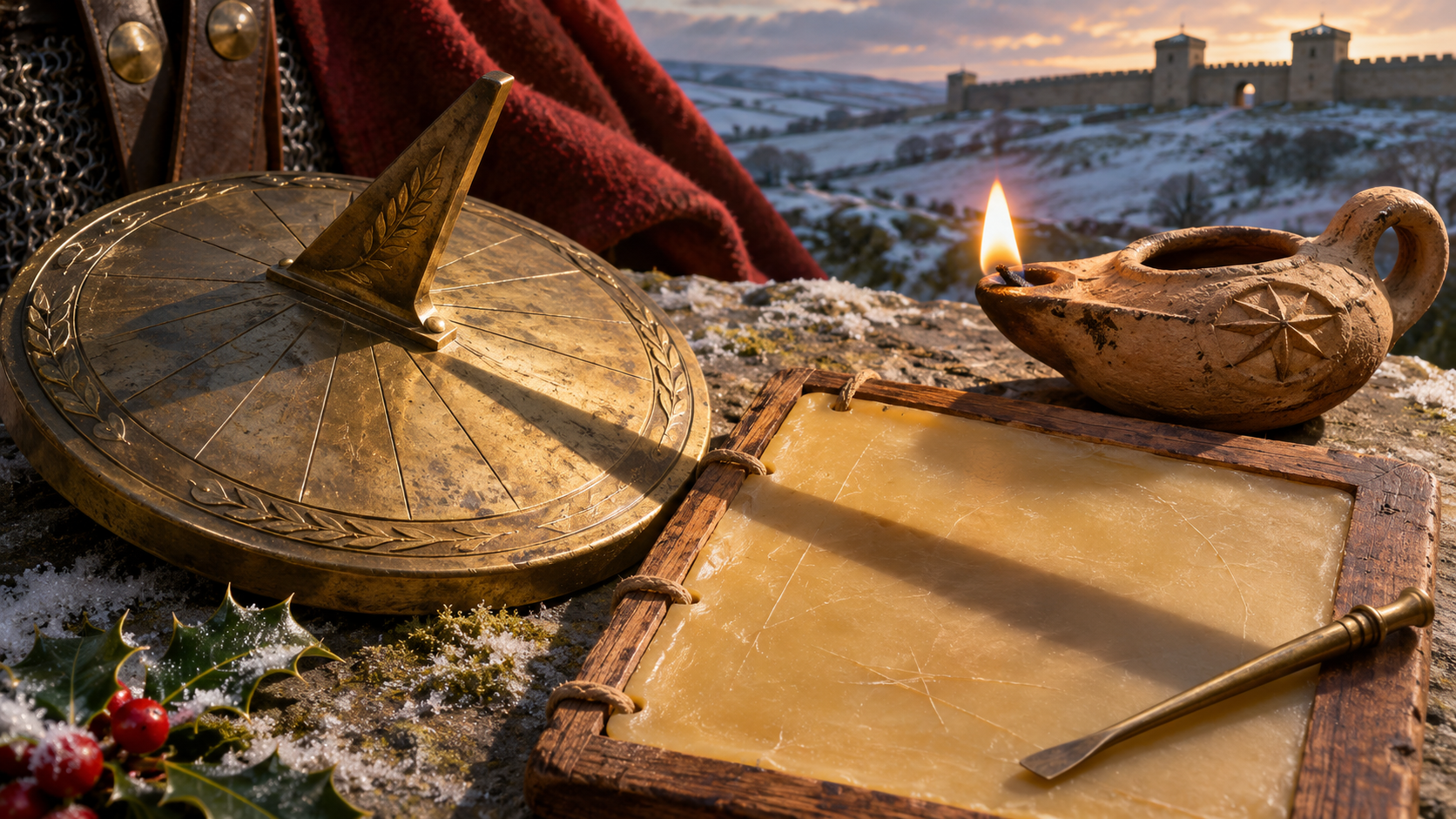
A Roman compilation commonly called the Chronography of 354 preserves material that includes a notice placing Christ’s birth in Bethlehem on 25 December. The list containing the notice is generally associated with AD 336. The distinction between those two years explains why accounts of the first Christmas sometimes give different dates. One date concerns the surviving compilation’s original production, the other the earlier material transmitted within it.
A calendar tells us what a community intended to remember on a recurring date. No secretary in fourth-century Rome had to possess Jesus’ birth certificate to enter the observance. The entry therefore provides good evidence for a Roman Christian practice, while leaving the historical birthday open. It also provides a latest point by which the custom existed there. The first surviving notice of an observance is seldom a record of the first person to propose it.
How March Could Have Produced December
One explanation starts at Easter. Early Christians devoted substantial energy to calculating when Jesus had died. In one Western reckoning the date was 25 March. Some Christians connected the date of his death with the date of his conception, giving his earthly life a symmetry that made theological sense to them. Count forward nine months and the Nativity falls on 25 December.
It is an unfamiliar way to approach a birthday. Most modern families know when a child was born and can only estimate when the pregnancy began. The ancient calculation runs in the opposite direction from a date already considered sacred. Its significance lies in showing how Christians could have arrived at a midwinter birthday through reflection on the Passion.
A parallel involving dates in early April and January has also interested historians, because 6 January became important in Eastern commemorations of Christ’s manifestation and, in some traditions, his birth. The differences between churches cannot all be reduced to one calculation. They do show that early Christians had more than one way of arranging the relationship between the Nativity and other events in Jesus’ life.
What About Roman Winter Festivals?
Romans already celebrated in December. Saturnalia began on 17 December and its festivities extended over several days. A solar observance on 25 December presents a closer calendar parallel. The image of light returning after the winter solstice also had obvious appeal for Christians who spoke of Christ as light. In the late Roman world people experiencing these connections lived in the same cities, under the same winter sky.
The difficult historical step is identifying who chose the Christian date and what they said about their reason. A matching date suggests a question. It does not preserve the minutes of a meeting. A Christian writer using solar imagery to explain Christmas may tell us a great deal about how an established feast was understood without revealing what first put it on the calendar.
Could Jesus have been born on 25 December? The surviving birth narratives leave that possibility open along with many others. What can be dated with much greater confidence is a moment in the fourth century when Christians in Rome could consult a calendar and find Bethlehem assigned to a particular winter day. We possess better evidence for how a city remembered the birth than for the weather on the night itself.
Sources
Luke — The shepherds and the birth at Bethlehem
Matthew — The visit of the Magi
Biblical Archaeology Review — How December 25 Became Christmas
T. C. Schmidt — Calculating December 25 as the Birth of Jesus
Next Reads
Why Is Christmas on 25 December? — Read the wider history of the date Christians chose for the Nativity.
The History of Good Friday and Easter — Trace how Christians came to commemorate the Passion.
Why the Number Three Keeps Appearing in Jesus’ Life and the Bible — Explore the patterns that connect the Gospel narratives.
