Who Removed Pilate From Power?
The Complaint That Cost Pilate His Job Came From Samaritans.
Pontius Pilate disappears from the Gospel narratives after authorising the execution of Jesus and dealing with its immediate aftermath. He carried on governing Judaea. The incident that eventually sent him on his way to Rome concerned a gathering near Mount Gerizim, a promise of sacred objects and a complaint about the use of force. The striking fact about Pilate’s fall is how little it had to do, in the surviving political account, with the decision for which the world remembers him.
The Jewish historian Josephus says Pilate was ordered to report to Emperor Tiberius. Before he reached Rome, Tiberius died. From there the reliable trail grows cold. Later writers offered exile, disgrace and suicide. None gives us the equivalent of a Roman judgement recording his sentence or a secure contemporary account of his death.
How Much Do We Know About Pilate’s Job?
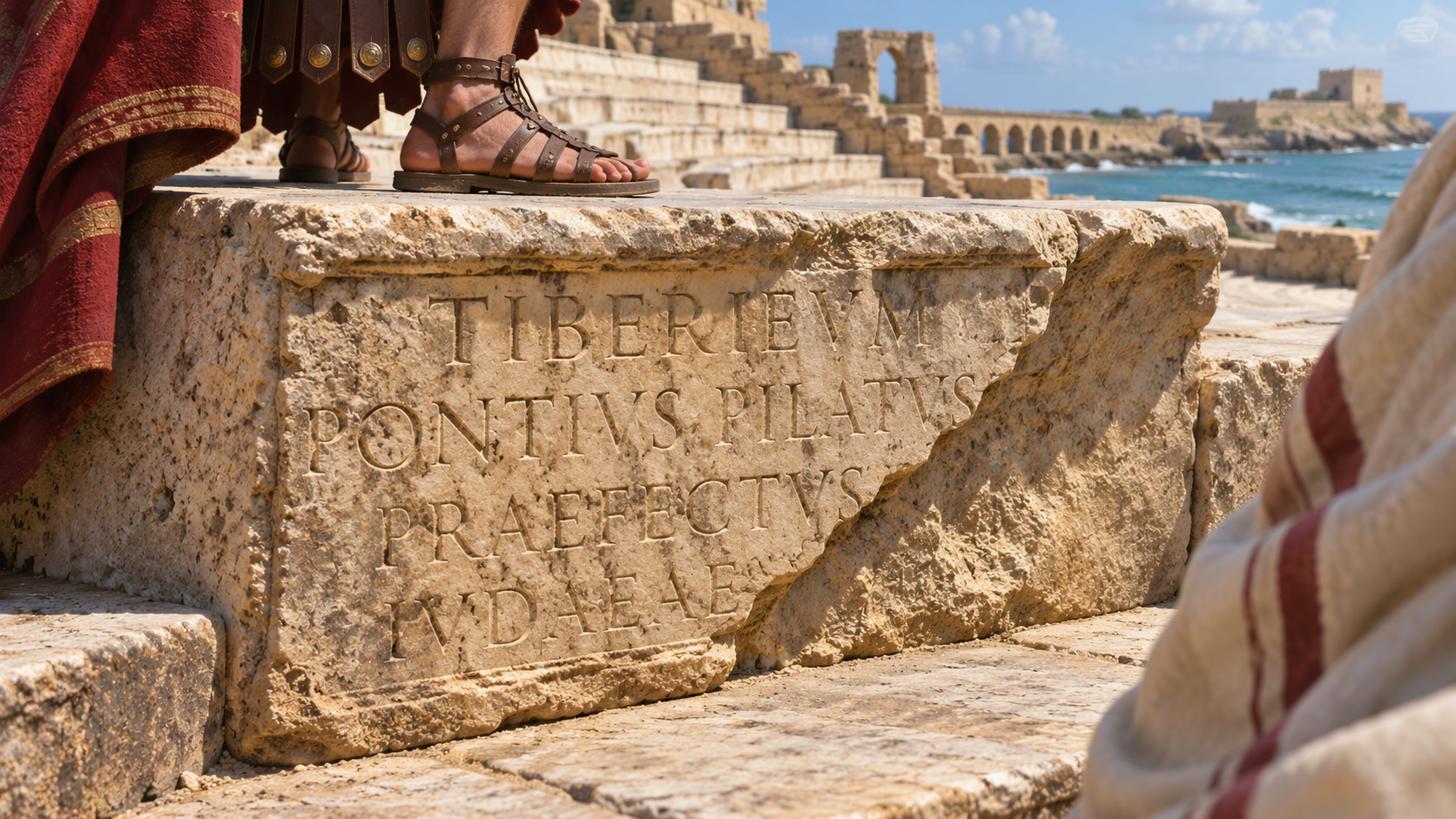
An inscription discovered at Caesarea Maritima names Pontius Pilate and identifies him as prefect of Judaea. Reused stone can make a surprisingly durable historical witness. The people who gave the block a new purpose had no obligation to preserve Pilate’s reputation. Part of his name and title survived the change. The inscription independently anchors him in the provincial administration.
A prefect had soldiers at his disposal and responsibilities for order. He also answered to superiors. From the viewpoint of people confronting him in Jerusalem, Pilate could exercise terrifying power. From the viewpoint of a more senior Roman official considering complaints about unrest, he was a subordinate whose conduct could create trouble for the empire. His final years make more sense when both perspectives are kept in view.
What Happened Near Mount Gerizim?
Josephus describes a man gathering Samaritans with a promise to reveal sacred vessels supposedly deposited by Moses on their holy mountain. Some participants came armed. Pilate deployed cavalry and infantry to block their movement. People were killed in the confrontation, prisoners were taken and leaders were executed.
The distinction between how the two sides understood the gathering mattered afterwards. An official could portray an armed crowd as a threat to public order. Samaritan representatives maintained that they had suffered unwarranted violence. Josephus was writing decades later, and his narrative is no verbatim transcript of either side’s submission. It nevertheless preserves the part that changed Pilate’s career. The people who complained knew where above his head to take the case.
They approached Vitellius, the Roman governor of Syria. He arranged for another official to take charge in Judaea and directed Pilate to Rome to answer before the emperor. This was a serious reversal. A change of office and an order to account for one’s actions, however, are observably different from conviction on a specified charge. Josephus takes us through the recall. He supplies no final hearing.
The Emperor Died Before Pilate Arrived
Tiberius died in March AD 37 and was succeeded by Gaius, better known as Caligula. For someone travelling to answer a complaint, that change mattered. The person before whom Pilate had been ordered to appear would never hear him. A new emperor had inherited an immense range of appointments, grievances and unfinished business.
It is tempting to complete the story according to what seems politically plausible. Perhaps the case lost urgency. Perhaps the new administration dealt harshly with an official associated with its predecessor. Without a surviving decision either reconstruction would turn a gap into an event. Even whether Pilate subsequently held another office remains uncertain.
Why Do Some Accounts Say Pilate Took His Own Life?
Centuries later the Christian historian Eusebius reports a tradition of grave misfortune and suicide under Gaius. His account belongs to a history concerned with divine justice. Pilate’s fate made a particularly inviting subject for a writer who wanted the events of the Passion to have consequences for the people involved. Other traditions attached his exile or death to places in western Europe.
These stories reveal a persistent desire to give Pilate a morally intelligible ending. Christian narratives could also treat him with surprising sympathy, developing the reluctance some Gospel scenes attribute to him. Neither hostility nor sympathy supplies the missing Roman record. The historical responsibility is plain enough without inventing his last hours. Jesus was crucified under his authority.
A stone at Caesarea preserves his official title. Josephus preserves the grievance that removed him. Between them they give us a man who exercised power, was challenged by people who survived its use and had to leave the province to answer for it. His name appears in a Christian creed recited across the world. The outcome of his own case in Rome is something no surviving court clerk can tell us.
Sources
Josephus — Antiquities, book 18, chapter 4
Eusebius — The later account of Pilate’s death
The Pilate inscription at Caesarea
Next Reads
The History of Good Friday and Easter — Trace how Christians came to commemorate the Passion.
How Much Were Judas’ 30 Pieces of Silver Worth? — Follow the betrayal money through Matthew’s account.
Why Forty Matters in the Bible — See how biblical time shaped a season of the Christian calendar.
