Can Science Identify an Apostle’s Bones?
One Bone Venerated In Rome Was Centuries Too Young To Belong To An Apostle.
A fragment of thigh bone in the Roman church of Santi Apostoli had long been associated with James the Younger. When scientists radiocarbon-dated it, they obtained a range of AD 214 to 340. The entire range falls well after the lifetime of Jesus’ disciples. The test answered a narrow question exceptionally well. Whoever the individual was, that bone could not have belonged to a man who followed Jesus in first-century Galilee.
Now walk across Rome to St Peter’s Basilica. Archaeology there has produced a different kind of answer. Beneath the church is an ancient cemetery and a small monument at the spot where early Roman Christians honoured Peter. Excavators can establish the antiquity of that devotion without being able to apply an equally decisive identity test to the bones. Those two Roman churches explain why asking where the apostles are buried yields a map of Christian memory more readily than twelve verified graves.
Peter and the Problem of Building on a Slope
The ground chosen for the first great basilica over Peter’s traditional burial place presented Constantine’s builders with an extravagantly difficult job. Tombs already occupied the Vatican slope. Parts of the cemetery had to be cut down or buried to create a level platform. One particular point received exceptional treatment. The little memorial at the heart of the tradition was preserved and incorporated into the new building.
This is unusually persuasive evidence that the site mattered before the emperor intervened. An earlier Roman Christian, Gaius, had already spoken of monuments associated with Peter at the Vatican and Paul on the road to Ostia. Writing and topography converge. Neither provides the name of a person who watched Peter’s burial and left a contemporary marker identifying his body. What can be followed across time is the location to which worshippers returned.
James, John and Philip Left a Trail of Buildings
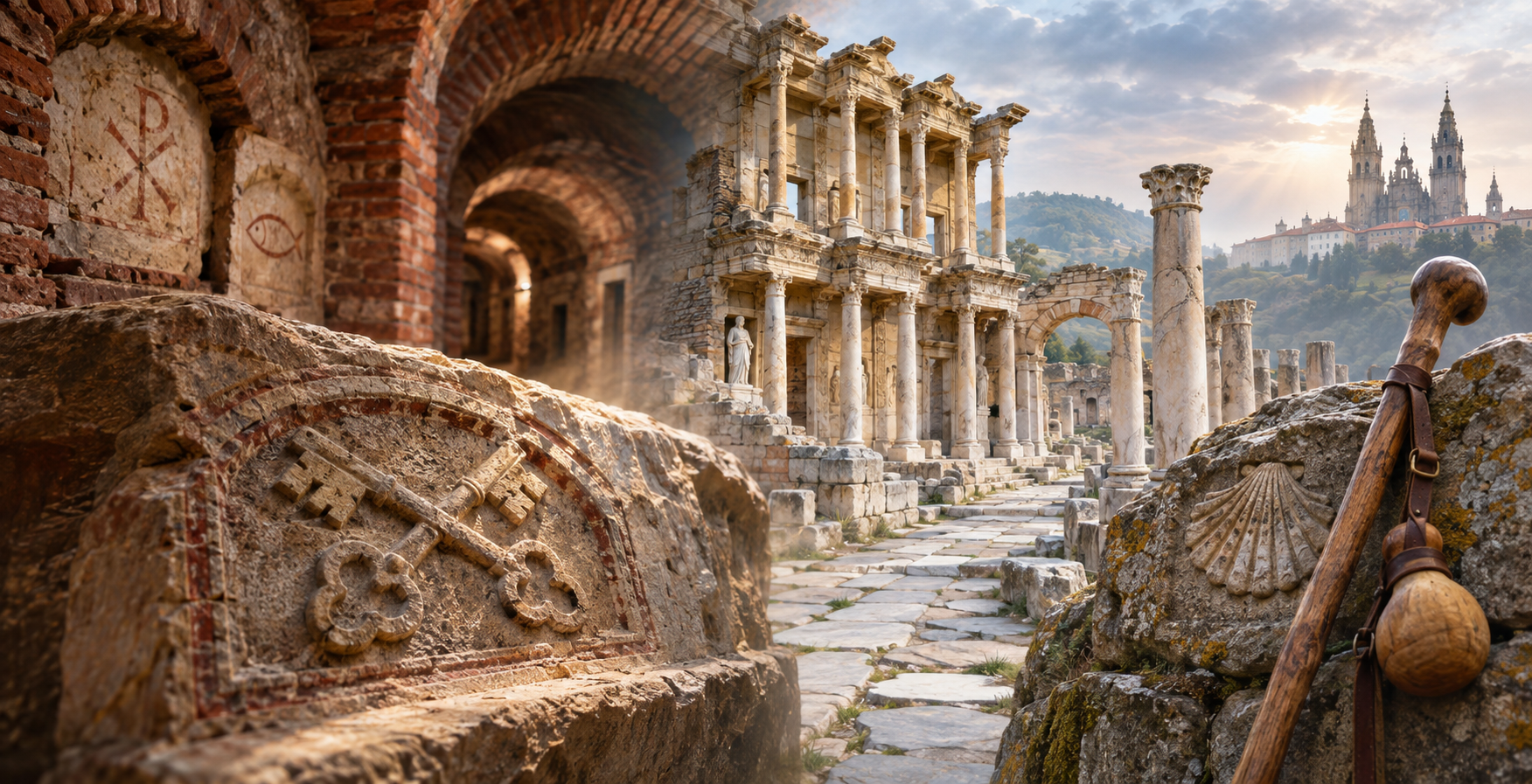
James the son of Zebedee is associated with Santiago de Compostela in Spain. His death is described in Acts in the setting of Herod’s rule in Judaea. Between the two places lies a tradition about the movement and later discovery of his remains. The medieval shrine and the pilgrimage roads leading to it are abundantly real. A modern pilgrim arriving in Galicia has completed a journey made meaningful by generations of predecessors. Demonstrating that James’s body made the journey would require evidence of a different order.
John’s traditional resting place at Ephesus in western Türkiye became the focus of a great basilica. At Hierapolis, also in Türkiye, early worshippers commemorated Philip. Excavated churches and a tomb associated with his veneration show how a pilgrimage complex could organise the movements of visitors around a particular place. The structures belong to the history of those visitors. An attribution on a pilgrim object would tell us whom people thought they were visiting, even if a first-century burial had left no identifying inscription.
Rome’s Santi Apostoli preserves relics attributed to Philip as well as to James. This is where it matters to keep the tested sample in view. The late radiocarbon result concerned the femur attributed to James. It cannot be transferred to every object in the church or used to date the Hierapolis tomb. A relic collection has to be examined item by item.
Why Several Cities Can Claim the Same Disciple
Andrew has traditions at Patras in Greece and Amalfi in Italy. Thomas is honoured at Mylapore in Chennai, while other traditions trace the movement of his remains through Edessa and eventually to Ortona in Italy. These claims often address different events. A place of death, a first grave and a church claiming a transferred relic can all appear on the same saint’s itinerary.
The medieval word for moving relics is translation. Encounter it in a shrine history and it can sound like a clerical exercise. In practice the arrival of relics could transform a city’s standing, attract pilgrims and establish a new annual festival. A detailed account of a medieval transfer might be excellent evidence for the final stage of a journey while leaving the previous thousand years obscure.
Bartholomew has important relic traditions in Benevento and Rome. Matthew is honoured at Salerno. Simon the Zealot and Jude have a shared relic tradition at St Peter’s in Rome. James the son of Alphaeus is traditionally identified with the James honoured beside Philip at Santi Apostoli, although early Christian men named James are unusually easy to conflate. Judas Iscariot has no comparable apostolic shrine with a securely identified body. The field associated with him in Jerusalem belongs to a story about land and death. Matthew describes its purchase as a burial place for strangers and never says his own body was buried there.
Could Science Ever Identify One of the Twelve?
A date outside a person’s lifetime can be decisive. A date inside it usually leaves thousands of possible identities. DNA could establish relationships between appropriately preserved samples, but a comparison is only as strong as the independently identified relative used as a reference. An inscription discovered in an undisturbed burial context could make a much greater difference, particularly if its wording, date and archaeological setting converged.
Meanwhile the graves remain worth visiting for a reason a laboratory cannot measure. At Santiago the roads themselves preserve the movement of pilgrims. At the Vatican the builders’ decision survives in brickwork and changes of level. In Rome an anonymous person who lived generations after the apostles was honoured under James’s name for centuries. A map that distinguishes those histories gives a traveller far more to see than twelve identical pins.
Sources
University of Southern Denmark — Testing the remains attributed to two apostles
St Peter’s Basilica — The early memorial to Peter
Christian Archaeological Society — Saints and Pilgrims in the Lykos Valley
Finestre sull’Arte — The apostles’ traditional shrines
Next Reads
The History of Good Friday and Easter — Trace how Christians came to commemorate the Passion.
Why the Number Three Keeps Appearing in Jesus’ Life and the Bible — Explore the patterns that connect the Gospel narratives.
How Much Were Judas’ 30 Pieces of Silver Worth? — Follow the betrayal money through Matthew’s account.
