The Nail That Stayed in a Roman Heel
A Five-Centimetre Nail Passed Sideways Through A Man’s Right Heel In Cambridgeshire.
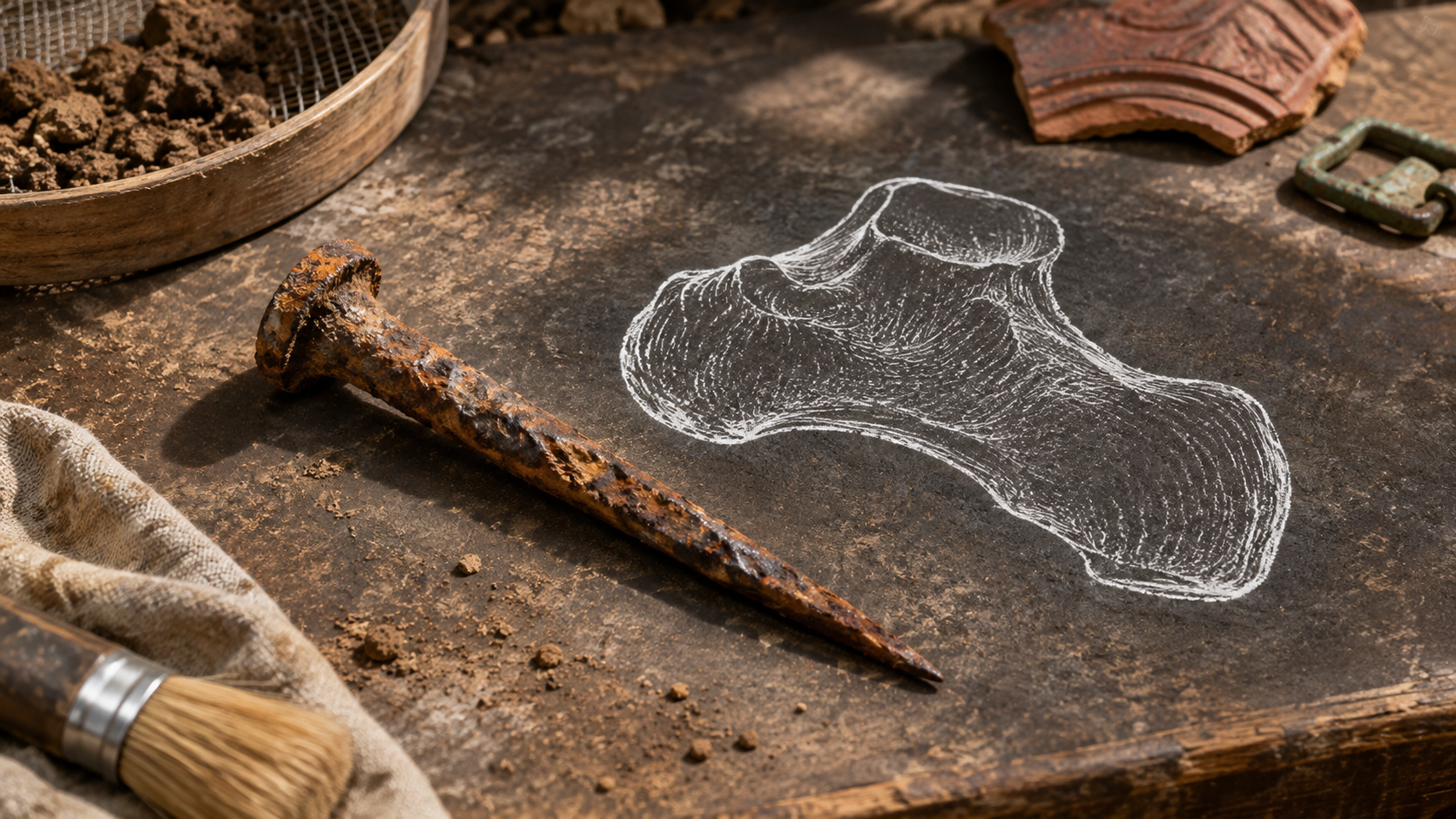
In 2017 archaeologists investigating land at Fenstanton, between Cambridge and Huntingdon, excavated a Roman cemetery. One grave contained a man laid out for burial much like his neighbours. Nails in a Roman grave would ordinarily attract a fairly mundane explanation. Wood disappears while its iron fittings survive. This nail, however, remained inside a heel bone. Its position made the man one of the clearest archaeological examples of Roman crucifixion anywhere in the empire.
The discovery answers a question paintings can leave a viewer unaware of asking. A nail could enter a heel from the side. That modest sentence has considerable historical value. It describes what happened to one actual person and establishes a possibility for understanding an execution practice more commonly reconstructed from texts and religious art.
Why a Nail Among Bones Is Usually Ambiguous
Archaeologists recover nails from coffins, boards, footwear and disturbed layers of settlement. A nail lying near a foot can move as wood decays, a body decomposes or soil enters a burial. Its final position might differ considerably from the place it occupied when the grave closed. For that reason an iron object near a skeleton requires an argument before anyone can call it evidence of an execution.
At Fenstanton the nail ran horizontally through the right calcaneus, the large bone at the back of the foot. The distinction is easiest to appreciate by picturing a footprint. The calcaneus bears weight under the heel. Driving a nail sideways through it leaves a different path from driving one down through the top of a foot. The bone itself fixes part of the geometry of what happened. No artist has to choose the route on the victim’s behalf.
The excavation took place ahead of development on land formerly occupied by a milk-bottling plant. Five small cemeteries yielded adults and children. The man catalogued as Skeleton 4926 acquired an international audience through one unusual find. The rest of the burials supply a corrective to the fame of his injury. This was somewhere people lived and buried their dead over time. It became an archaeological site because an ordinary modern land use was changing.
A Jerusalem Find Makes the British Evidence More Valuable
A first-century burial in Jerusalem had already produced a comparable discovery. Human remains placed in an ossuary, a container for bones, included a heel pierced by an iron nail. The associated name is usually rendered Yehohanan. Here was physical evidence from the region and broad period in which Jesus lived. Fenstanton brought a comparable injury to light in a distant Roman province and at a later date.
Two finds do not make a representative sample of the Roman Empire. They do make it harder to dismiss lateral nailing of a heel as a peculiarity imagined by a modern reconstruction. Geography matters in both directions. The separation makes the parallel striking and prevents historians from assuming the victims shared an executioner, a local custom or a religious identity.
The comparison also changes how the burial itself looks. Both men came within reach of archaeologists because someone buried them. In Jerusalem the remains were gathered into an ossuary. In Britain a body was laid in a grave within a cemetery. These discoveries demonstrate that crucifixion could be followed by burial. They cannot tell us what proportion of victims received it. People whose bodies vanished without trace are precisely those least likely to appear in an excavation report.
Why Have So Few Nails Survived in Victims?
Most of the conditions needed for a find like this work against one another. A victim must leave recoverable remains. A nail must pierce bone, stay in place and survive long enough to be recognised. Fastening through soft tissue could leave little skeletal evidence. Ropes would usually decay. Removing a nail after death would separate the object that archaeologists need from the injury that gives it meaning.
Then the burial must escape later destruction, lie within a project’s excavation area and receive sufficiently careful examination. It is impossible to work backwards from the surviving examples to a reliable count of executions. The archaeological rarity belongs partly to the way injuries enter the record. It tells us remarkably little on its own about how common the punishment was.
What Does It Tell Us About Jesus?
It gives historians a credible physical comparison for the mechanics of crucifixion. It cannot identify the shape of Jesus’ cross, the position of his feet or how many nails were used in Jerusalem on that occasion. The Fenstanton man’s hands and the arrangement of the supporting timber cannot be reconstructed simply by following the nail in his heel.
Nor does the injury establish that this man was a Christian. Rome used crucifixion as a punishment long before anyone in Britain could have associated a cross with a church. His name, the accusation against him and the identity of whoever arranged his burial remain unknown. One detail of his death is clearer than almost anything about his life. For a man rendered anonymous in the historical record, that is a powerful discovery and an uncomfortable measure of how little survives.
Sources
University of Cambridge — The Fenstanton excavation and heel bone
Cambridgeshire County Council — The remains and their exhibition
Center for Online Judaic Studies — The ossuary of Yehohanan
Next Reads
The History of Good Friday and Easter — Trace how Christians came to commemorate the Passion.
How Much Were Judas’ 30 Pieces of Silver Worth? — Follow the betrayal money through Matthew’s account.
Why Forty Matters in the Bible — See how biblical time shaped a season of the Christian calendar.
