The Wise Men Had Three Gifts. Who Gave Them Names?
Matthew Counts The Gifts And Leaves The Travellers Unnamed
A child dressed as the third king has a perfectly reasonable question. Which present is mine? A carol, a costume cupboard or a set of nativity figures can supply an answer. The Gospel of Matthew cannot. Its visitors open their treasures together, and the only things the writer takes the trouble to distinguish are gold, frankincense and myrrh.
Matthew calls the visitors magi from the East. He gives them a question about a newborn king, a star they have seen and a dangerous interview in Jerusalem. He leaves their number, personal names and precise homeland open. The familiar three kings emerged as successive generations read other biblical passages alongside Matthew, represented the visitors in art and gave them individual parts to play. One detail often lost along the way is that the king whom Matthew actually introduces by name would very much like to know where the child is.
The First Door They Knock On Is In Jerusalem
Matthew begins the visit after Jesus has been born in Bethlehem in Judaea, during the reign of Herod. The visitors arrive in Jerusalem asking where they can find the newborn king of the Jews. Readers already possess the name of the town the travellers need. The delay looks curious if the star functions as a navigation device delivering precise directions from the beginning of the journey. It makes excellent sense if the travellers have recognised a royal sign and gone first to the seat of power.
Jerusalem contains people with information the visitors lack. Herod assembles chief priests and scribes to ask where the Messiah is to be born. They identify Bethlehem from scripture. The story thus assigns different knowledge to different people. Specialists from elsewhere recognise a sign in the heavens. Local interpreters can name a town. A ruler has the authority to summon both parties and a use of his own for anything they can tell him.
The contrast between the two interviews is easy to miss. Herod asks the local scholars a question about place. When he has the visitors to himself he asks a question about time. Their combined answers give him information that neither group could have supplied on its own.
Herod interviews the magi privately about the time the star appeared. He sends them to investigate and asks for a report, claiming that he too wishes to pay homage. The audience will discover what that request conceals. On the return journey a warning in a dream persuades the travellers to take a different road. For all the attention bestowed on the star, their last important decision concerns whether to trust a man who has given them quite accurate directions.
What Did A Magus Do?
The singular of magi is magus. Matthew's Greek word, magoi, belonged to a wider ancient vocabulary for eastern religious or learned specialists. Its associations could include interpreting dreams and celestial signs. The English rendering “wise men” conveys respect but gives little sense of what these particular visitors do. Astrologers comes closer to their reading of a birth from the sky, although the word can suggest a modern horoscope column.
A modern distinction between astronomy and astrology would have made a poor organising principle for their work. A person might observe the movement of a planet carefully and also regard its appearance as news about a ruler. Accuracy in recording a position and belief in the political meaning of that position could coexist. Matthew assumes that his visitors know how to read the heavens. He spends no time teaching his audience their method.
Persia and Babylonia are plausible settings to consider when imagining learned observers east of Judaea. The term magi has Persian associations, while Mesopotamia had a long tradition of observing and interpreting the sky. Neither fact tells us which city Matthew had in mind, what language his visitors spoke at home or how many weeks they spent travelling. Even a confident identification of their professional background would be a poor substitute for a departure point.
Their outsider status does more work in the narrative than their passports could. People at a distance have recognised that something important has happened in Judaea. Their arrival unsettles people much closer to the event. The contrast is sometimes turned into a judgement against an entire population. Matthew's own cast makes that reading crude. Jewish scripture supplies the destination. Jesus and his family are Jewish. The individual who exploits the visitors' knowledge has a particular interest in keeping a throne.
When Did The Wise Men Become Three Kings?
A party carrying three kinds of treasure is easily imagined as three bearers. For an artist planning a composition, that arrangement offers an obvious advantage. Each person can approach the child with a recognisable object, and the viewer can follow the movement towards Mary figure by figure. Other arrangements were possible. Early Christian art includes scenes with two visitors and with four. Some Syriac traditions entertained as many as twelve.
Those variations are more informative than a search for the first artist who counted to three. They show that early audiences could recognise the subject before the cast was fixed. A procession, a mother and child, an act of homage and something valuable to present were sufficient. Once a three-person arrangement became familiar, it could seem as essential to the event as the gifts that originally made it convenient.
Royal status came by a different route. Isaiah 60 imagines nations drawn towards light and kings towards its brightness. It describes camels and people bearing gold and frankincense. Psalm 72 envisages kings bringing tribute and bowing before the ruler. A Christian reader who heard those passages alongside Matthew could understand the visitors' journey as a fulfilment of hopes already embedded in scripture. The similarities are specific enough to explain the attraction of that reading.
There are also revealing differences. Isaiah's poem addresses Zion. Matthew's visitors leave Jerusalem to find the child in Bethlehem. Isaiah has two of the named gifts, while Matthew adds myrrh. Psalm 72 can explain why a reader pictured kings, but Matthew never gives the magi crowns or kingdoms. Even the camels have a clearer textual home in Isaiah than they do on the journey described in the Gospel.
Imagine the scene with the visitors temporarily relieved of their crowns. Its royal tension becomes easier to hear. A king in Jerusalem learns that another king has been born. Visitors who have approached the reigning monarch go on to bow before the child. Put three more kings in the room and the act becomes the submission of royalty from across the world. That is a meaningful development in Christian interpretation. It also changes the drama.
Who Named Caspar, Melchior And Balthazar?
The names familiar in Western Europe took shape in Christian traditions outside the New Testament. Spelling varies, with Gaspar alongside Caspar and Balthasar alongside Balthazar. Other communities handed on different names. An Armenian infancy narrative, for example, associates named rulers with Persia, India and Arabia. A map that assigns one country to each visitor tells us which tradition somebody has followed.
In the basilica of Sant'Apollinare Nuovo in Ravenna, three figures in patterned clothing lean forward with their offerings. Their names appear above them. The sixth-century mosaic is a memorable witness to the Western trio, although scholars have raised the possibility that the inscriptions themselves were added later. A date for the surrounding artwork should never be made to do service as a secure date for every letter now visible on it.
Giving an unnamed character a name changes what a picture can do. A viewer can recognise Balthazar across different scenes, wonder which gift he carries and imagine where he ruled. Ages, countries and physical appearances can then distinguish one king from the next. In European art, a Black African king became an especially significant part of the group. Artists' choices changed across centuries and regions. They reveal how particular societies pictured the peoples of the wider world.
It is tempting to treat one visual convention as if it recovered something Matthew had omitted by accident. Yet there is no lost line in the Gospel that a later artist can be seen restoring. The named figures belong to the history of a story being adopted across languages and cultures. Their long lives in churches, households and public celebrations are historical facts in their own right. They need no invented first-century biographies to make them interesting.
What Gold, Frankincense And Myrrh Were Worth As Gifts
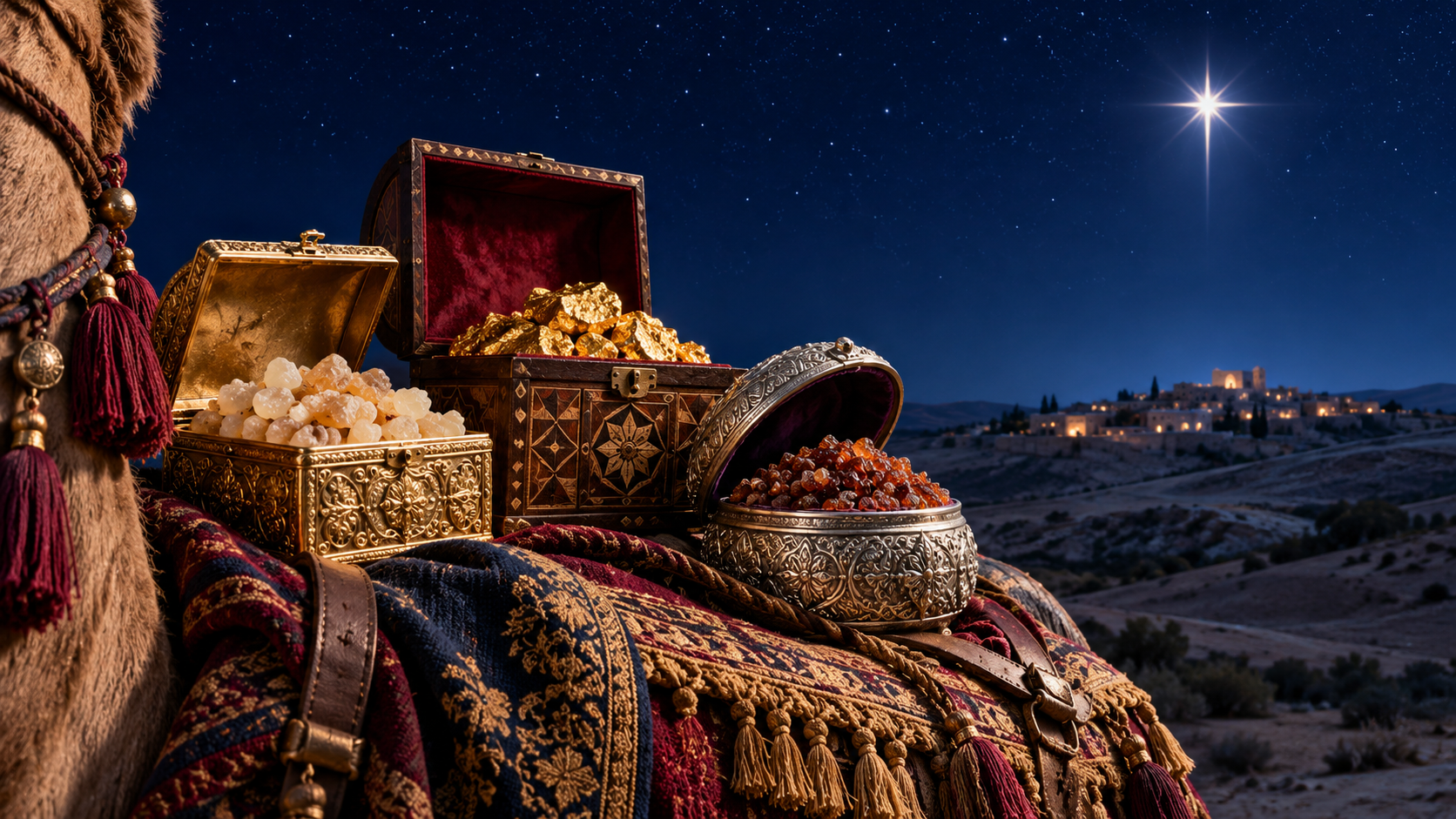
Gold needs little translation for a modern reader. The other two gifts can sound like exotic substances chosen solely to satisfy a Christmas carol. Both are aromatic tree resins. Frankincense produces fragrant smoke when burned. Myrrh had uses in perfume and preparations for the body. Materials that could be transported, stored and offered in small quantities made excellent high-status gifts. Their importance is easier to grasp if we picture people actually handling them.
The combination also had a life outside Christianity. The Getty notes that in the third century BC the Hellenistic king Seleucus II offered gold, frankincense and myrrh to Apollo's temple at Miletus. That parallel establishes something modest and valuable. An ancient audience could recognise such goods as prestigious offerings. It does not establish that Matthew knew the record of that donation or based his narrative on it.
Christians soon read a second meaning into each substance. Irenaeus, writing in the second century, associated gold with kingship, frankincense with divinity and myrrh with death and burial. The interpretation invites a reader to take in the whole life of Jesus at the moment the visitors first see him. The last gift acquires particular poignancy for a reader familiar with the account in John in which myrrh is brought after the Crucifixion.
Matthew does not record three speeches in which the visitors explain what they are presenting. Nor does he identify the man carrying the myrrh or describe Mary's reaction to it. Those silences leave room for later poetry and drama. They also preserve the immediate effect of the scene. People with portable wealth enter a house, see a child with his mother, bow and give away some of what they have carried. Their actions disclose whom they recognise.
Could Astronomy Identify The Star Of Bethlehem?
A much-discussed candidate is the series of close apparent approaches of Jupiter and Saturn in 7 BC. The planets can seem to draw together, separate and approach again as the Earth and the outer planets move in their orbits. Modern calculations can reconstruct where the planets appeared against the background stars. That is a genuine achievement. It answers a different question from whether a particular ancient observer interpreted the event as the birth of a Jewish king.
A conjunction need not produce one dazzling point of light. Two planets can be visibly distinct and still form a striking arrangement for a trained observer. This helps explain how something significant to the magi might have passed without public excitement in Jerusalem. It also increases the number of possible candidates. If what counts is a meaning available only to specialists, brightness alone will never identify the event we want.
A comet offers a more immediately recognisable visitor to the sky. A nova, in which a star brightens dramatically, offers another way for an apparently new light to appear against a familiar background. Each proposal explains a different part of a modern reader's mental picture. A comet can appear over successive nights. A nova can seem to have appeared where there was previously nothing to catch the eye. Matthew supplies no measurements of brightness, angular separation or duration against which to test either idea securely.
The last stretch of the journey is the hardest for a purely astronomical reading. Matthew says the star goes ahead and stands over the place where the child is. Something seen at astronomical distance can indicate a general direction to an observer. Walk to the house next door and the same object will occupy essentially the same position relative to the distant sky. The language reads naturally as particular guidance within a religious narrative. A reconstruction of planetary positions has no equivalent of a house number.
Another biblical text helps explain why a star might signify royal authority in the first place. In Numbers 24, Balaam's oracle places a star coming from Jacob alongside a sceptre arising from Israel. Someone reading Matthew in the light of that passage has an interpretive route from a light in the sky to a king on earth. The literary connection and the possibility of a remembered sky event can coexist. Neither supplies the missing independent observation that would settle the astronomical question.
Did The Magi Arrive On Christmas Night?
Matthew locates the family in a house when the visitors enter. Luke describes a newborn laid in a manger and shepherds who go to see him. The two writers organise their infancy narratives around different visitors and different signs. The shepherds are told what they will find. The magi have a harder time working out where to go. A nativity scene puts both journeys within a few feet of each other so that a viewer can see them at once.
Matthew gives one clue often pressed into service as a birthday certificate. Herod orders the killing of boys in Bethlehem and its surroundings aged two and under, using the information he had obtained from the magi. The order tells us the range Herod chose to cover in the story. It does not tell us that Jesus had celebrated his second birthday, any more than a search for every child below school age tells us the precise age of the child being sought.
There is no mileage to calculate, no stated speed of travel and no date of departure. We cannot derive an interval of twelve days from Matthew either. In much of Western Christianity the visit is celebrated at Epiphany on 6 January, following Christmas on 25 December. The calendar allows people to attend first to the birth and then to its recognition by visitors from elsewhere. It is a pattern of worship developed by a community remembering the story.
There is a consequence for how the pictures themselves should be read. A crib containing shepherds, an ox, three kings and a star is designed to gather a congregation around the child. Its maker can collapse several moments into one space without making a claim about simultaneous arrivals. Much the same thing happens when a church window places scenes from different parts of a life above one another. Nobody needs to suppose that the events in the upper pane took place upstairs.
Read the two Gospels separately and details that disappear in the combined picture come back into focus. Luke gives the shepherds people to tell after their visit. Matthew gives the magi a powerful person from whom information must be withheld. Publicising what they have seen is part of one account. Discretion is essential to the other. That difference has a direct bearing on the safety of a family who will shortly be warned to leave for Egypt.
That distinction matters most when the kings have finished handing over their gifts. In a nativity play they can bow, leave the stage and return for the applause. In Matthew they must decide how to go home. Giving Herod the child's address would serve the king who received them in Jerusalem. Leaving by another road protects the stranger they have just honoured. Matthew tells us nothing about how many crowns passed through that doorway. He is remarkably precise about which king went without an answer.
Sources
USCCB — Matthew 2 — The two stages of the journey, gifts, house and return route.
Biblical Archaeology Society — Witnessing the Divine — Early depictions, varying numbers and the inscriptions at Ravenna.
J. Paul Getty Museum — Balthazar’s Gift — The resins, an earlier royal offering and the history of Balthazar in art.
Colin Humphreys — The Star of Bethlehem: A Comet in 5 BC and the Date of the Birth of Christ — One astronomical reconstruction combining a planetary conjunction with a later comet.
Next Reads
Why the Number Three Keeps Appearing in Jesus' Life and the Bible — How to distinguish a biblical count from a number supplied by tradition.
The History of Good Friday and Easter: How a Sacred Story Became a Global Season — How the Passion narratives became observances in the Christian year.
The Abrahamic Religions Explained: How One Ancient Idea of God Changed the World — The Jewish setting from which Christianity emerged.
