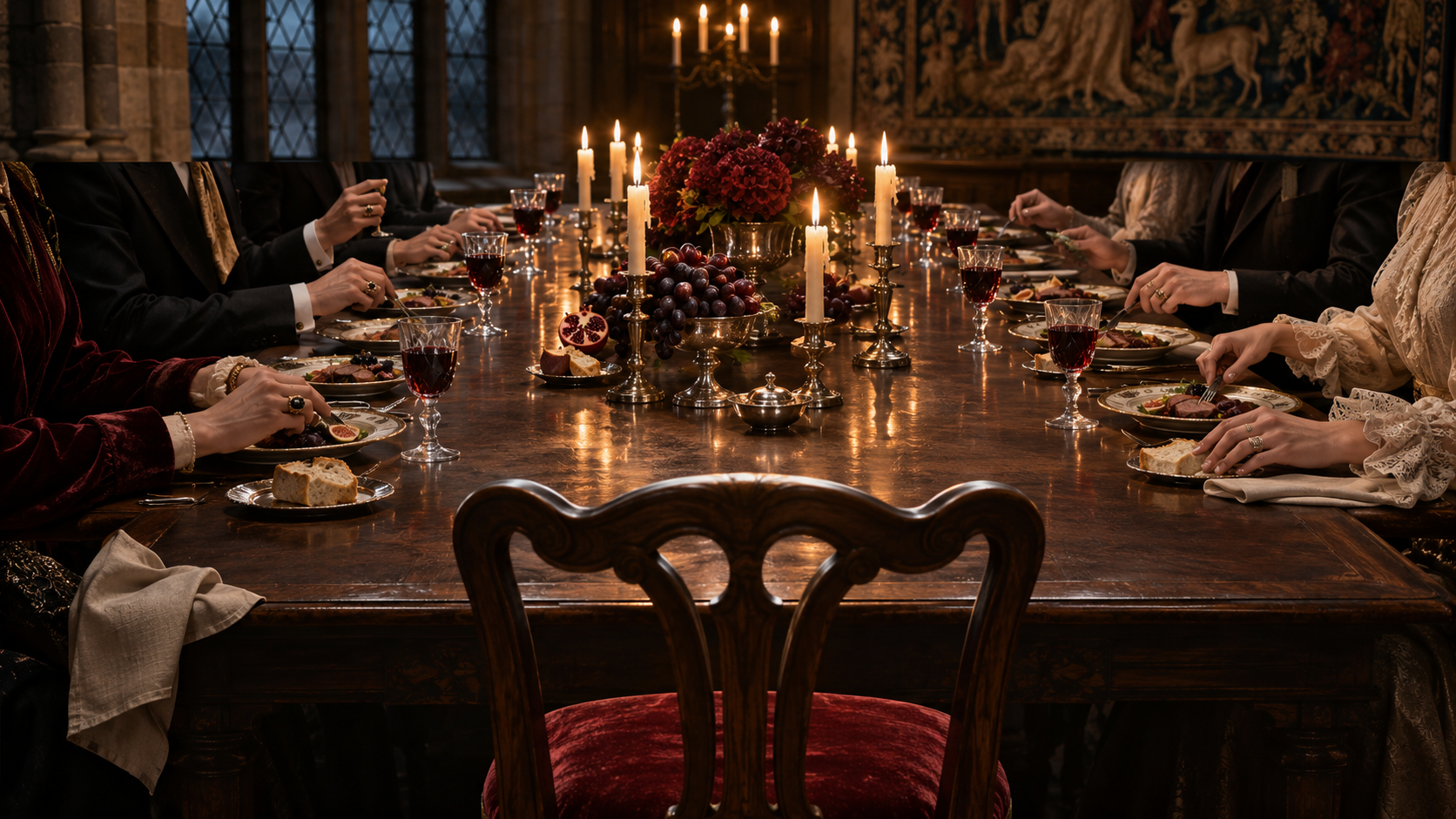
Why would a host who had invited thirteen people to dinner feel better after inviting one more?
An Extra Place At Supper Helps Explain How A Number Acquired A Reputation
Suppose twelve people have agreed to dinner and somebody asks to bring a friend. The old superstition gives the host two ways out. Find a fourteenth guest or lose the thirteenth. Neither solution would help if the trouble lay in the date on the invitation. Yet these two fears, of thirteen at table and of Friday the 13th, have become so closely associated that one is routinely offered as the explanation for the other.
The Last Supper gives Christians a powerful image of thirteen people sharing a meal before a betrayal. The Gospel chronology places the Crucifixion on a Friday. Neither story identifies Friday the 13th as unlucky. The clearest early printed evidence for the combined superstition comes from much later, including nineteenth-century France. The distance between those facts is where Judas, a Norse god, a French king and a remarkably determined group of New York diners enter the story.
What The Gospels Let Us Count
In Matthew 26, Jesus sits down for the evening meal with the Twelve. Mark 14 also describes his arrival with the Twelve. Add Jesus and the familiar thirteen figures in paintings of the Last Supper make sense. It is an inference from an identified group. Neither evangelist pauses to total the company or remarks that the number around the table carries a warning.
The designation that does matter is the Twelve. Jesus has chosen a circle of followers whose number recalls the tribes of Israel. Judas belongs to that circle. When Mark identifies him in the events leading to the arrest, the reader repeatedly encounters his membership of the group. The troubling arithmetic, if there is any, is that a betrayer can be found among the twelve people closest to Jesus.
The disciples' response makes the point painfully well. At the announcement that one of them will betray him, they begin asking whether it could be them. Nobody counts the places or looks towards an extra chair. A companion who shares the dish can hand Jesus over. That breach of trust gives the meal its force before a later storyteller has supplied a single detail about where Judas sat.
Calling Judas the thirteenth guest quietly adds an order of arrival. It requires somebody else to have been twelfth and a moment when the company was safely complete before Judas joined it. Matthew and Mark provide no such sequence. In John's account Judas leaves the supper after receiving a piece of bread. A departure is part of the narrative. His supposedly disastrous late arrival belongs to its afterlife.
How A Meal Became A Rule Of Hospitality
A belief about thirteen at dinner makes a prediction that the Gospel accounts never make. In one familiar version a member of the company will die within the year. Other tellings narrow the danger to whoever gets up first. The difference matters to the diners. One version makes attendance hazardous, while the other turns the end of dinner into an awkward negotiation over who will push back a chair.
As an explanation for a custom, the Last Supper has an obvious attraction. A listener already knows how the evening ends. Retell the story backwards, starting with the death of Jesus, and the count can begin to sound prophetic. Tell it forwards, as the evangelists do, and people make decisions at every stage. Judas agrees to hand Jesus over. Armed men arrive to take him. The proceedings before the authorities follow. A guest list explains none of their actions.
The old table belief also has a social life independent of anybody's theology. A host can add a place to spare an anxious guest embarrassment. Somebody observing the extra invitation may carry the practice into another household without ever asking about Judas. Customs can travel through courtesy, imitation or a joke. Their movement does not require every participant to know a common origin story, much less to have learned it in childhood.
This makes it hard to reconstruct a superstition merely by asking people why they observe it. Their answers are evidence of explanations in circulation at the time they speak. To establish that the explanation started the practice, a historian needs an earlier witness, some indication that people understood the connection then, and ideally some trace of how others took it up.
What Good Friday Contributes
Mark gives the evening after Jesus dies unusual urgency. It is the day of Preparation, immediately before the Sabbath. Joseph of Arimathea asks Pilate for the body. With the Sabbath approaching, burial cannot be put off casually. Read against the Jewish week, the timing places the death on Friday. The Gospel supplies a sequence of days even for readers whose translation uses a description in place of the weekday's modern English name.
Good Friday preserves that association within Christian worship. Its solemnity is easy to understand. Calling it an unlucky day takes a further step. Christians commemorate the death as part of the story of salvation. They have good reason to set the day apart even if they think Friday an entirely suitable day to travel, sign an agreement or invite somebody round for supper.
There is a second obstacle to treating the Passion as the record of the first Friday the 13th. The accounts situate events around Passover. Translating between ancient Jewish dates and the later civil calendar involves different months and different ways of marking the start of a day. The Gospel writers give readers no recurring instruction about a Friday falling on the thirteenth day of their own month.
And the famous meal belongs to the evening before the Crucifixion in the familiar Christian sequence. To obtain the modern date explanation, a storyteller takes the size of the company from one episode and the weekday from another. That combination is perfectly intelligible as folklore. It tells us something about which parts of the Passion story remained familiar enough to bear the weight of a new association.
Loki And The Guest List That Went Missing
In a widely repeated Norse version, twelve gods are feasting when Loki arrives uninvited. As guest number thirteen he brings disaster, engineering the death of Baldr through the unwitting Höðr and a weapon made from mistletoe. Sometimes the whole company is placed in Valhalla. The narrative has the economy of a good dinner-table anecdote. Every memorable feature seems to explain some part of the superstition.
The surviving stories are less accommodating. In the account of Baldr's death in the Prose Edda, the gods enjoy testing his extraordinary protection against harm. Loki discovers that mistletoe is an exception and helps the blind Höðr strike him. The fatal weakness is the overlooked plant. The text does not identify the killing as the consequence of a thirteenth guest arriving at a feast.
A different Norse poem, Lokasenna, does have a feast at which Loki makes himself thoroughly unwelcome. He quarrels with the assembled company and trades insults. That supplies good material for a story about an offensive arrival at dinner. It still leaves a modern reteller to produce the numbered invitation list and to place Baldr's death at precisely that event.
Folklorist Stephen Winick examined the claim for the Library of Congress. His comparison illustrates a difficulty with citing a whole mythology as a source. Individual details can belong to genuine old stories while the connecting scene belongs to a later writer. A reference to the Eddas sounds impressive until someone asks which passage has twelve guests waiting for a thirteenth.
It would take a different kind of evidence again to show that Europeans learned to fear a date from that particular story. Even an authentic medieval banquet with thirteen diners would establish only that the tale existed. Someone would still have to explain when or where hearers began applying it to Fridays on a calendar. The familiar Loki account fails before it reaches that second question.
What Happened To The Knights Templar On 13 October 1307?
Here the famous date survives scrutiny. On Friday 13 October 1307, officers acting for Philip IV of France arrested members of the Knights Templar in France. The military religious order faced accusations and proceedings that ran for years. Its formal suppression came later. A single morning of arrests makes a dramatic opening to that history, even though the order's fate unfolded over a much longer period.
The alleged consequence is far less secure. There is no established chain of evidence showing that the arrests made subsequent Fridays the 13th unlucky. An arrest order can document what happened on a particular day. To turn that event into the origin of a popular custom requires evidence from people who remembered it each time the weekday and date coincided. The records most often invoked to prove the date cannot also prove that later response.
There is an easy way to see the problem. Imagine discovering that a king had lost a battle on Tuesday the 17th. A contemporary chronicle could establish the loss and a calendar could confirm the weekday. Neither would tell you whether a household a hundred years later hesitated to hold a wedding on Tuesday the 17th. That would require evidence about the household or the custom. It cannot be calculated from the battle.
The Templar connection works especially well for modern audiences because it comes with a precise day, month and year. The explanations involving Judas and Loki sound like stories. This one looks like a fact that can be checked in an archive. The true part has indeed been checked. Its precision makes it easier to miss the much larger claim attached to it, for which the archive has yet to supply comparable evidence.
When Friday And Thirteen Appear Together In Print
Nineteenth-century French writing offers something the medieval arrest records cannot. It puts unlucky Friday and thirteen together in the mouths or minds of people dealing in contemporary beliefs. Winick identifies two suggestive examples from 1834. One is a character in a play attributing his misfortunes to having been born on a Friday, the thirteenth of December. A fictional character is a perfectly good witness to a joke an audience was expected to recognise.
There are limits even here. Does the speaker dread any Friday the 13th, that particular December date, or the combination of two things each unlucky on its own? Early examples can sit between those categories. Later French references make the general belief clearer. A line of dialogue need not settle the question of priority to be much better historical evidence than an account of a fourteenth-century event to which the belief was attached afterwards.
An often-cited English-language example concerns the composer Gioachino Rossini, who died on Friday 13 November 1868. In a biographical account published the following year, Henry Sutherland Edwards remarked on the combination in connection with Rossini's supposed feelings about Fridays and thirteen. The passage is evidence that an English-language reader could be expected to understand the association. It would be a stretch to credit either Rossini or his biographer with inventing it.
The distinction is worth keeping whenever an origin story offers a first. The oldest example a researcher has located sets a date by which an idea was available. Spoken jokes, family rules and casual observations rarely leave an orderly paper trail. An earlier printed reference may yet turn up. What the existing examples give us is a period in which the connection was becoming visible, along with the wording people actually used to make it.
The Dinner Club That Tried To Tempt Fate
In New York in 1882, the Thirteen Club deliberately gathered for dinner on Friday 13 January. Eating thirteen to a table turned the old rule of hospitality into a public challenge. The guests could test a frightening prediction simply by enjoying their evening and allowing the calendar to proceed. A society dedicated to defying a custom is particularly persuasive evidence that at least some people around it recognised the custom.
There is a lovely complication to this form of protest. A private dinner with thirteen people might pass entirely unnoticed. Advertise the same arrangement as a challenge and strangers learn to count the places. Reports of the club's defiance could spread familiarity with the taboo among people who had never observed it. A superstition can owe some of its cultural reach to people who find it ridiculous.
Thomas W. Lawson's 1907 novel Friday, the Thirteenth took the date into the setting of stock-market speculation. There the belief can have consequences even for somebody who dismisses it. A trader who expects other people to panic has a reason to act on that expectation. The date does not need supernatural power to affect a decision. It needs only an audience willing to imagine what another audience might do.
What Belongs To Text, Tradition And Myth?
The Bible supplies Jesus and the Twelve at supper and the sequence leading into the Sabbath. Christian tradition commemorates the Crucifixion on Good Friday. The dinner taboo and the designation of Judas as the unlucky thirteenth belong to popular tradition. Loki as the fatal thirteenth dinner guest is a later myth presented as an ancient source. The Templar arrests are history whose supposed authorship of the superstition is an unsupported origin theory.
What remains uncertain is the moment somebody first joined thirteen to Friday and expected the combination to spoil the day. What can be dated is more revealing than a guessed birthday. In a French theatre the idea could explain a character's misfortunes. At a New York dinner it could sell a joke at fate's expense. When the calendar reaches Friday 13 November 2026, the people who raise an eyebrow at the date will be doing something both those audiences would recognise.
Sources
USCCB — Mark 14 — Jesus joins the Twelve for the meal.
USCCB — Mark 15 — The burial takes place immediately before the Sabbath.
Stephen Winick, Library of Congress — On the Possible Origins of Friday the Thirteenth — The early French evidence and the problems with the Norse and Templar origin stories.
HISTORY — Friday the 13th — The Thirteen Club dinner and the Lawson novel.
Next Reads
The History of Good Friday and Easter: How a Sacred Story Became a Global Season — How the Passion narratives became observances in the Christian year.
Why the Number Three Keeps Appearing in Jesus' Life and the Bible — How to distinguish a biblical count from a number supplied by tradition.
The Abrahamic Religions Explained: How One Ancient Idea of God Changed the World — The Jewish setting from which Christianity emerged.
